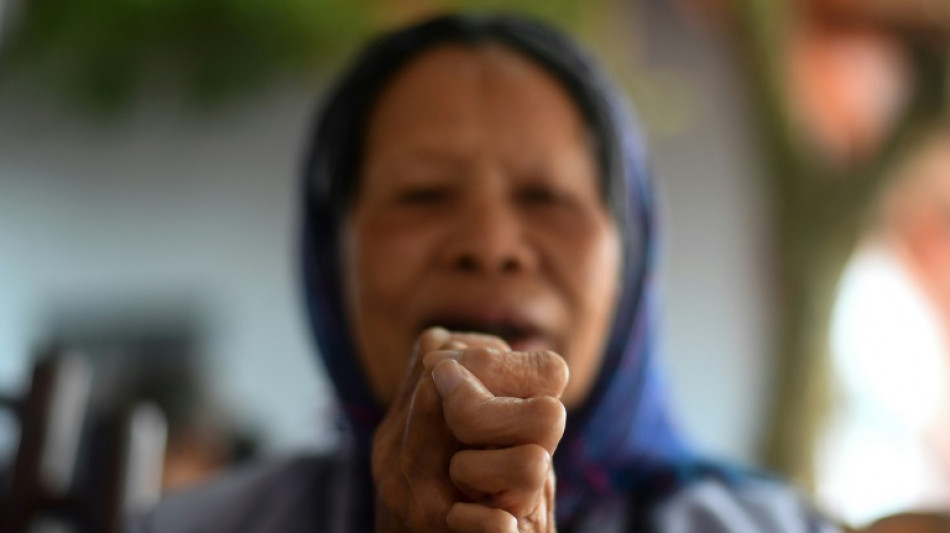
'Constant danger': Life after leprosy, a long neglected disease / Photo: © AFP/File

 Ukraine takes Russia fight to 'scorching sands' of Sahel
 Chinese AI tool pulled to prevent 'misuse' after South Korea hacks

 Asian stocks mostly up as traders weigh AI, oil dips after surge

 Walking through flames: orangutans rescued in Indonesia fires
 LeBron shines in pre-season debut for re-tooled 76ers
 Okinawa resolution calls for revision of US forces pact after murder

 Verdict expected Friday in Mexico trial over murders of Australia, US surfers

 New York mayor says asking Trump to withdraw ICE after shooting

 Walking through flames: orangutan rescued in Indonesia fires

 James shines in pre-season debut for re-tooled 76ers

 Fuel, fertilizer costs strain US farmers' support for Republicans in midterms

 Trump's 'super intelligence' rebrand to sell AI faces uphill battle

 Fiji demands US provide evidence Chinese official paid bribes for Beijing

 More than just football: How scandal-tainted City led Manchester's rebirth

 Record Eden Park streak creates tension for All Blacks

 EU trade chief seeks 'tangible outcomes' in China talks
 Man City face Anfield cauldron after guilty Premier League verdicts

 CNN, MS Now, Politico urge judge to extend White House access

 Trump administration to launch new vaccine research center

 Russian strikes kill 30 in Ukraine frontline city, talks set in US

 US military to livestream firing squad execution of Fort Hood shooter

 Aces star Wilson wins record-extending fifth WNBA MVP

 Undefeated 49ers seek Seahawks revenge

 Madrid mourns evicted retiree, 'icon' of Spain housing protests

 OpenAI revenue gap report rattles AI stocks

Dan Izzett has lived with leprosy's effects on his body for 70 years, and has lost much to what he calls an "ancient, fascinating, very unkind disease".
The Zimbabwean former civil engineering technician and pastor was diagnosed at the age of 25 in 1972, but first contracted the disease when he was just five.
That long incubation period gave the bacteria that causes leprosy, Mycobacterium leprae, lots of time to spread through his body.
His right leg was amputated in 1980 in Zimbabwe's capital Harare. Now 75, Izzett has no feeling above his elbows, below his knees or in 70 percent of his face.
That lack of feeling poses a "constant danger," Izzett told AFP in a phone call from his home in southwest England.
In October 2020, "I put my hands on a hot plate and hadn't noticed it until I could smell my flesh burning," he said, leading to the amputation of the middle finger of his right hand.
The following year, the little toe on his left foot was amputated. Last month, he lost another toe.
Izzett said he chose to speak out about his experience because millions of survivors who were less well off were unable to, partly because of the stigma and discrimination that still surrounds the disease.
- The 'forgotten' patients -
Leprosy, also known as Hansen's disease, has been haunting humanity for at least 4,000 years, often affecting the poorest communities.
It is a considered a neglected tropical disease by the World Health Organization, and remains under researched and little discussed compared to many other illnesses.
In 2021, more than 140,500 new cases were detected worldwide, nearly three quarters of them in Brazil, India and Indonesia, according to the WHO.
However pandemic-related disruptions have led to nearly 40 percent fewer cases being detected a year, with fears that tens of thousands have gone undiagnosed.
Even before the pandemic, the official numbers likely did not reflect reality.
"We know the number of patients who have been tested, but we do not count the forgotten, undetected patients," said Bertrand Cauchoix, a leprosy specialist at the Raoul Follereau Foundation in France.
This is in part because the disease's incubation period can last up to 20 years. Testing and diagnosis also takes time, during which patients could potentially infect their family members.
Before he received his diagnosis, said Izzett, "my wife got the disease from me".
Back in the 1970s, Izzett was given the antibiotic Dapsone, which was then a lifetime treatment.
In the mid-80s, a combination of drugs including Dapsone known as multidrug therapy (MDT) became available. It can cure leprosy over a 12-month course -- though nerve damage and other remnants of the disease remain.
Mathias Duck, a former chaplain in Paraguay's capital Asuncion, only needed six-months of MDT after being diagnosed with leprosy in 2010.
"I consider myself the luckiest person affected by leprosy because I was diagnosed and treated in time and so I have no impairments whatsoever," the 44-year-old told AFP.
The WHO provides MDT to patients worldwide for free, with Swiss pharmaceutical giant Novartis donating doses since 2000.
However there has been little progress for new treatments.
"There is no money for leprosy, only charitable donations," Cauchoix said.
- Don't use the 'L word' -
Alexandra Aubry, a specialist at the Centre for Immunology and Infectious Diseases in France, evaluates whether every new antibiotic developed for other illnesses could also be used for leprosy.
Her laboratory is one of the few in the world able to carry out tests on the leprosy bacteria, which does not survive in a petri dish.
They are trying to find a way to "simplify" treatment so it can take less than six months, she said.
There are also a couple of vaccines being developed, though they remain in early phases of human testing.
"It is very complex to get funding for this," Aubry said.
"To assess the effectiveness of a vaccine, you have to follow the vaccinated population for 10 to 15 years," with the timeframe extended further by the disease's long incubation period, she said.
In comparison to how swiftly the world responded to Covid, leprosy efforts are "a drop in the bucket," Duck said, calling for far more research and political action.
But he added that there is something everyone can do for World Leprosy Day on Sunday -- stop using the word "leper".
"We call it the 'L word'," Duck said, describing it as discriminatory.
"It's a little step that most people can do," he added, "to give people affected by leprosy "the dignity they deserve".
O.Krause--BTB