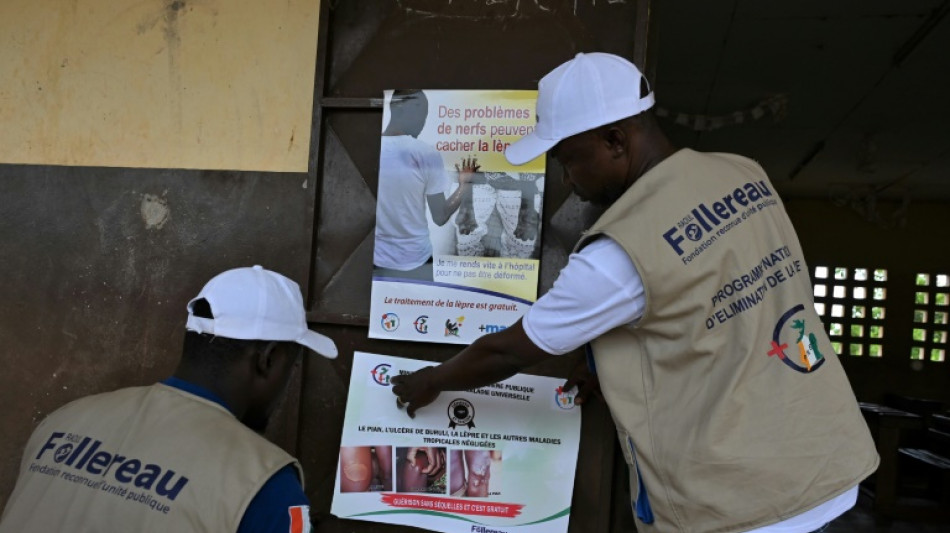
WHO urges investment in neglected tropical diseases / Photo: © AFP

 'I completely trust the club,' says Man City boss Maresca
 '10 out of 10' Quintana reminisces over dream Vuelta win

 Maddinson given shock recall but fails to score

 Navi Pillay, South African rights champion, wins Nobel Peace Prize

 Saudi Arabia says three killed at airport as Yemen war expands

 Everton's US owners mull sale of club two years after takeover

 Ukraine takes Russia fight to 'scorching sands' of Sahel
 Chinese AI tool pulled to prevent 'misuse' after South Korea hacks

 Asian stocks mostly up as traders weigh AI, oil dips after surge

 Walking through flames: orangutans rescued in Indonesia fires
 LeBron shines in pre-season debut for re-tooled 76ers
 Okinawa resolution calls for revision of US forces pact after murder

 Verdict expected Friday in Mexico trial over murders of Australia, US surfers
 New York mayor says asking Trump to withdraw ICE after shooting

 Walking through flames: orangutan rescued in Indonesia fires

 James shines in pre-season debut for re-tooled 76ers

 Fuel, fertilizer costs strain US farmers' support for Republicans in midterms

 Trump's 'super intelligence' rebrand to sell AI faces uphill battle

 Fiji demands US provide evidence Chinese official paid bribes for Beijing

 More than just football: How scandal-tainted City led Manchester's rebirth

 Record Eden Park streak creates tension for All Blacks

 EU trade chief seeks 'tangible outcomes' in China talks
 Man City face Anfield cauldron after guilty Premier League verdicts

 CNN, MS Now, Politico urge judge to extend White House access

 Trump administration to launch new vaccine research center

The World Health Organization on Monday called for greater investment in combating neglected tropical diseases, which left more than 1.6 billion people, often in least-developed countries, requiring treatment in 2021.
NTDs are a diverse group of conditions, found mainly in tropical regions, that include dengue, leprosy and rabies.
They are deemed neglected diseases because they are largely overlooked and benefit from only limited funding.
The WHO said NTDs disproportionately affect the poorest, primarily in areas where water safety, sanitation and access to health care are inadequate.
Soce Fall, director of the WHO's NTDs department, said they had been neglected precisely because they did not affect developed countries.
By comparison, he cited the funding plunged into Mpox last year once it began spreading outside Africa.
"The level of investment needed -- we are far from reaching it," he told a press briefing.
"We need to protect people wherever they are, and whatever their social condition."
- Millions 'liberated' -
In 2021, around 1.65 billion people were estimated to require treatment for at least one NTD, of which 857 million were in southeast Asia and 584 million in Africa.
The figure was down by 80 million from 2020 and has fallen consistently from 2.19 billion in 2010, the WHO said in a progress report released on World NTD Day.
But 16 countries account for 80 percent of the global NTD burden. They include the Democratic Republic of Congo, Egypt, Ethiopia, India, Nigeria, Pakistan, the Philippines, and Tanzania.
As of December, 47 countries had eradicated at least one NTD, with eight certified as having eliminated one in 2022 alone.
"Around the world, millions of people have been liberated from the burden of neglected tropical diseases," said WHO director-general Tedros Adhanom Ghebreyesus.
"We still have a lot of work to do. The good news is, we have the tools and the know-how not just to save lives and prevent suffering, but to free entire communities and countries of these diseases."
- Guinea worm almost eradicated -
NTDs are caused by a variety of pathogens including viruses, bacteria, parasites, fungi and toxins.
They include bilharzia, Chagas disease, dengue, Guinea worm, sleeping sickness, leishmaniasis, leprosy, river blindness, rabies, scabies, snakebite envenoming and trachoma.
"These diseases cause devastating health, social and economic consequences, and when they aren't deadly, they very often cause life-long social stigma and consequent economic hardship," the WHO said.
Fall said leprosy persisted in 139 countries and dengue in 129, "so we are far from elimination".
Formerly endemic, Guinea worm is poised to become the second human disease in history to be eradicated, following smallpox, and the first without a medicine or vaccine.
About 3.5 million human cases occurred in 1986 -- but just 13 were recorded in 2022.
Ghanaian President Nana Akufo-Addo said the west African country had eliminated trachoma and Guinea worm, and was on the brink of doing likewise with sleeping sickness and leprosy.
"Investing in NTD elimination programmes creates a ripple effect in society. It leads to better education, health and employment outcomes. It transforms lives and our communities," he said in a statement.
"An Africa free from NTDs is possible."
J.Fankhauser--BTB