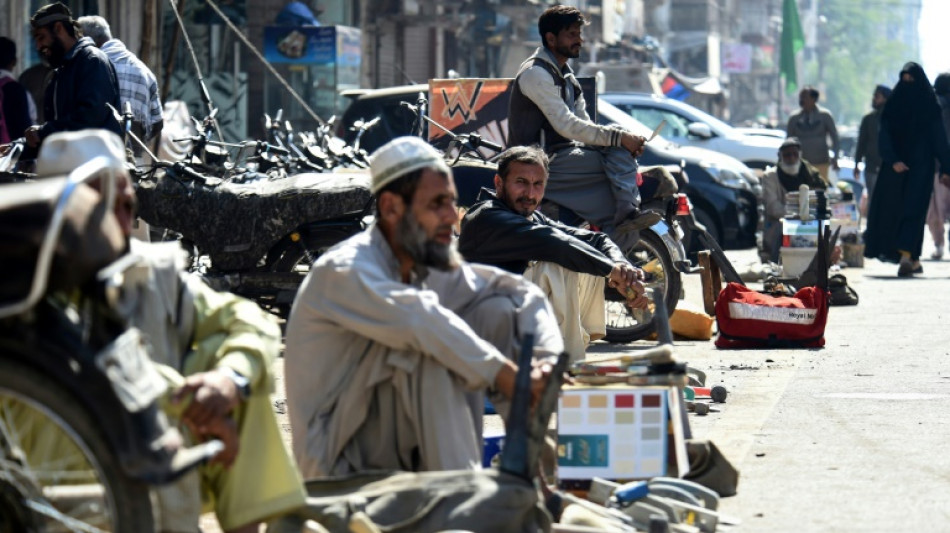
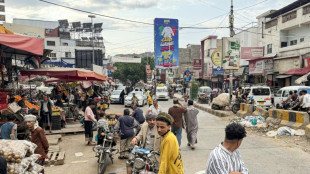
Pakistan inflation hits 48-year high as IMF visits / Photo: © AFP

 'I completely trust the club,' says Man City boss Maresca
 '10 out of 10' Quintana reminisces over dream Vuelta win

 Maddinson given shock recall but fails to score

 Navi Pillay, South African rights champion, wins Nobel Peace Prize

 Saudi Arabia says three killed at airport as Yemen war expands

 Everton's US owners mull sale of club two years after takeover

 Ukraine takes Russia fight to 'scorching sands' of Sahel
 Chinese AI tool pulled to prevent 'misuse' after South Korea hacks

 Asian stocks mostly up as traders weigh AI, oil dips after surge

 Walking through flames: orangutans rescued in Indonesia fires

 LeBron shines in pre-season debut for re-tooled 76ers
 Okinawa resolution calls for revision of US forces pact after murder

 Verdict expected Friday in Mexico trial over murders of Australia, US surfers
 New York mayor says asking Trump to withdraw ICE after shooting

 Walking through flames: orangutan rescued in Indonesia fires

 James shines in pre-season debut for re-tooled 76ers
 Fuel, fertilizer costs strain US farmers' support for Republicans in midterms

 Trump's 'super intelligence' rebrand to sell AI faces uphill battle

 Fiji demands US provide evidence Chinese official paid bribes for Beijing
 More than just football: How scandal-tainted City led Manchester's rebirth

 Record Eden Park streak creates tension for All Blacks

 EU trade chief seeks 'tangible outcomes' in China talks
 Man City face Anfield cauldron after guilty Premier League verdicts

 CNN, MS Now, Politico urge judge to extend White House access

 Trump administration to launch new vaccine research center

Inflation has risen to a 48-year high in crisis-hit Pakistan, according to government data released Wednesday, as IMF officials visit for urgent talks on a stalled bailout package.
Year-on-year inflation in January was recorded at 27.55 percent, its highest since May 1975.
Pakistan's economy is in dire straits, stricken by a balance of payments crisis as it attempts to service high levels of external debt, amid political chaos and a deteriorating security situation.
The world's fifth most populous country has less than $3.7 billion in its central bank -- enough to cover just three weeks of imports.
On Tuesday, a delegation from the International Monetary Fund arrived in Islamabad to revive negotiations over a stalled bailout package with the government, which had long held out from meeting the global lender's tough conditions.
Food prices rose by a staggering 43 percent in January year-on-year, which analyst Yousuf Nazar based in Britain described as a "killer".
"The overall rate actually masks or understates the misery of the people, and what is really going on behind these numbers," he told AFP.
"It also reflects badly on the management -- on the managers of the economy."
In the past week, with the prospect of national bankruptcy looming and no countries willing to offer less painful bailouts, Islamabad has started to bow to pressure to meet IMF demands.
The government loosened controls on the rupee to rein in a rampant black market in US dollars, a step that caused the currency to plunge to a record low. Artificially cheap petrol prices have also been hiked.
The state bank is no longer issuing letters of credit, except for essential food and medicines, causing a backlog of thousands of shipping containers at Karachi port stuffed with stock the country can no longer afford.
- 'One cannot earn enough' -
Industry has been hammered by the imports block and massive rupee devaluation. Public construction projects have halted, textiles factories have partially shut down and domestic investment has slowed.
The National Consumer Price Index for January rose by 2.88 percent from the previous month, the figures released by the country's statistics bureau on Wednesday showed.
In downtown Karachi on Monday, dozens of day labourers including carpenters and painters waited with their tools on display for work that never comes.
"The number of beggars has increased and the number of labourers has decreased," said 55-year-old mason Zafar Iqbal, who was eating biryani from a plastic bag donated by a passerby.
"Inflation is so high that one cannot earn enough."
Former prime minister Imran Khan, who was ousted last year in a no-confidence motion, negotiated a multi-billion-dollar loan package from the IMF in 2019.
But he reneged on promises to cut subsidies and market interventions that had cushioned the cost-of-living crisis, causing the programme to stall.
It is a common pattern in Pakistan, where most people live in rural poverty, with more than two dozen IMF deals brokered and then broken over the decades.
F.Müller--BTB