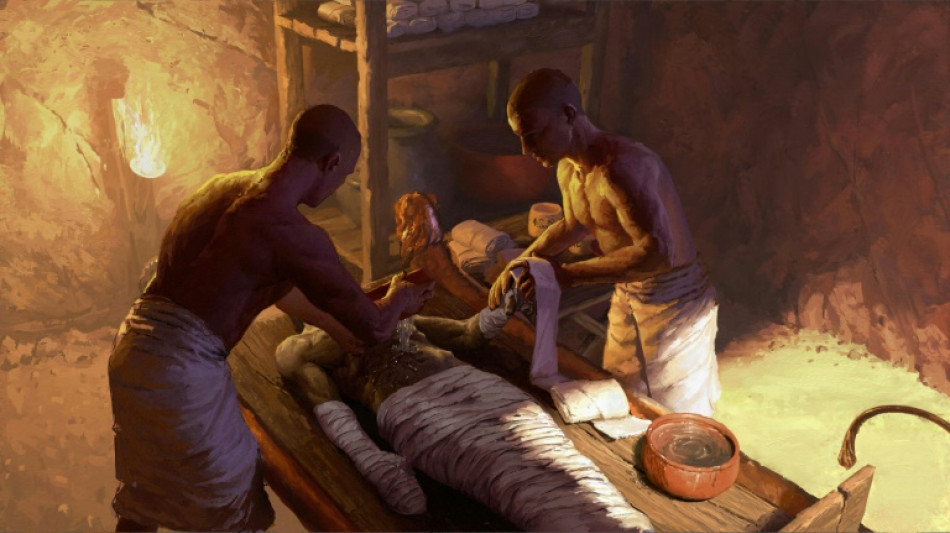
'Surprising' ancient Egyptian mummy ingredients discovered / Photo: © Ludwig Maximilian University of Munich/AFP

 'I completely trust the club,' says Man City boss Maresca

 '10 out of 10' Quintana reminisces over dream Vuelta win

 Maddinson given shock recall but fails to score

 Navi Pillay, South African rights champion, wins Nobel Peace Prize

 Saudi Arabia says three killed at airport as Yemen war expands

 Everton's US owners mull sale of club two years after takeover

 Ukraine takes Russia fight to 'scorching sands' of Sahel
 Chinese AI tool pulled to prevent 'misuse' after South Korea hacks

 Asian stocks mostly up as traders weigh AI, oil dips after surge

 Walking through flames: orangutans rescued in Indonesia fires

 LeBron shines in pre-season debut for re-tooled 76ers

 Okinawa resolution calls for revision of US forces pact after murder

 Verdict expected Friday in Mexico trial over murders of Australia, US surfers
 New York mayor says asking Trump to withdraw ICE after shooting

 Walking through flames: orangutan rescued in Indonesia fires

 James shines in pre-season debut for re-tooled 76ers

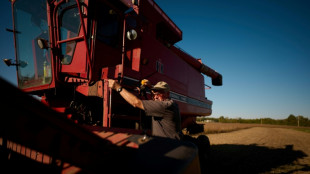 Fuel, fertilizer costs strain US farmers' support for Republicans in midterms

 Trump's 'super intelligence' rebrand to sell AI faces uphill battle

 Fiji demands US provide evidence Chinese official paid bribes for Beijing

 More than just football: How scandal-tainted City led Manchester's rebirth

 Record Eden Park streak creates tension for All Blacks

 EU trade chief seeks 'tangible outcomes' in China talks

 Man City face Anfield cauldron after guilty Premier League verdicts

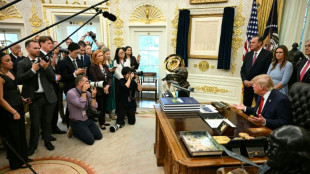 CNN, MS Now, Politico urge judge to extend White House access

 Trump administration to launch new vaccine research center

The discovery of dozens of beakers and bowls in a mummification workshop has helped reveal how ancient Egyptians embalmed their dead, with some "surprising" ingredients imported from as far as Southeast Asia, a study said Wednesday.
The exceptional collection of pottery, dating from around 664-525 BC, was found at the bottom of a 13-metre (42 feet) well at the Saqqara Necropolis south of Cairo in 2016.
Inside the vessels, researchers detected tree resin from Asia, cedar oil from Lebanon and bitumen from the Dead Sea, showing that global trade helped embalmers source the very best ingredients from across the world.
Ancient Egyptians developed a remarkably advanced process to embalm corpses, believing that if bodies were kept intact they would reach the afterlife.
The process took up to 70 days. It involved desiccating the body with natron salt, and evisceration -- removing the lungs, stomach, intestines and liver. The brain also came out.
Then the embalmers, accompanied by priests, washed the body and used a variety of substances to prevent it from decomposing.
But exactly how this was done has largely remained lost to time.
Now a team of researchers from Germany's Tuebingen and Munich universities in collaboration with the National Research Centre in Cairo has found some answers by analysing the residue in 31 ceramic vessels found at the Saqqara mummification workshop.
By comparing the residue to containers found in adjacent tombs, they were able to identify which chemicals were used.
- 'To make his odour pleasant' -
The substances had "antifungal, anti-bacterial properties" which helped "preserve human tissues and reduce unpleasant smells," the study's lead author, Maxime Rageot, told a press conference.
Helpfully, the vessels have labels on them. "To wash," reads the label of one bowl, while another says: "to make his odour pleasant".
The head received the most care with three different concoctions -- one of which was labelled "to put on his head".
"We have known the names of many of these embalming ingredients since ancient Egyptian writings were deciphered," Egyptologist Susanne Beck said in a statement from Tuebingen University.
"But until now, we could only guess at what substances were behind each name."
The labels also helped Egyptologists clear up some confusion about the names of some of the substances.
The scant details we have about the mummification process mostly comes from ancient papyrus, with Greek authors such as Herodotus often filling in gaps.
By identifying the residue in their new bowls, the researchers found that the word "antiu", which has long been translated as myrrh or frankincense, can actually be a mixture of numerous different ingredients.
In Saqqara, the bowl labelled antiu was a blend of cedar oil, juniper or cypress oil and animal fats.
- Embalming drove 'globalisation' -
The discovery showed the ancient Egyptians had built up "enormous knowledge accumulated through centuries of embalming," said Philipp Stockhammer of Germany's Max Planck Institute of Geoanthropology.
For example, they knew that if the body was taken out of the natron salt, then it was in danger of being immediately "colonised by microbes that would eat up the skin," he said.
Stockhammer said "one of the most surprising findings" was the presence of resins, such as dammar and elemi, which likely came from tropical forests in Southeast Asia, as well as signs of Pistacia, juniper, cypress and olive trees from the Mediterranean.
The diversity of substances "shows us that the industry of embalming" drove momentum for "globalisation," Stockhammer said.
It also shows that "Egyptian embalmers were very interested to experiment and get access to other resins and tars with interesting properties," he added.
The embalmers are believed to have taken advantage of a trade route that came to Egypt through present-day Indonesia, India, the Persian Gulf and the Red Sea from around 2000 BC.
The Saqqara excavation was led by Ramadan Hussein, a Tuebingen University archaeologist, who died last year before the research was published in the journal Nature on Wednesday.
K.Brown--BTB