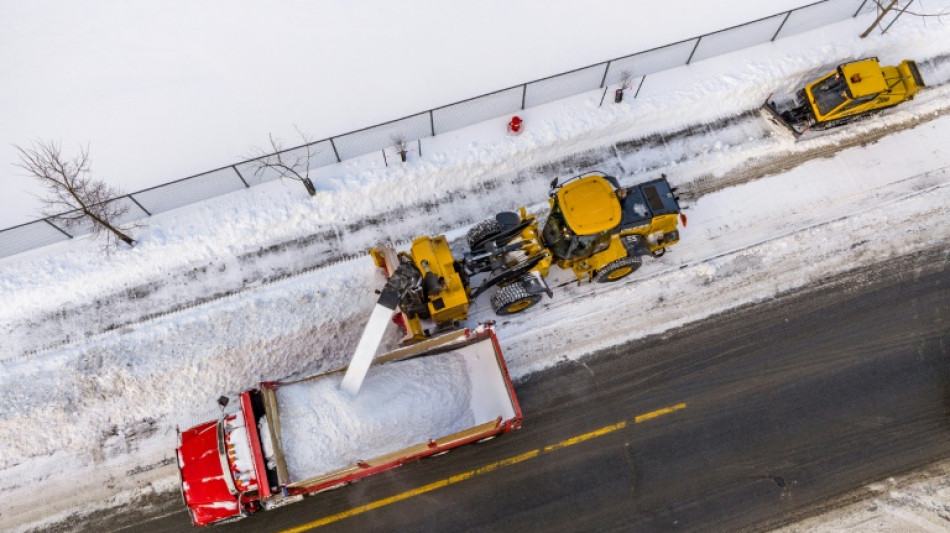
Montreal snow-clearing: good for traffic, bad for environment / Photo: © AFP

 'I completely trust the club,' says Man City boss Maresca

 '10 out of 10' Quintana reminisces over dream Vuelta win

 Maddinson given shock recall but fails to score

 Navi Pillay, South African rights champion, wins Nobel Peace Prize

 Saudi Arabia says three killed at airport as Yemen war expands

 Everton's US owners mull sale of club two years after takeover

 Ukraine takes Russia fight to 'scorching sands' of Sahel
 Chinese AI tool pulled to prevent 'misuse' after South Korea hacks

 Asian stocks mostly up as traders weigh AI, oil dips after surge

 Walking through flames: orangutans rescued in Indonesia fires

 LeBron shines in pre-season debut for re-tooled 76ers
 Okinawa resolution calls for revision of US forces pact after murder

 Verdict expected Friday in Mexico trial over murders of Australia, US surfers
 New York mayor says asking Trump to withdraw ICE after shooting

 Walking through flames: orangutan rescued in Indonesia fires

 James shines in pre-season debut for re-tooled 76ers

 Fuel, fertilizer costs strain US farmers' support for Republicans in midterms

 Trump's 'super intelligence' rebrand to sell AI faces uphill battle

 Fiji demands US provide evidence Chinese official paid bribes for Beijing

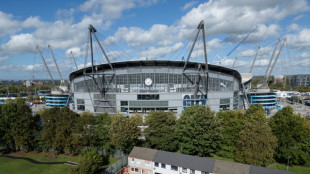 More than just football: How scandal-tainted City led Manchester's rebirth

 Record Eden Park streak creates tension for All Blacks

 EU trade chief seeks 'tangible outcomes' in China talks

 Man City face Anfield cauldron after guilty Premier League verdicts

 CNN, MS Now, Politico urge judge to extend White House access

 Trump administration to launch new vaccine research center

A choreographed ballet of massive trucks, snowplows and snowblowers takes over the streets of Montreal whenever it snows, an enormous logistical effort with a significant environmental cost.
Hundreds of snow-clearing vehicles are deployed across the frigid Canadian city for 100 or more days each year on average, dusting the road with salt and belching emissions into the air.
"The snow challenge in Montreal is colossal," says city spokesperson Philippe Sabourin.
If the city's streets and sidewalks were put end to end, they would total 10,000 kilometers (6,200 miles) or the equivalent of the distance from Montreal to Beijing, he said.
Some 3,000 employees and 2,200 vehicles go into action day and night every time it snows, helping make the streets passable.
In Montreal alone, the equivalent of 150,000 tons of salt is spread on roads and sidewalks over the winter.
"It has an impact on ecosystems," Florent Barbecot, a professor of hydrogeology at the University of Quebec in Montreal, told AFP.
"We have seen for a few years the level of salt which is rising a little bit everywhere in the environment."
Some of it stays on the roads, dries and evaporates when temperatures warm, "ending up in the atmosphere... which will affect future precipitation," he said.
The city recognizes that salt is bad for the environment, but despite ongoing research, no effective substitute has been found.
It is "a material that does us a great service," by lowering the freezing temperature of ice and melting icy patches, Sabourin explained.
With almost two meters (six feet) of snowfall in Montreal each year, the city simply cannot go without massive snow management.
- People 'not happy' -
As a substitute, "we tried coffee grinds, it smelled good, but it was not a success," Sabourin added.
Beetroot juice has also been tried, which is less corrosive than salt, "but it stained floors a lot, people were not happy," he said.
Until the late 1990s, snow soiled by waste and pollution was dumped directly into the St. Lawrence River, before the practice was banned.
Some of it is now poured into snow chutes connected to the sewer system.
But the majority (75 percent) is stored in quarries, where the snow is piled high. One mound on the city's south side stretches the width of several football fields and rises ten storeys high.
At the foot, trucks appear tiny in comparison as they dump snow, most of it looking more grey than white.
In a few months, the spring thaw will melt the snow, and waste and gravel will be separated from the water, which is treated before being discharged into the river.
- 'Societal choice' -
According to Barbecot, the city should simply use less salt, but that would require changing "the way we live" by limiting urban sprawl and driving less.
"That's a societal choice," he said.
In the streets, locals do not seem ready to embrace such a massive shift.
According to Charles Drolet, who was working behind the wheel of a city snowblower, residents mostly just want to see more frequent ploughing of streets.
For resident Francine Lalonde, salting roads and snow removal "is a necessary evil," despite the negative environmental impacts.
E.Schubert--BTB