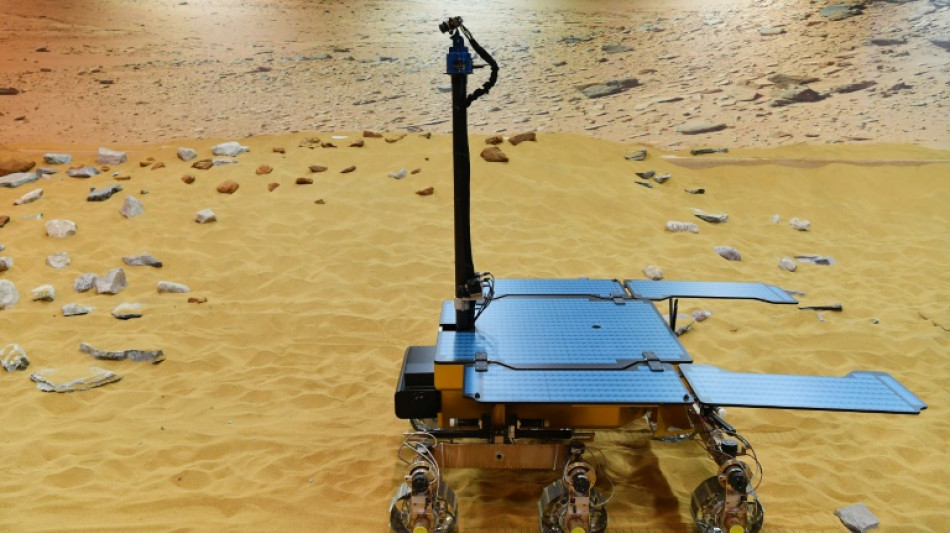
Long-delayed ExoMars mission still dreams of 2028 launch / Photo: © AFP/File

 Djokovic crashes out of Shanghai Masters in his first match

 EU says Turkey's crackdown on rights hampers membership bid

 Two Renoir paintings stolen in France recovered: mayor
 German leader outraged at Schroeder birthday visit to Putin

 Stocks up, oil retreats as Trump rules out pre-vote Iran attack

 South African judge Navi Pillay wins Nobel Peace Prize

 'I completely trust the club,' says Man City boss Maresca

 '10 out of 10' Quintana reminisces over dream Vuelta win

 Maddinson given shock recall but fails to score

 Navi Pillay, South African rights champion, wins Nobel Peace Prize

 Saudi Arabia says three killed at airport as Yemen war expands

 Everton's US owners mull sale of club two years after takeover

 Ukraine takes Russia fight to 'scorching sands' of Sahel
 Chinese AI tool pulled to prevent 'misuse' after South Korea hacks

 Asian stocks mostly up as traders weigh AI, oil dips after surge

 Walking through flames: orangutans rescued in Indonesia fires

 LeBron shines in pre-season debut for re-tooled 76ers

 Okinawa resolution calls for revision of US forces pact after murder

 Verdict expected Friday in Mexico trial over murders of Australia, US surfers

 New York mayor says asking Trump to withdraw ICE after shooting

 Walking through flames: orangutan rescued in Indonesia fires

 James shines in pre-season debut for re-tooled 76ers

 Fuel, fertilizer costs strain US farmers' support for Republicans in midterms

 Trump's 'super intelligence' rebrand to sell AI faces uphill battle

 Fiji demands US provide evidence Chinese official paid bribes for Beijing

War, budget cuts, a pandemic and a crash: For all its trials, Europe's ExoMars mission might be more deserving of the name Perseverance than NASA's Martian rover.
But the European Space Agency still hopes the mission can launch in 2028 on its long-delayed quest to search for extraterrestrial life on the Red Planet.
This time last year, the ESA's Rosalind Franklin rover was all ready for a September launch from the Baikonur Cosmodrome in Kazakhstan, planning to catch a ride on a Russian rocket and descend to the Martian surface on a Russian lander.
Then Moscow invaded Ukraine in March, and sanctions imposed by the ESA's 22 member states led to Russia pulling out and the mission being suspended.
It was just the latest blow for the hundreds of scientists who have been working on the project for more than two decades.
First conceived in 2001, the ambitious programme quickly proved too expensive for Europe, which has still to land a rover on Mars.
The United States' space agency NASA stepped in to fill the funding gap in 2009. But three years later, budget cuts led to NASA pulling out.
Help then came from an unexpected source: Russia's space agency Roscosmos.
Together, the ESA and Roscosmos launched the Schiaparelli EDM module in 2016 as a test run for ExoMars.
But when Schiaparelli arrived at Mars, a computer glitch caused it to crash into the surface and fall silent.
That failure pushed back the launch of the joint Russian-European ExoMars mission to July 2020.
The Covid-19 pandemic pushed that date back to 2022, when it was again delayed by the invasion of Ukraine.
- Tricky Russian negotiations -
Late last year, the ESA's ministerial council agreed to kept the mission alive with an injection of 500 million euros ($540 million) over the next three years.
David Parker, the ESA's director of human and robotic exploration, said last week that one of the arguments they put forward for continuing the mission was "that this is a unique piece of European science.
"It's like James Webb," he said referring to the space telescope that has been sending back astonishing images of distant galaxies since 2022.
"But it's for Mars -- it's that scale of ambition.
"This is the only mission that is foreseen that can actually find evidence of past life."
But some significant hurdles remain that could make a 2028 launch difficult -- including that the ESA needs a new way to land its rover on Mars.
The ESA will first have to recover European components, including an onboard computer and radar altimeter, from Russia's Kazachok lander, which is still at its assembly site in Turin, Italy.
However only Russia can extract the components from the lander.
Difficult negotiations have been underway for Russian experts to come and dismantle the lander.
"We expected them in mid-January, but they didn't come," ESA ExoMars programme team leader Thierry Blancquaert told AFP.
"We asked them to have everything done by the end of March," he added.
- NASA to the rescue? -
To get off the ground, the new mission will depend on support from NASA, which has so far indicated it is happy to help.
For its new lander, the ESA hopes to take advantage of US engines used to get NASA's Curiosity and Perseverance rovers onto the Martian surface.
It will also have to rely on NASA for radioisotope heater units, after losing access to Russia's supply. These units keep the spacecraft warm.
NASA has not yet voted on a budget that would support such efforts, but "we are preparing the collaborative work together and things are progressing well," Blancquaert said.
Francois Forget, an astrophysicist at France's CNRS scientific research centre, said that "this new impetus for cooperation is linked to the fact that this time, the US has a joint project with Europe: Mars Sample Return."
The mission, planned for around 2030, is intended to return to Earth samples collected from Mars by both ExoMars and Perseverance, which touched down on the planet in July 2021.
Unlike Perseverance, the Rosalind Franklin rover can drill up to two metres (6.5 feet) below the surface of Mars, where traces of possible ancient life could be better preserved.
ExoMars' planned landing site is also in an area of Mars expected to have been more favourable to hosting past life.
"We think there was a lot of water there," said Forget.
"There is another Mars to explore, so even in 10 years' time the mission will not be obsolete," he added.
F.Pavlenko--BTB