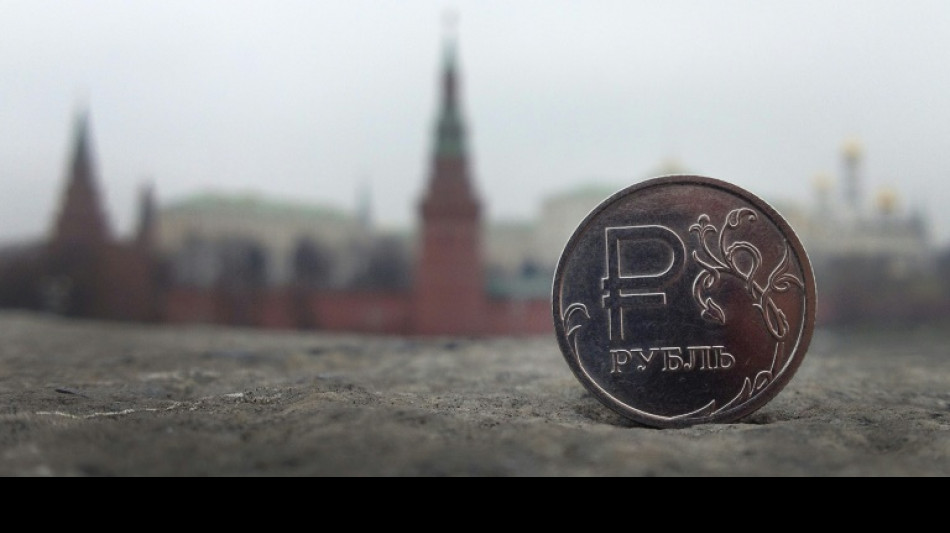
SWIFT, the global finance arm that the West can twist / Photo: ©

 Man City could face 'drastic' sanctions after reported guilty verdict: ex-chairman

 Furious Fury says row between rival promoters could scupper Joshua bout

 'Invincible' 223cm teen basketball player stars as China win bronze

 Tenth woman found dead in South Africa's string of killings
 Japan schoolboy, 11, wins gold while empty seats blight Asian Games
 Japan organisers 'not satisfied' as empty seats blight Asian Games

 Canals full, roads submerged as Bangkok declares flood disaster

 China, US to open AI 'communication channel' after summit

 Nepal tunnel survivor wants to help post-flood rebuild

 New China sprint star, 17, vows 'no limits' after Asian Games gold
 Japanese 11-year-old wins Asian Games eSports gold

 TikTok agrees to teen limits in US settlement following Meta
 Venezuela's oil cradle pins hopes on US energy deals

 US, China buy time with trade truce as pressure builds

 'Leo, Leo': Young Catholics give pope rockstar welcome in France

 Lula bans sports betting days ahead of Brazil's election

 Guatemala ensures survival of vulnerable 'fossil' fish

 Mancini finds positives in Italy loss, accepts fans' jeers

 Alcaraz helps Europe into Laver Cup lead

 Six missing after building collapses in historic Athens district

 Mbappe scores but suffers knee injury as Zidane gets debut France win
 Mancini's Italy return spoiled by Belgium defeat

 Rodri confident in Man City innocence despite reported charges

 Jay-Z rape accuser says she made 'false accusations'

 Senegal draw first match under Vieira and Nigeria survive scare

An exclusion from SWIFT, a very discreet but important cog in the machinery of international finance, is one of the most disruptive of the possible sanctions that the West could deploy against Russia for its invasion of Ukraine.
Ukrainian President Volodymyr Zelensky called Thursday for such a move after Russian forces invaded his country, as Western powers consider imposing additional sanctions on Moscow.
The White House has pointedly refused in recent weeks to exclude the possibility of barring Russia from the international system that banks use to transfer money, a move that would cripple Russia's ability to trade with most of the world.
European leaders were expected to discuss the measure at their emergency summit later Thursday as one possible option. An EU official briefing journalists suggested the measure would most likely be held in reserve for a future round of sanctions, should the EU need to escalate its punishment.
What is SWIFT?
Founded in 1973, the Society for Worldwide Interbank Financial Telecommunication, or SWIFT, actually doesn't handle any transfers of funds itself.
But its messaging system, developed in the 1970s to replace relying upon Telex machines, provides banks the means to communicate rapidly, securely and inexpensively.
The non-listed, Belgium-based firm is actually a cooperative of banks and proclaims to remain neutral.
What does SWIFT do?
Banks use the SWIFT system to send standardised messages about transfers of sums between themselves, transfers of sums for clients, and buy and sell orders for assets.
More than 11,000 financial institutions in over 200 countries use SWIFT, making it the backbone of the international financial transfer system.
But its preeminent role in finance has also meant that the firm has had to cooperate with authorities to prevent the financing of terrorism.
Who represents SWIFT in Russia?
According to the national association Rosswift, Russia is the second-largest country following the United States in terms of the number of users, with some 300 Russian financial institutions belonging to the system.
More than half of Russia's financial institutions are members of SWIFT, it added.
Russia does have its own domestic financial infrastructure, including the SPFS system for bank transfers and the Mir system for card payments, similar to the Visa and Mastercard systems.
Are there precedents for excluding countries?
In November 2019, SWIFT "suspended" access to its network by certain Iranian banks.
The move followed the imposition of sanctions on Iran by the United States and threats by then Treasury Secretary Steven Mnuchin that SWIFT would be targeted by US sanctions if it didn't comply.
Iran had already been disconnected from the SWIFT network from 2012 to 2016.
Is it a credible threat?
Tactically, "the advantages and disadvantages are debatable," Guntram Wolff, director of the Brussels-based Bruegel think tank, told AFP.
In practical terms, being removed from SWIFT means Russian banks can't use it to make or receive payments with foreign financial institutions for trade transactions.
"Operationally it would be a real headache," said Wolff, especially for European countries which have considerable trade with Russia, which is their single biggest supplier of natural gas.
Western nations threatened to exclude Russia from SWIFT in 2014 following its annexation of Crimea.
But excluding such a major country -- Russia is also a major oil exporter -- could spur Moscow to accelerate the development of an alternative transfer system, with China for example.
W.Lapointe--BTB