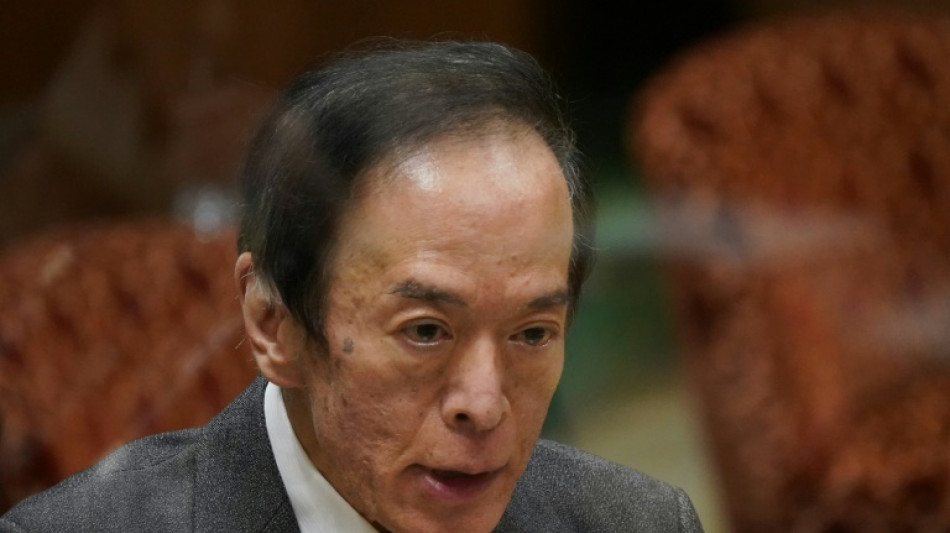
Japan parliament approves new central bank chief Ueda / Photo: © AFP/File

 Three Mexicans convicted in murders of Australian, US surfers

 Powerful waves lash California coast as storm threatens more damage

 Trump hails Russia deal to release diesel as midterms loom

 Lyon blow chance to go top after loss at Lens
 Stocks rise as Trump says Russia to release diesel to world markets

 Wildfire smoke shuts schools in Amazon's biggest city

 Turkey jails 2 journalists pending trial for fund crisis 'misinformation'
 Major earthquake rocks Panama, triggers tsunami warning

 Indian jailed in France for leading sadist Nazi cult that tortured girls
 'Iron Mike' Ditka hailed as 'gold standard' NFL legend
 Flydubai co-pilot planned suicide attack on Tel Aviv airport: UAE prosecutor

 Mike Ditka: Chicago Bears icon as player and coach

 Outrage over plan to livestream US military firing squad execution
 US sanctions: a 'test of resilience' for ICC

 NFL legend Mike Ditka dead at 86
 Hurricane Isaias set to strike Gulf Coast late Friday
 Trump forms panel to probe US Fed governor Lisa Cook
 Clashes in Durban as fresh anti-migrant riots erupt in South Africa
 France students plan more protests, UN 'concerned' over violence
 De Zerbi calls on struggling Spurs to react in Man Utd clash
 US sanctions on ICC: a 'test of resilience'
 Outrage over US military plan to livestream firing squad execution

 Argentina snap up defence guru Edwards ahead of World Cup

 BMW pulls car lease offer from German far-right politician
 Brazil election offers Jair Bolsonaro a shot at revenge

Japan's parliament on Friday approved economics professor Kazuo Ueda as the central bank's next governor, after a decade of monetary easing by outgoing chief Haruhiko Kuroda.
Upper house lawmakers okayed Ueda's nomination a day after their counterparts in the lower house, paving the way for the 71-year-old to take over next month.
The move came shortly before the Bank of Japan was to end a two-day policy meeting that is Kuroda's last, with investors watching closely for any final surprises.
Most observers expect the bank to leave its policy unchanged, but there has been speculation about surprise tweaks, including a possible further widening of the band in which rates for 10-year government bonds fluctuate.
In recent months, the BoJ has steadfastly resisted tightening, even as peers in other developed economies have hiked rates to tackle inflation.
Kuroda has insisted that the bank's longstanding goal of sustained two percent inflation -- considered necessary to turbocharge the world's third-largest economy -- has not yet been achieved.
Inflation hit 4.2 percent in January, driven by factors including higher fuel costs, but Kuroda has argued the price rises were the result of temporary factors like the war in Ukraine.
He wants to see evidence of more sustained rises, including salary increases, before adjusting the bank's policies.
Ueda told lawmakers last month that he saw the "continuation of monetary easing as appropriate", warning of uncertainty in financial markets and the global economy.
Current factors driving higher prices "will likely ebb in the future, and inflation in consumer prices will likely drop below two percent," he added.
Ueda has a PhD in economics from the Massachusetts Institute of Technology and is seen as a good communicator who prefers cautious reflection over abrupt action.
Kuroda, 78, will step down at the end of his second term on April 8, after a tenure -- the longest-ever for a Bank of Japan chief -- defined by his signature "bazooka" easy-money policies.
Since he took charge, the central bank's assets have quadrupled, surpassing GDP in a first for a Group of Seven nation.
N.Fournier--BTB