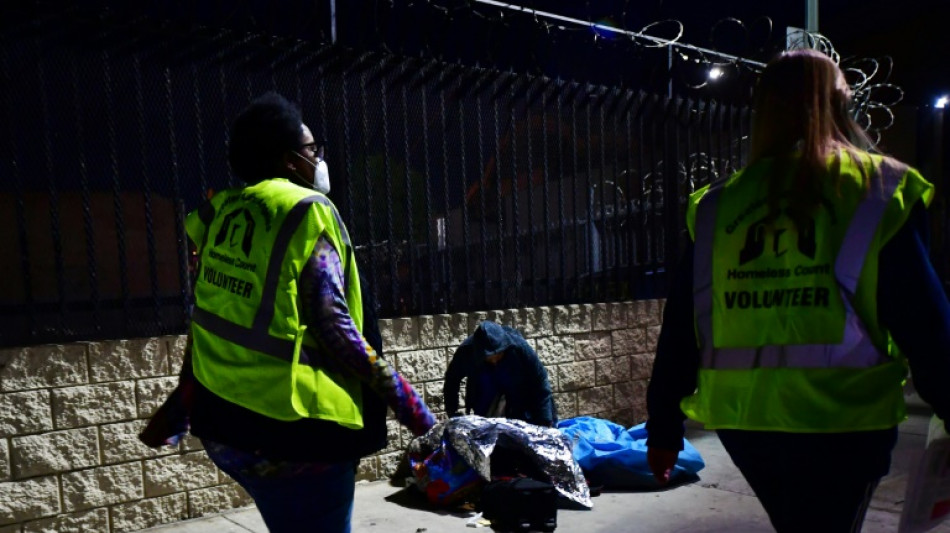
Los Angeles counts its growing homeless population / Photo: ©

 Man City chairman defiant over reported Premier League charges

 Germany ready to 'walk through fire' for Klopp, says Tah

 At least 16 killed in Russian and Ukrainian strikes

 Powerful storm pummels US Northeast
 Bangkok declares disaster after homes flooded, roads submerged by heavy rain

 Norris calls for errant Colapinto to be banned for causing Baku crash

 Russell finds himself again and prepares to heap pressure on Antonelli
 South Korea hold nerve to win Asian Games basketball gold

 Russell holds off Verstappen to claim imperious victory in Baku
 Russell holds off Verstappen to win Azerbaijan Grand Prix

 India's Kohli says 2027 ODI World Cup will be his last

 Huge crowds cheer Pope Leo along Champs-Elysees ahead of Paris mass
 Putellas wants to bring 'winning culture and mentality' to London City

 Rare Italian opera returns to Moscow after nearly 120-year hiatus

 Pope to celebrate giant Paris mass after 'peace' appeal
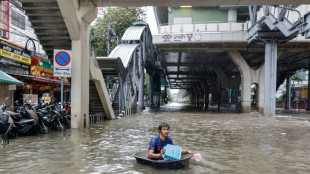 Homes flooded, roads submerged: Bangkok declares disaster over heavy rains

 Ahead of Paris mass, pope urges life together in 'dignity and peace'

 Austria 'ghetto' language classes leave children to repeat school
 S.African women runners arm themselves after string of killings

 'I felt embarrassed': Japan eSports whizz-kid, 11, wins Games gold
 Indonesia fires threatens critically-endangered orangutan: IUCN

 Bangkok declares flood disaster across city

 'World records not enough': North Korea weightlifters target Olympic gold rush

 Iran proposes Hormuz plan, Trump reportedly refuses
 El Nino rewrites the menu in the world's top restaurants

Tents, makeshift shelters and dilapidated campervans line the streets of Skid Row as Mike Murase and his team tally the exploding population of homeless people in Los Angeles.
In the United States' second biggest city, the unhoused huddle by small fires, trying to keep warm on one of the coldest nights of the year.
Homelessness is "an intractable, stubborn issue that the politicians and agency leaders have not had the will to try to solve," 75-year-old Murase tells AFP.
Murase and his colleagues criss-cross the dozen-or-so roads they have been assigned as part of a three-day effort to count the number of people living on the streets.
Figures from 2020 -- the last time the survey was carried out -- showed Los Angeles city alone had more than 66,000 homeless people, up more than 13 percent from the year before.
Everyone expects this year's number to be much higher.
"During Covid there were so many jobs that were lost, you know, restaurant workers or laborers," says Murase.
"A lot of these people were unable to pay rent for maybe two, three months. They get kicked out and they have no family or other relatives to go to and they end up on the street.
"I think there is a misconception that they're mostly criminals, or addicts, or mentally ill people.
"There's a large number of people with those conditions, but there are (also) families, children."
- Tourists shocked -
Visitors to Los Angeles often express shock at the sheer number of people living on the streets of one of the wealthiest cities in the wealthiest state of the wealthiest nation on the planet.
Tents and tarpaulin shelters clump next to Hollywood tourist spots, or string out along embankments next to the city's freeways.
Rusting mobile homes with broken windows line the roads of Venice Beach, where multi-million dollar houses glower down at them.
Obviously ill people wander through traffic, railing at unseen demons, or picking at their grimy clothes as they mutter into greasy beards.
Others rummage through trash cans, or lie dazed on thoroughfares, the smell of urine a fug that pedestrians pick their way distastefully around.
Some of the unhoused are new to the streets, victims of the pandemic economic crush, but others have been there for years.
"I've lived downtown for about like seven, eight years. And it's always been an issue seeing people on the street," says Kimberly Briggs, who is volunteering alongside Murase.
"I just want to participate in something that helps bring resolution to this problem, because there is suffering on the streets and housing is a human right."
The count is a federal government requirement that will help to determine grants to the local organizations trying to fix the unfixable.
Volunteers are instructed not to interact with people; rather they must simply document what they see.
The survey Murase and Briggs are doing takes them between warehouses ripe with spices whose heady scents mingle with the smell of cannabis.
Many of the streets appear deserted, though there is evidence of people: here, the carapace of a campervan; there, plastic sheets stretched between shopping carts to form a rudimentary tent.
A closer look at a darkened area reveals a human form lying against a brick wall, almost camouflaged by the head-to-toe blanket that covers him or her.
Briggs carefully logs their presence in a special app on her phone, and the team walks on.
An occasional "good evening" comes from some of those trying to settle in for the night, but most -- like the man who sits blankly in his wheelchair -- ignore the census-takers.
- Trash and rats -
Homelessness comes easy in the United States, where the welfare safety nets of other developed countries are largely absent, and the uninsured or under-insured can be a hospital bill away from a missing rent check and the resulting eviction.
In California that problem is exacerbated by skyrocketing real estate prices that have pushed the average purchase price of a home to around $700,000 -- twice the national figure.
Before the pandemic, experts calculated that a person earning minimum wage would have to work 80 hours a week just to afford the rent on a one-bedroom apartment in Los Angeles.
To be able to pay for food and bills, they would have to work even longer.
On Skid Row, the flickering campfires fueled by scraps of trash cast shadows on the walls, revealing the occasional rat scurrying from one hiding place to another.
Less than a mile away, ritzy apartment buildings and office towers gleam silently into the night sky.
"Look at all the private developers that are building all these tall buildings in Downtown LA," splutters Murase.
"What we need in the city is more affordable housing, and more services. That's what we should be spending our dollars on.
"Let's treat people as human beings."
W.Lapointe--BTB