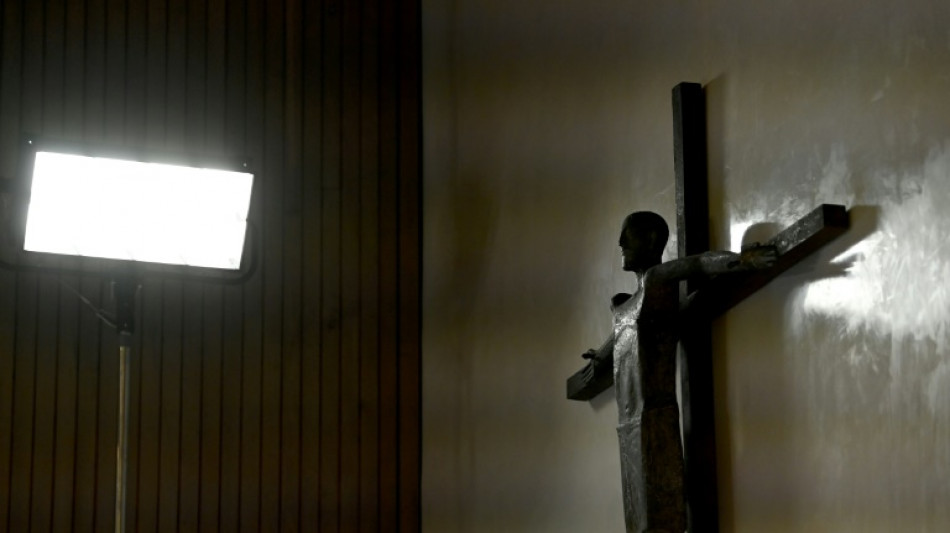
German Catholics challenge Vatican with sweeping reform drive / Photo: © POOL/AFP/File

 Three Mexicans convicted in murders of Australian, US surfers

 Powerful waves lash California coast as storm threatens more damage

 Trump hails Russia deal to release diesel as midterms loom

 Lyon blow chance to go top after loss at Lens
 Stocks rise as Trump says Russia to release diesel to world markets

 Wildfire smoke shuts schools in Amazon's biggest city

 Turkey jails 2 journalists pending trial for fund crisis 'misinformation'

 Major earthquake rocks Panama, triggers tsunami warning

 Indian jailed in France for leading sadist Nazi cult that tortured girls

 'Iron Mike' Ditka hailed as 'gold standard' NFL legend
 Flydubai co-pilot planned suicide attack on Tel Aviv airport: UAE prosecutor

 Mike Ditka: Chicago Bears icon as player and coach

 Outrage over plan to livestream US military firing squad execution

 US sanctions: a 'test of resilience' for ICC
 NFL legend Mike Ditka dead at 86
 Hurricane Isaias set to strike Gulf Coast late Friday
 Trump forms panel to probe US Fed governor Lisa Cook
 Clashes in Durban as fresh anti-migrant riots erupt in South Africa
 France students plan more protests, UN 'concerned' over violence
 De Zerbi calls on struggling Spurs to react in Man Utd clash
 US sanctions on ICC: a 'test of resilience'
 Outrage over US military plan to livestream firing squad execution

 Argentina snap up defence guru Edwards ahead of World Cup

 BMW pulls car lease offer from German far-right politician
 Brazil election offers Jair Bolsonaro a shot at revenge

Germany's Catholic Church has ended a landmark renewal project by agreeing a slew of reforms including blessing same-sex marriages and allowing female deacons, at the risk of angering the Vatican.
Bishops, priests, nuns and lay representatives of the Church gathered in Frankfurt from March 9-11 for the last assembly of Germany's "Synodal Path", a process launched in 2019 in response to the clerical sex abuse scandal.
Some 200 delegates voted on 15 separate issues, among the most high-profile of which was the overwhelming agreement to ordain women into the diaconate. Deacons can assist priests during Mass, perform baptisms and bless marriages.
The final decision on whether to allow female deacons remains with Pope Francis.
The delegates in Frankfurt did not go so far as to vote in favour of female priests, a far more contentious issue.
The "Synodal Path" participants also backed offering blessings for same-sex couples, in defiance of the Vatican which considers homosexuality a sin.
Crucially, the measure was supported by a majority of German bishops, who have the authority to perform the ceremonies in their diocese without Vatican approval.
The result was welcomed by the head of the German Bishops' Conference Georg Baetzing as a "very good" outcome.
Blessings for same-sex relationships are already offered in Germany by some Catholic priests, but the public show of support is likely to encourage more such ceremonies.
- 'Can't stay the same' -
The German reform drive, which has included controversial discussions about priestly celibacy and changing the decision-making structure in Church, has sparked deep tensions with Rome and even triggered fears of a schism.
Baetzing played down those concerns in Frankfurt.
"The Synodal Path neither leads to a division nor is it the beginning of a national Church," he told delegates.
Baetzing hopes the German proposals will be incorporated in Pope Francis's global synod, which will see a discussion about Church reforms in October.
Germany's Catholic Church remains the country's largest religion, counting 21.6 million members in 2021.
But it has lost around three million members over the last decade and struggled to recruit new priests, spurring calls for modernisation and renewal.
Much of the exodus came in the wake of revelations of child sex abuse by clergy, mirroring similar scandals around the world.
A study commissioned by the German Bishops' Conference and released in 2018 showed that 1,670 clergymen had committed some type of sexual attack against 3,677 minors, mostly boys, between 1946 and 2014.
However, the authors said the actual number of victims was almost certainly much higher.
The president of the lay-run Central Council of German Catholics, Irme Stetter-Karp, said she had "wished for more" change after the Frankfurt assembly.
"The Church cannot remain as it is," said Stetter-Karp, also the co-president of the "Synodal Path".
She praised the decision on female deacons, as well as a proposal to ask Pope Francis to re-examine priestly celibacy.
But she regretted that no progress had been made on overhauling the power structure within Germany's Catholic Church, given a lack of the required support from bishops.
"Anyone who takes the abuse scandal seriously, must work on structural changes," she said.
C.Kovalenko--BTB