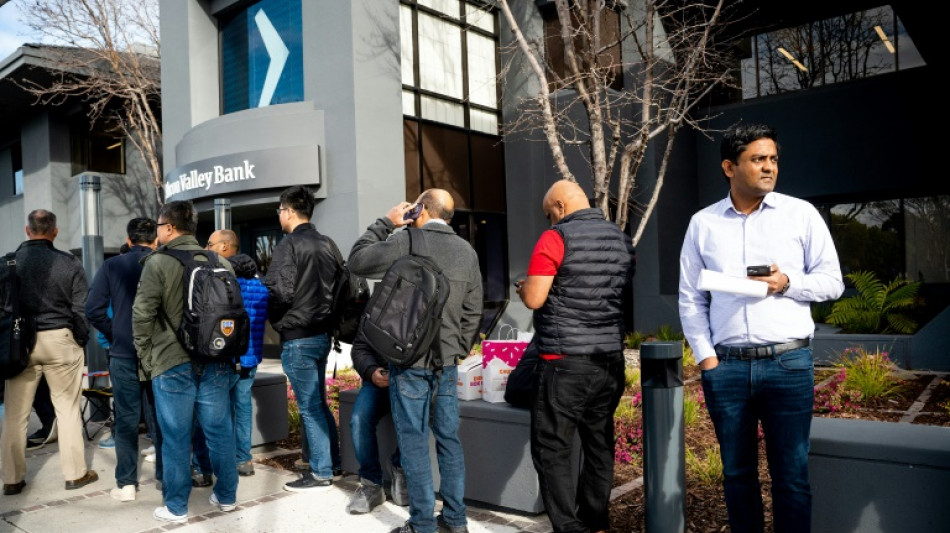
Regret and blame in Silicon Valley after bank run / Photo: © AFP

 India deploys police, restricts transport ahead of major protest

 Three Mexicans convicted in murders of Australian, US surfers

 Powerful waves lash California coast as storm threatens more damage

 Trump hails Russia deal to release diesel as midterms loom

 Lyon blow chance to go top after loss at Lens

 Stocks rise as Trump says Russia to release diesel to world markets

 Wildfire smoke shuts schools in Amazon's biggest city

 Turkey jails 2 journalists pending trial for fund crisis 'misinformation'

 Major earthquake rocks Panama, triggers tsunami warning

 Indian jailed in France for leading sadist Nazi cult that tortured girls

 'Iron Mike' Ditka hailed as 'gold standard' NFL legend

 Flydubai co-pilot planned suicide attack on Tel Aviv airport: UAE prosecutor

 Mike Ditka: Chicago Bears icon as player and coach

 Outrage over plan to livestream US military firing squad execution

 US sanctions: a 'test of resilience' for ICC

 NFL legend Mike Ditka dead at 86

 Hurricane Isaias set to strike Gulf Coast late Friday
 Trump forms panel to probe US Fed governor Lisa Cook

 Clashes in Durban as fresh anti-migrant riots erupt in South Africa

 France students plan more protests, UN 'concerned' over violence

 De Zerbi calls on struggling Spurs to react in Man Utd clash
 US sanctions on ICC: a 'test of resilience'

 Outrage over US military plan to livestream firing squad execution

 Argentina snap up defence guru Edwards ahead of World Cup

 BMW pulls car lease offer from German far-right politician
The nearly overnight collapse of Silicon Valley Bank has left the US tech scene in shock, wondering how one of its most valued institutions could vanish so suddenly, shunned by the companies that used it most.
SVB, like many other niche banks around the world, was a highly specialized lender with specific idiosyncrasies -- and its one-track focus could have been its undoing.
"I am so angry. And sad and scared. Just remember, we did this collectively," tweeted Nicole Glaros, a startup entrepreneur.
"If you did the right thing, and kept your money at SVB, you're being f'ed," she said, using an abbreviated expletive.
"If you did the wrong thing, and moved your money, you f'ed thousands of startups and people you've never met," she added.
SVB, which was founded in the 1980s, claimed that "nearly half" of US technology and life science startups banked with them for a wide range of services, but mainly to park cash handed to them by their venture capitalist backers to operate.
"Before SVB sprang to life, it was difficult, if not impossible, for a start-up to secure a relationship with a large, established bank," wrote Michael Moritz, a partner at Sequoia Capital, a VC powerhouse, in the Financial Times.
California startups "were bypassed or ignored" by the establishment banks and "in a perverse way, SVB has paid a price for its loyalty," he wrote.
The collapse of SVB, like the demise of cryptocurrency friendly Signature Bank on Sunday, did not follow the playbook of the 2008 financial crisis, which erupted from problems that only experts initially understood.
Instead, SVB's implosion followed a far more classic pattern, reminiscent of scenes from the Great Depression nearly a hundred years ago, when distressed depositors lined up at failed US banks desperately hoping to get their hands on money that was already lost.
In this case, the depositors were tech entrepreneurs, who were responding to frantic warnings from colleagues or backers to clear out their accounts quickly.
"On Thursday... I suddenly saw very clear emails, written in capital letters, coming from my board of directors: WITHDRAW YOUR MONEY NOW!", said Clement Cazalot, CEO of startup Machinery Partner.
According to reports, the calls were coming from the most powerful venture capital firms in San Francisco and Silicon Valley, including Peter Thiel's Founders Fund, Union Square Ventures and Coatue Management.
- 'Get your money out!' -
The panic began after a bungled presentation by SVB that was meant to reassure clients that everything at the bank was under control, despite the fact SVB was raising cash after some bad investment decisions.
"I think when the forensics on this are done, you’re going to find out that maybe as few as 20 people... decided on Wednesday or Thursday morning to go into a war room mentality," said New York University business professor Scott Galloway, who also works with startups.
"And when your VC calls you and tells you to get your money out, you get your money out," he said on Pivot, a New York Magazine podcast.
The dash for the exit doors came just a few months after the collapse of FTX, one of the biggest names in the cryptocurrency industry, though the causes there -- linked to fraud and other alleged crimes by its founders -- were quite different.
But the collapse of FTX was similarly fast and precipitated the implosion of other cryptocurrency firms and runs at two other banks, Signature and Silvergate, that had recentered their own businesses on alternative currencies.
While different cases, SVB and those banks had all courted danger by concentrating their business on one type of higher risk asset, making them vulnerable, said Dan Ives, an analyst at Wedbush.
Under those conditions, a bank's stability can change in an instant, especially if clients panic and begin to think with one mind.
"I think the ripple effects of this in Silicon Valley are going to be felt for the next decade," Ives said.
P.Anderson--BTB