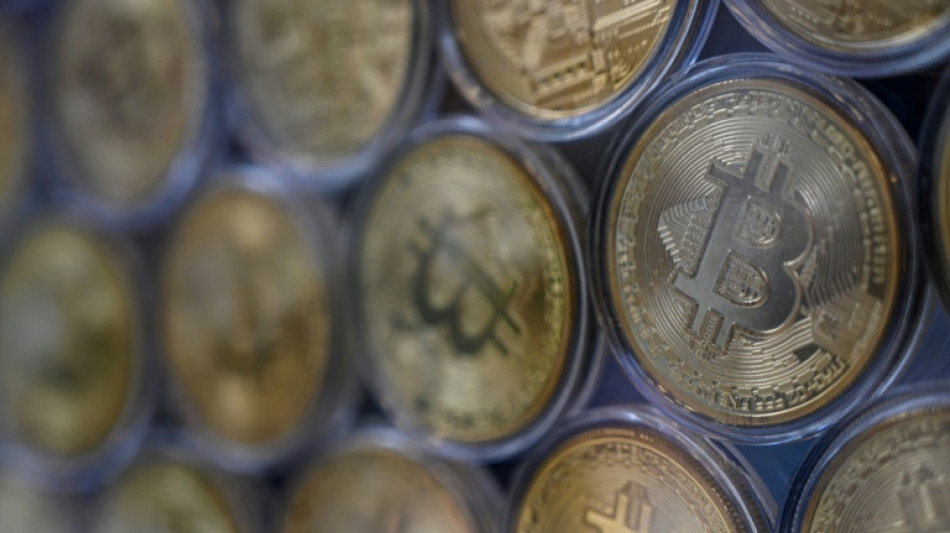
Cryptocurrencies enter Ukraine conflict / Photo: ©

 USA trims International lead after Presidents Cup four-balls

 Russia accuses Europe of blocking Ukraine talks, as strikes drag on

 'He said hello': Families pray with pope on Paris avenue

 Pope celebrates giant Paris mass, flies to Lourdes

 Thousands march in Madrid over eviction of 87-year-old woman
 England women back to winning ways with last-gasp defeat of New Zealand

 Trump rejects Iran proposal for deal to reopen Hormuz

 England's Cox says injured Buttler leaves 'big shoes to fill'
 Ruthless Perpignan upset sloppy Bordeaux-Begles
 Deadly abbey attack feeds anti-Ukrainian sentiment in Poland

 Antonelli says he drove 'safety-first' on his worst weekend of season
 Fernandez fights back to reach Singapore Open final

 Giant statue of Pope Leo XIV takes shape in Peru workshop

 Ukraine crush holders Italy to reach first BJK Cup final

 Pope celebrates giant Paris mass in landmark visit

 Germany selects Munich for Olympics host bid

 Sagnol sacked as Georgia boss after Nations League upset

 Man City could face 'drastic' sanctions after reported guilty verdict: ex-chairman

 Furious Fury says row between rival promoters could scupper Joshua bout

 'Invincible' 223cm teen basketball player stars as China win bronze

 Tenth woman found dead in South Africa's string of killings

 Japan schoolboy, 11, wins gold while empty seats blight Asian Games

 Japan organisers 'not satisfied' as empty seats blight Asian Games

 Canals full, roads submerged as Bangkok declares flood disaster

 China, US to open AI 'communication channel' after summit

Having evacuated part of his team from Kyiv, Mike Chobanian, boss of cryptocurrency exchange Kuna, is watching the effects of Russia's invasion on his flourishing industry with a weary eye.
"Business is running, but we're in survival mode over here," the 37-year-old boss said during a video call from his current refuge after leaving the Ukraine capital.
Russia's military build-up led many Ukrainians to turn to cryptocurrencies, before the invasion seized up the sector.
But it is still facilitating global fundraising efforts, albeit through an opaque decentralised system that Russia could also exploit to circumvent sanctions.
The Ukrainian government on Friday imposed sanctions against the rouble, forcing Chobanian to halt cryptocurrency swaps with the Russian currency.
"But who cares when it's war?" said Chobanian.
His platform saw a steady rise in business from Ukrainian accounts in recent weeks.
Worried about rising tensions, locals were buying up stablecoins, the dollar-backed electronic currencies often criticised by Western regulators for their opacity.
"Bitcoin, you engage yourself in gambling, you don't know if it's going to go up or down," he explained.
"But here you're trying to preserve what you have and people perceive the US dollar as a safe heaven. Cash is useless, you can't do much with it, it can be easily taken away with a gun. USDT (stablecoin) is a safe haven."
But trading has become increasingly difficult since the invasion.
Several cryptocurrency users have, however, launched fundraisers that they say are dedicated to aiding the Ukrainian military and relief efforts.
More than $4 million in cryptocurrencies arrived in two days on a single fundraising wallet for the "Come Back Alive" organisation, cryptocurrency research firm Elliptic said Friday.
- Sanction busting -
"There's no limit, it can be raised from around the world, it's not dependent on the banking system, it's more transparent because it's a blockchain. It's a better option," said Chobanian.
This enthusiasm is not completely shared by the Ukrainian government.
On the communication site UkraineNOW, the Ministry of Defence calls for donations via bank transfers, but specifies that "national legislation does not allow the Ministry of Defence of Ukraine to use other payment systems ('Webmoney', 'Bitcoin', 'PayPal', etc.)."
And the same decentralised network that makes cryptocurrencies attractive to Ukrainian fundraisers could also benefit Russia.
Among the sanctions being considered against Moscow is exclusion from the Swift system, which allows interbank settlements between financial institutions around the world.
Some fear that cryptocurrencies could allow Russia to bypass such sanctions.
"North Korea has conducted robust hacking efforts with the intention of stealing cryptocurrency from exchanges and DeFi platforms," explained Caroline Malcolm, from the analysis firm Chainalysis.
"They've been able to bring in billions of dollars worth of funds to the country, evading sanctions."
Iran has also used cryptocurrency to bring money into the country, but mined it rather than hacking it, she added.
But as with the traditional financial system, "the cryptocurrency ecosystem can put measures in place to identify transactions from identified sanctioned entities," she said.
This could mainly be achieved by analysing data from blockchains -- the registers where all cryptocurrency transactions are recorded.
L.Dubois--BTB