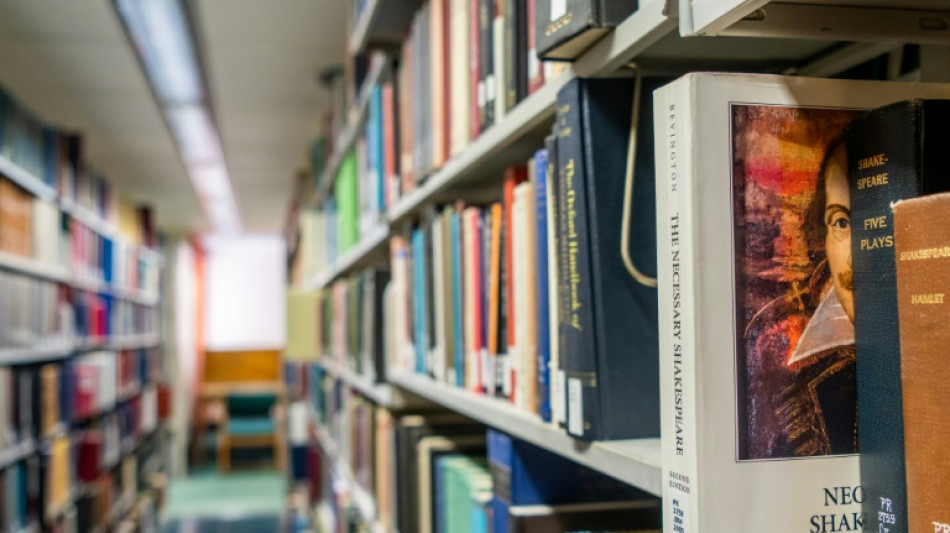
Censorship or evolution? 'Sensitivity readers' divide publishing world / Photo: © GETTY IMAGES NORTH AMERICA/AFP/File

 Hunger and malnutrition stalk Gazans, a year on from ceasefire

 Fernandez trumps MotoGP championship duo to grab Indonesia pole

 October 7 scars push Israel's first-time voters to right

 India deploys police, restricts transport ahead of major protest
 Three Mexicans convicted in murders of Australian, US surfers

 Powerful waves lash California coast as storm threatens more damage
 Trump hails Russia deal to release diesel as midterms loom

 Lyon blow chance to go top after loss at Lens

 Stocks rise as Trump says Russia to release diesel to world markets

 Wildfire smoke shuts schools in Amazon's biggest city

 Turkey jails 2 journalists pending trial for fund crisis 'misinformation'
 Major earthquake rocks Panama, triggers tsunami warning

 Indian jailed in France for leading sadist Nazi cult that tortured girls

 'Iron Mike' Ditka hailed as 'gold standard' NFL legend

 Flydubai co-pilot planned suicide attack on Tel Aviv airport: UAE prosecutor

 Mike Ditka: Chicago Bears icon as player and coach

 Outrage over plan to livestream US military firing squad execution

 US sanctions: a 'test of resilience' for ICC

 NFL legend Mike Ditka dead at 86
 Hurricane Isaias set to strike Gulf Coast late Friday
 Trump forms panel to probe US Fed governor Lisa Cook
 Clashes in Durban as fresh anti-migrant riots erupt in South Africa
 France students plan more protests, UN 'concerned' over violence
 De Zerbi calls on struggling Spurs to react in Man Utd clash
 US sanctions on ICC: a 'test of resilience'
It's a profession which is increasingly under the spotlight as the culture wars rumble on: "sensitivity readers" -- editors who identify insensitivities or stereotypes in manuscripts -- are becoming a lightning rod for the publishing industry.
Such readers have worked in the wings of the Western literary world for years now, though they were largely confined to children's literature.
But amid social reckonings such as the #MeToo and Black Lives Matter movements, sensitivity readers are becoming prominent in contemporary fiction publishing also -- and not everyone is pleased about it.
Publishers "are doing a damn good job, trying to ruin our books, and to ruin our fun as readers," the American author of "We Need To Talk About Kevin," Lionel Shriver, complained on ultra-conservative British channel GB News last month.
Sensitivity readers have recently been pilloried again with the announcement that books by children's writer Roald Dahl and Ian Fleming, the author of the James Bond novels, were being republished to be more adapted to current sensibilities.
In Dahl's books, for example, some characters are no longer identified as "fat" or "crazy." Fleming's books were being reissued with racial references -- including the N-word -- removed.
Accusations of censorship began flying almost immediately from observers who fear sanitized literature could whitewash the past as well as the present.
"People say that, but I don't feel that they understand the process," Patrice Williams Marks, a Los Angeles-based sensitivity reader, tells AFP.
"If you're writing about a people or community that you're unfamiliar with, and you want it to be authentic... then you find somebody who's a sensitivity reader who's part of that community and ask for their opinions," she explains.
"I always let them know that they don't have to accept the changes that I suggest," says Lola Isabel Gonzalez, another sensitivity reader, also based in Los Angeles.
- Modern censors? -
So who are "sensitivity readers"?
Mostly they are freelance editors, often paid by the word or number of pages -- and with strict confidentiality clauses, of course -- by authors or publishers concerned about the accuracy of their manuscripts.
Or, as critics charge, to avoid at all costs the disaster of being canceled in a social media storm over a faux pas.
The proofreaders often list their areas of expertise: "child of immigrants," "bisexual," "autistic," "hijabi," "deaf," "expertise in both mainland Chinese and Hong Kong culture" and so on.
"There are good reasons for regulating children's reading: it is foundational and formational," British author Kate Clanchy wrote last year.
But she is much more circumspect when it comes to adults.
Adults "are able to put books down if they upset them, so their books may safely contain difficult ideas," argues Clanchy, who was herself at the center of a sensitivity reader controversy when her memoir was accused of being racist and insensitive.
For Shriver, who has long complained about such readers, they are nothing less than "sensitivity police."
"At the keyboard, unrelenting anguish about hurting other people's feelings inhibits spontaneity and constipates creativity," she wrote in The Guardian newspaper in 2017.
In France, a country widely resistant to this type of revisionism, the essayist Raphael Enthoven in 2020 denounced these "modern censors" as "the vanguard of the Identity Plague."
- Progress -
But many other writers are in favor of readers -- like the American Adele Holmes, who called on Marks's services for her first book, "Winter's Reckoning."
"Patrice was able to point out some areas of white privilege and the white savior role," Holmes told AFP.
And, more prosaically, for the character of a Black woman described as having "silky" hair, Marks suggested using the word "coil" instead, to make it more realistic.
Holmes feels that the proofreader helped her "immensely."
As for the criticisms, she argues they come from people who feel "threatened" by minorities, in a publishing world long known to be predominantly white.
For her part, Marks dates the renewed interest in her profession to the 2020 killing of George Floyd, an African American man, by a white police officer in Minneapolis. The murder ignited protests and a social reckoning on modern racism in the United States and around the world.
Since then, authors have "become more conscious of the lens that they're looking through," Marks told AFP.
Gonzalez also sees this increased care as reflecting social evolution.
"I don't think I could have done it professionally in any other decade," she says of her job, welcoming the fact that "Generation Z" is challenging established social narratives.
Those younger generations understand the importance of sensitivity reading, she argues -- as opposed to their elders, who might "have a harder time seeing it as progress."
O.Lorenz--BTB