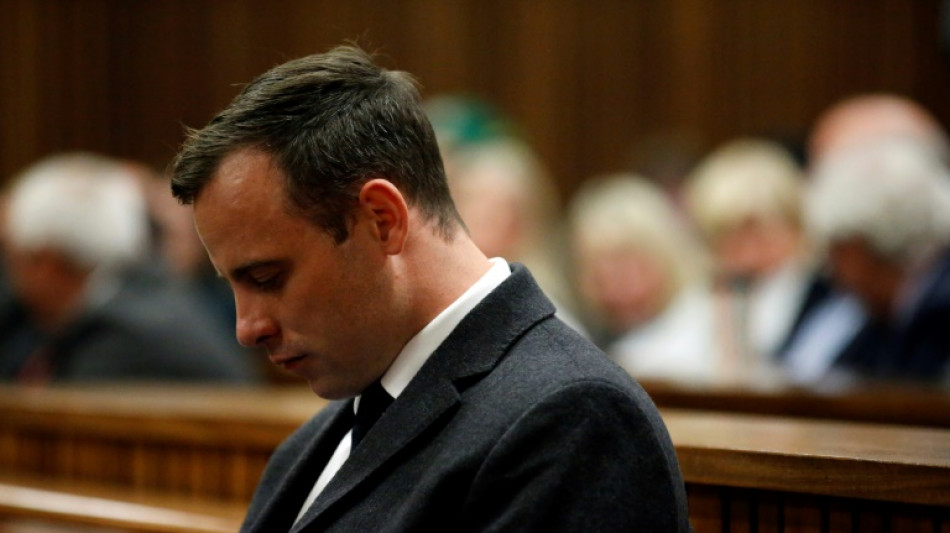
Oscar Pistorius: Olympian hero turned disgraced killer / Photo: © POOL/AFP/File

 Butterflies seek new habitats as climate changes: study
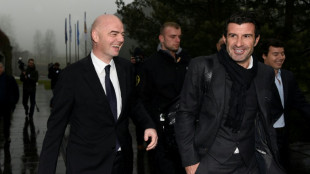 'Deceitful' Infantino 'must go' says Luis Figo

 ヌーシャ・オーベル:彼女はポツダムの抱える問題に対処できるのか?

 努莎·奧貝爾:她能否應對波茨坦面臨的問題?

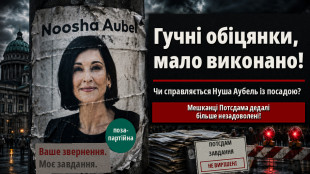 Нооша Аубель: Чи зможе вона впоратися з проблемами Потсдама?

 Noosha Aubel: Is she up to the task of tackling Potsdam’s problems?

 Alarm at German airport after drone found near Ukrainian plane, mid-air incident
 Salah arrives in Turkey for Trabzonspor talks

 Embattled FIFA chief Infantino holds emergency talks with directors

 Russian barrage on Kyiv kills 17 as Ukraine fails to down single missile

 'Lost': Migrants despair after Britain expels them back to France

 Cathay Pacific's profit soars 71% despite Iran war driving up fuel costs
 Russian barrage on Ukraine kills 15, wounds dozens more

 South Korea police raid Starbucks HQ over 'Tank Day' fiasco

 Tech back in fashion as Asian markets extend rebound

 Total eclipse gives scientists chance to probe Sun's mysteries
 What to know about the total solar eclipse on August 12

 'Like the end of the world': the eclipse chasers flocking to Spain
 Taiwan begins military drills as China pressure grows

 UK mansion where 'listeners' spied on Nazi generals becomes museum

 Sabalenka tops Uchijima in WTA Toronto opener

 Alcaraz withdraws from Cincinnati Masters with wrist injury
 SpaceX revenue jumps 92% in first earnings report, but shares slide

 US eyes Hormuz deal 'today or tomorrow' as ship sinks in Red Sea

 SpaceX revenue jumps 92% in first earnings report

At the 2012 London Olympics, before 80,000 roaring fans and a constellation of camera flashes, it took Oscar Pistorius 45.44 seconds to become a global icon.
The South African's 400-metre sprint was the first time in history that a double-amputee had raced at the Olympic Games.
It capped an Olympian triumph over adversity for Pistorius. His journey from disabled child to world-class athlete seemed to embody the very best of sporting endeavour and the human spirit.
Then in the early hours of Valentine's Day, 2013, at his upmarket Pretoria home, he shot and killed his 29-year-old model girlfriend Reeva Steenkamp.
He later said he had believed her to be an intruder.
Pistorius's world imploded and his 2014 trial saw him sat for months in a windowless courtroom.
A sparkling career was cut short, sponsors dumped him and he was forced to sell his homes to cover mounting legal bills.
A five-year conviction for manslaughter was upgraded to murder on appeal and in July 2016, he was sentenced to six years, less than half the minimum term for the charge.
The athlete had sobbed, shaken and vomited in the dock as details of his lover's brutal death were examined in excruciating detail as the world watched transfixed.
In 2017, the Supreme Court of Appeal more than doubled that jail term to 13 years and five months after the state appealed that it had been unduly lenient.
Prosecutors had argued that Pistorius failed to show genuine remorse.
"He's not only broke, but he is broken, there is nothing left," lawyer Barry Roux told his sentencing hearing in 2016.
Now a decade after the killing, he is facing a parole hearing that could see him released early from prison.
- Darker side -
The high-profile proceedings exposed the now 36-year-old's darker side: offering glimpses of a dangerously volatile man with a penchant for guns, beautiful women and fast cars.
In 2009, he had spent a night in jail after allegedly assaulting a 19-year-old woman at a party in a case that was settled out of court.
Two years later, he was accused of firing a gun through the sunroof of an ex-girlfriend's moving car, although a court found there was not enough evidence to convict him on that charge.
Weeks before he shot Steenkamp, he discharged a gun by accident at a Johannesburg restaurant.
The sprinter slept with a pistol under his bed at his home in a high-security estate for fear of burglars.
He was once detained in Amsterdam after gunpowder residue was detected on his prosthetics and he took a New York Times journalist interviewing him to a shooting range.
"He likes fast cars. He is just built for speed," his trainer Jannie Brooks told AFP.
He once crashed his boat on a river, breaking two ribs, an eye socket and his jaw. Empty alcohol bottles were found in the boat.
At one point he owned two white tigers but sold them to a zoo in Canada when they became too big.
- 'Put your legs on' -
Born in 1986 in Johannesburg without fibulas (calf bones), his parents decided when he was 11 months old to have his legs amputated below the knee so he could be fitted with prosthetic legs.
This allowed him to play sports and he excelled, concentrating on running only after fracturing a knee playing rugby.
"It was never made an issue. My mother would say to my brother, 'You put on your shoes, and Oscar, you put on your legs, then meet me at the car,'" Pistorius said in a 2011 interview.
A middle child whose parents divorced when he was six, he has had a problematic relationship with his father Henke, but was close to his siblings, who were at his side in court.
His mother died when he was 15 and the date of her death is tattooed on his arm.
In 2004, just eight months after taking to the track, he smashed the 200m world record at the Athens Paralympics.
Next up was the 2008 Beijing Paralympic Games where he took the 100m, 200m and 400m sprint titles and launched a battle to take part in able-bodied athletics, overcoming arguments that his custom-built carbon-fibre running blades gave him an unfair advantage.
In 2011 he became the first amputee to run at the World Championships, winning silver with South Africa's 4x400m sprint team.
"You're not disabled by your disabilities but abled by your abilities," he told Athlete magazine in an interview that year.
In 2012, he again made history by becoming the first double-amputee to compete at both the Olympics and Paralympics.
"He is the definition of global inspiration," Time magazine proclaimed in its 2012 list of the world's most influential people.
Less than a year later, Pistorius featured on the cover with the words "Man, Superman, Gunman".
J.Horn--BTB