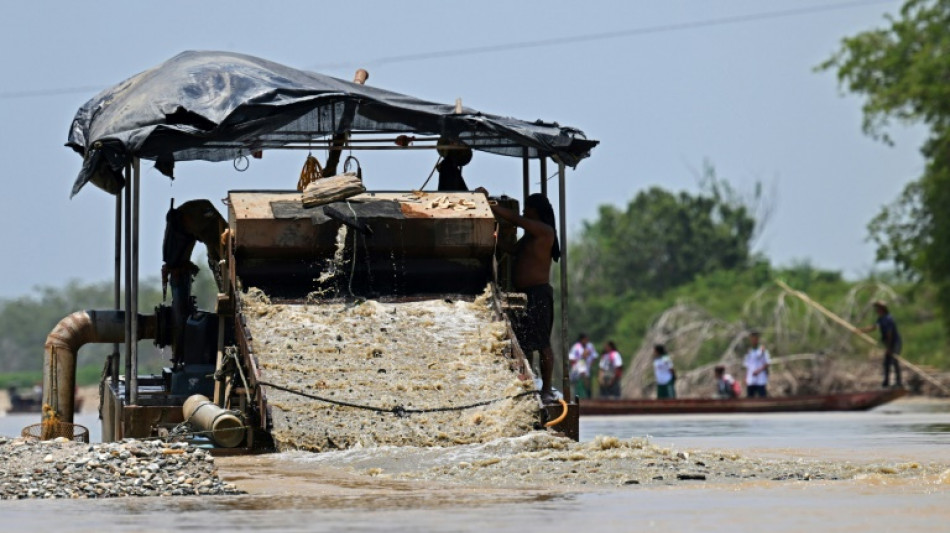
Battle in Colombia over river-wrecking gold 'dragons' / Photo: © AFP

 Spanish PM begins vote campaign overshadowed by housing protests

 Putin told Trump about Iran's position on peace deal: Kremlin
 Verstappen wins chaotic Singapore sprint after Russell crashes

 Kiss tells Wallabies to 'return fire' after first loss as coach

 Russian strikes kill 11 including 3 children: Ukrainian authorities

 Russian teenager Andreeva breezes into China Open final

 Major earthquake hits Panama, injures at least 27

 India detains 'cockroach' leaders ahead of election protest

 'No divisions, no borders', French astronaut says of seeing Earth

 India's 'cockroach' movement chief detained ahead of major protest

 Year later, Gaza ceasefire promises mostly unfulfilled

 Taiwan's leader says increasing defence spending to 'deter war'
 Major quake hits Panama, no deaths reported

 Hurricane Isaias makes landfall in Florida
 Brazil prosecutors sue Shell for $108 mn over deadly 2024 floods

 Major earthquake destroys buildings, roads in Panama
 Anthropic AI model sent fake murder tip to Philadelphia police

 7.7-magnitude quake rocks Panama, triggers tsunami warning

 Prince Harry booed at English rugby match

 Kiplimo and Feysa seek repeat Chicago Marathon wins

 Fuellkrug halts Dortmund after late goal flurry

 Injured Ravens quarterback Jackson ruled out of Falcons clash

 Brewers aim to take down two-time defending champion Dodgers in NLCS rematch

 Tsunami alert after major earthquake rocks Panama

 Outer bands of Hurricane Isaias lash US Gulf Coast

The giant skeletons of burnt and dismantled gold dredgers litter the rivers of northwest Colombia, where the government is waging a full-out war on illegal mining.
Nicknamed "dragons" by locals, the massive machines used to suck gold from riverbeds are blamed for destroying the environment and financing organized crime.
But their dismantling in a massive army operation has been met with hostility by communities who depend on mining for their daily survival.
Around El Bagre in the gold-rich Bajo Cauca region, a protest by miners that started early this month has been marked by acts of vandalism the government blamed on the Gulf Clan drug cartel for instigating.
But Luis Manuel Campo, 32, one of the miners, insisted to AFP that "we have nothing to do with criminal groups."
Campo co-owns a dredger with three other people.
"We are not hiding. We just want the persecution to stop," he said.
"We want to be formally recognized as miners so that we can work in peace, without stigma."
- New gold rush -
The names of the villages in this region such as Zaragoza and Caceres serve as a reminder of the Spanish colonizers who were already extracting gold in Bajo Cauca in the 17th century.
It became a bastion of rightwing paramilitary fighters in the 1990s, and is now a stronghold of the Gulf Clan, Colombia's most powerful cartel.
President Gustavo Petro this month called off a ceasefire with the Clan, accusing it of being behind attacks on civilians committed by protesting miners.
Criminal groups in Colombia make almost as much money from illegal mining as they do from trafficking cocaine, authorities say.
With a recent rise in gold prices, Bajo Cauca has been gripped by a new type of gold rush, with poor communities scouring the gravelly river beds with shovels, bulldozers and dredging machines.
"Apart from gold, there is nothing here," said Campo.
Locals say about 350 dredging machines are active in the region -- big and small -- on top of those operated legally by the Mineros Aluvial multinational.
- 'Profitable' -
The illegal dredgers range from simple machines with makeshift conveyer belts to larger mechanical contraptions that require several divers to guide a massive vacuum pipe under the dark water.
Then there are the "dragons" -- three-storey, 20-meter (66-foot) long boats with massive engines.
There are about two dozen of these in the Bajo Cauca region.
One "dragon" costs about half a million dollars, their owners tell AFP.
"At the current (gold) price, it is profitable," said Alex Cossio, 41, who runs one of these monsters.
One "dragon" can extract up to two kilograms (4.4 pounds) of gold per day -- worth more than $50,000, according to a police official who did not want to be named.
AFP visited a number of these beasts, including one named "Native" that has been operational for only two months in a branch of the Nechi river.
"The (army) helicopters fly over us every day, we are afraid," said Cossio, who insisted there was no link to organized crime.
"Diesel, food, logistics... We buy everything in the neighborhood, a large number of families live from our activity," he added.
AFP observed at least six "dragons" lying mutilated and burnt by the riverside, some already being repaired by their owners.
There is no official data on how many dredgers have been destroyed.
"We tried to stop them, it was terrible," said Julia Tatis, who owns a small eatery, of a raid this month on three of the machines in Nueva Esperanza, a poor hamlet on the water's edge.
"The military just arrived saying we are the Gulf Clan. And they burned everything," added dredge owner Juan Manuel Carcamo.
- Damage 'already done' -
Campo insists the dredges are working river beds "that were already exploited by Mineros 40 years ago... The damage has already been done."
Lawyer Francisco Arrieta Franco is an advocate for the miners who he describes as victims.
"It is false to say the dredges belong to the Clan," he told AFP.
"It's complicated and expensive to operate a dredger. Criminals are more interested in extortion, which is everywhere in this region."
Locals say the miners are subject to Gulf extortion rather than perpetrators of it.
In a gold shop in El Bagre, an employee warned of trouble if the government continues to "harass" the miners.
"We need these dredgers to work and to eat," shouted the employee, who did not want to be named. "They serve the whole community!"
Added a miner, also on condition of anonymity: "It is when you have an empty stomach that you are forced to do illegal things."
N.Fournier--BTB