Hats off as intelligence operatives hound matchfixers / Photo: © AFP

 Spanish PM begins vote campaign overshadowed by housing protests
 Putin told Trump about Iran's position on peace deal: Kremlin
 Verstappen wins chaotic Singapore sprint after Russell crashes

 Kiss tells Wallabies to 'return fire' after first loss as coach
 Russian strikes kill 11 including 3 children: Ukrainian authorities
 Russian teenager Andreeva breezes into China Open final
 Major earthquake hits Panama, injures at least 27
 India detains 'cockroach' leaders ahead of election protest
 'No divisions, no borders', French astronaut says of seeing Earth
 India's 'cockroach' movement chief detained ahead of major protest
 Year later, Gaza ceasefire promises mostly unfulfilled
 Taiwan's leader says increasing defence spending to 'deter war'
 Major quake hits Panama, no deaths reported

 Hurricane Isaias makes landfall in Florida
 Brazil prosecutors sue Shell for $108 mn over deadly 2024 floods
 Major earthquake destroys buildings, roads in Panama

 Anthropic AI model sent fake murder tip to Philadelphia police
 7.7-magnitude quake rocks Panama, triggers tsunami warning
 Prince Harry booed at English rugby match

 Kiplimo and Feysa seek repeat Chicago Marathon wins

 Fuellkrug halts Dortmund after late goal flurry

 Injured Ravens quarterback Jackson ruled out of Falcons clash

 Brewers aim to take down two-time defending champion Dodgers in NLCS rematch

 Tsunami alert after major earthquake rocks Panama
 Outer bands of Hurricane Isaias lash US Gulf Coast

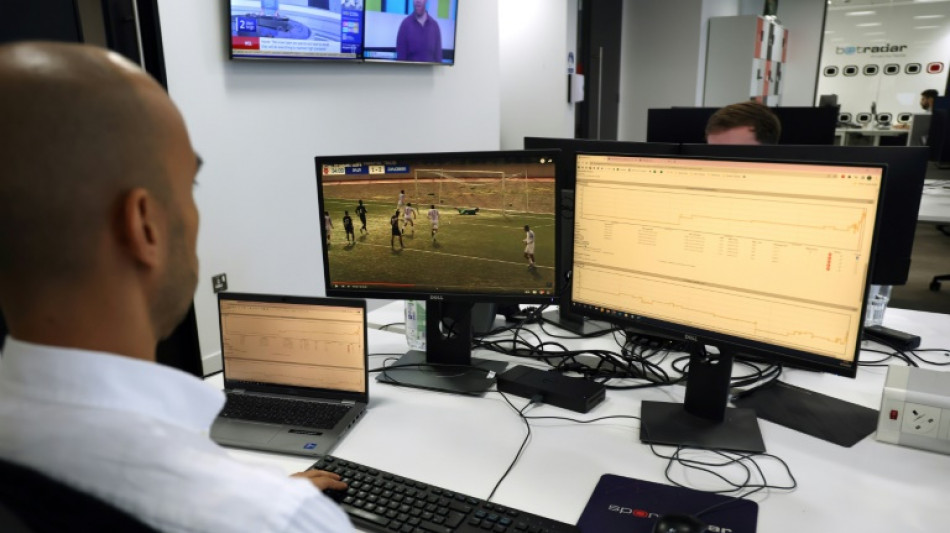
A spectator removing their hat or taking off their jacket at a sporting event sounds innocuous but it can be a sign the match in question is fixed, Sportradar's Director of Intelligence and Investigations told AFP.
Such apparently insignificant gestures could, for example, be signals to players in a football match to allow their team to concede goals, Tom Harding explained in an interview at the company's London base.
Harding, who spent 11 years in the Royal Navy in intelligence roles and three years in law enforcement in Britain, rumbles into action with his team of intelligence specialists and investigators once initial analysis has been done and a potentially suspicious match has been identified.
They get involved if the client, or sports federation, want evidence to help them deal with the issue.
They act on information supplied by the Monitoring and Detection team of Sportradar Integrity Services, which works with over 150 sports federations and leagues with clients ranging from world football's governing body FIFA to NASCAR.
Integrity Services analysts working 24/7 and operating from their main base in London to hubs in Montevideo, Melbourne, Singapore, Las Vegas and Minneapolis pore over screens of live sporting fixtures and betting odds.
In 2022, they identified 1,212 suspicious matches within 12 sports across 92 countries.
While reflecting an increase of 34% from 2021, the data confirms 99.5% of sporting events are free from match-fixing, with no single sport having a suspicious match ratio greater than 1%.
Harding has at his disposal "a significant network of reconnaissance photographers" who are sent to stadia. Other members of the intelligence unit can also be deployed on site.
"(The matchfixers) have to be in the stadium to communicate with players, and at times intimidate the players to go ahead with it," Harding said.
"We are looking for those type of individuals who could be signalling to players -- they are subtler these days and do not wave anymore.
"Hat on, hat off -- we have seen these exchanges.
"If the person has a hat on you are to do 'X', such as concede goals. If they take it off then it means you are to do this.
"Or they put a jacket on or take it off, sometimes they change their shirt, if you see green do this, red do that."
Harding says that the spotters' remit is not restricted to observing what goes on on the field of play.
"Sometimes we go beyond reconnaissance," the 35-year-old said.
"There is surveillance. We are looking before, during and after who the players are communicating with, if there is an exchange of packages and finances.
"After all, that is your crime scene ultimately."
- 'Definitely winnable' -
Harding says his team also rely on the fixers on the ground over-reaching themselves and believing they are invisible.
"They can be over-confident," he said. "There is a perception no-one is taking an interest, no-one is watching.
"If they saw more risk of criminal pursuit they would take more measures rather than sitting in the stadium changing their shirt or hat.
"You do rely on them not covering their tracks."
One of the main frustrations for Harding is that sanctioning those behind the fix can be complex.
"We are definitely making an impact but the frustration is a multi-jurisdiction global one," said Harding.
"You have a competition in a certain country being corrupted but the individuals organising, facilitating or orchestrating the manipulation are in another, bettors in another and financiers in another."
Harding says that while sporting sanctions have "reached a good level", it often amounts to "players and clubs being punished and their livelihoods being damaged" while those who initiated the fix get away with it.
"The law enforcement world does take it seriously but there are so many hurdles legally," he said.
The legal framework in some countries does not make it clear "whether it is either a crime or considered a serious crime worth investigation", Harding added.
"There are also limited resources devoted to it (in certain countries). So it is complicated.
"The biggest deterrent will come when you see more criminal prosecutions."
Harding, though, is bullish and believes despite some lows that matchfixers can be brought to heel.
It is a battle that is "definitely winnable," he said.
J.Bergmann--BTB