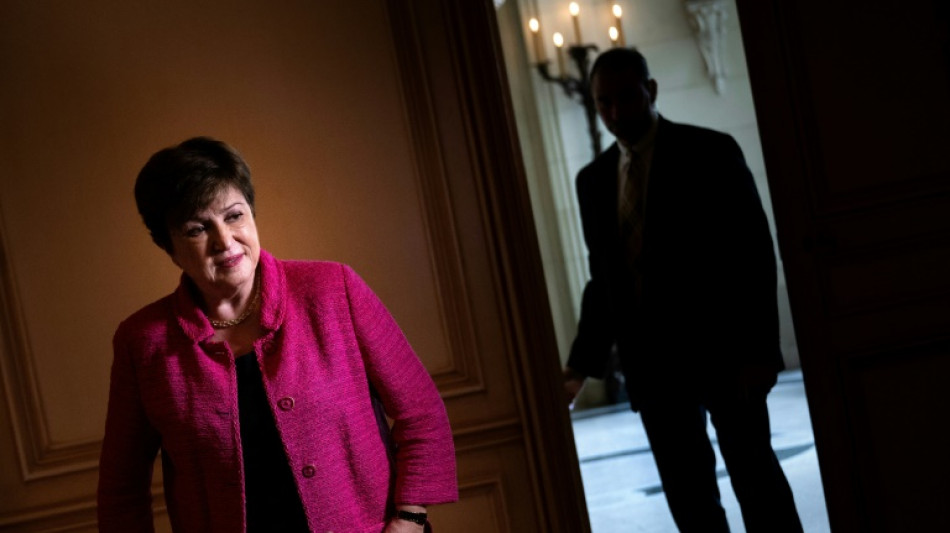
IMF chief calls on central banks to continue inflation fight / Photo: © AFP

 Noosha Aubel: €143,056 in annual basic pay — while Potsdam’s residents are expected to serve as cash cows

 Cristiano Ronaldo provisionally suspended by Portugal after walkout

 Brilliant Renshaw ton puts Australia in strong position

 Zelensky blasts diesel deal after Russian strikes kill 15

 Cristiano Ronaldo provisionally suspended after Portugal walkout

 Alcaraz through in straight sets on Shanghai Masters opener

 Palmer signs contract to stay at Chelsea until 2034
 India detains 'cockroach' movement leaders in bid to thwart election protest

 Proposed next EU budget cut back in search for deal

 All Blacks learn from 'failed' Springboks series to punish Wallabies
 Marquez grabs MotoGP championship lead after Indonesia sprint chaos

 All Blacks extend Eden Park streak with big win over Wallabies

 Marquez grabs MotoGP championship lead with Indonesia sprint win

 Schauffele closes in on leaders after 'weird' round in Japan

 Medvedev through at Shanghai Masters in first match since disqualification

 Trump sows doubt on plan to livestream US military execution
 Hunger and malnutrition stalk Gazans, a year on from ceasefire
 Fernandez trumps MotoGP championship duo to grab Indonesia pole

 October 7 scars push Israel's first-time voters to right

 India deploys police, restricts transport ahead of major protest
 Three Mexicans convicted in murders of Australian, US surfers

 Powerful waves lash California coast as storm threatens more damage

 Trump hails Russia deal to release diesel as midterms loom

 Lyon blow chance to go top after loss at Lens

 Stocks rise as Trump says Russia to release diesel to world markets

Central banks around the world should keep battling inflation by hiking interest rates despite ongoing concerns about financial stability, the head of the International Monetary Fund told AFP on Thursday.
Since last year, central banks have been raising their benchmark lending rates to tackle inflation, which rose to levels not seen for decades in many countries including the United States.
But their fight has been complicated by the recent collapse of Silicon Valley Bank after taking on too much interest-rate risk, setting off a period of turbulence in the banking sector on both sides of the Atlantic.
"We don't envisage, at this point, central banks stepping back from fighting inflation," IMF managing director Kristalina Georgieva said in an interview ahead of the fund's spring meeting next week.
"They have to stay the course in a much more difficult, more complex environment," she said.
The biggest casualty so far has been Swiss banking giant Credit Suisse, which was pushed by regulators to merge with regional rival UBS on concerns about its long-term financial health.
But Georgieva said: "Central banks still have to prioritize fighting inflation and then supporting, through different instruments, financial stability."
- US-China tensions weigh on growth -
Georgieva added that US-China trade tensions -- part of a broader realignment of the global economy -- was also having a detrimental impact on world growth.
While there has been a long period in which decisions on production were guided by costs, "this is no more," she said.
"Today, the US, but also other countries, are saying I want to have security of supplies and I want to protect national security," she added.
"The question is how far they should go," she asked, adding that it was possible to guard both aspects "without completely undermining the foundation for growth."
Left unchecked, the long-term cost of trade fragmentation could be as high as seven percent of global economic output, she said in a speech earlier on Thursday to ambassadors and officials in Washington.
- 'Elusive' recovery -
In the same speech, she warned that a continued slowdown in almost all the world's advanced economies is expected to drag global growth below three percent this year.
"With rising geopolitical tensions, with inflation still running high, a robust recovery remains elusive," she said. "That harms the prospects of everyone, especially for the most vulnerable people and most vulnerable countries."
Global growth almost halved last year to 3.4 percent as the impact of Russia's invasion of Ukraine rippled through the world economy, abruptly halting the recovery from the Covid-19 pandemic.
While Asia's emerging markets are expected to see substantial increases in economic output -- with India and China predicted to account for half of all growth this year -- the good news will be outweighed by a slowdown expected for 90 percent of the world's advanced economies.
"Growth remains historically weak -— now and in the medium term," said Georgieva.
She added that global growth will likely remain at roughly three percent for the next half-decade, the lowest medium-term forecast since the 1990s.
Low-income countries are expected to suffer a double shock from high borrowing costs and a decline in demand for their exports, which Georgieva said could cause poverty and hunger to increase.
M.Furrer--BTB