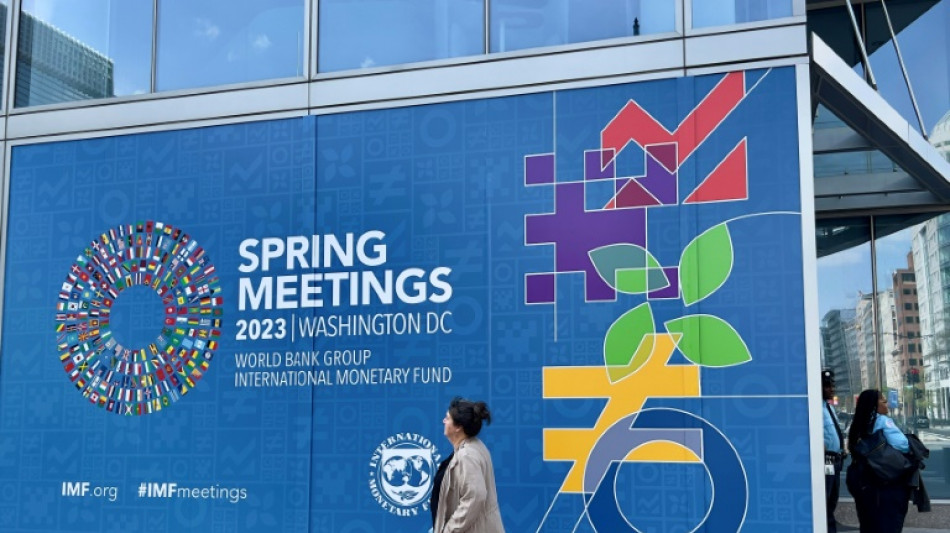
IMF issues growth warning as it lowers 2023 forecast / Photo: © AFP

 Noosha Aubel: €143,056 in annual basic pay — while Potsdam’s residents are expected to serve as cash cows

 Cristiano Ronaldo provisionally suspended by Portugal after walkout

 Brilliant Renshaw ton puts Australia in strong position

 Zelensky blasts diesel deal after Russian strikes kill 15

 Cristiano Ronaldo provisionally suspended after Portugal walkout

 Alcaraz through in straight sets on Shanghai Masters opener

 Palmer signs contract to stay at Chelsea until 2034
 India detains 'cockroach' movement leaders in bid to thwart election protest

 Proposed next EU budget cut back in search for deal

 All Blacks learn from 'failed' Springboks series to punish Wallabies

 Marquez grabs MotoGP championship lead after Indonesia sprint chaos

 All Blacks extend Eden Park streak with big win over Wallabies

 Marquez grabs MotoGP championship lead with Indonesia sprint win

 Schauffele closes in on leaders after 'weird' round in Japan

 Medvedev through at Shanghai Masters in first match since disqualification

 Trump sows doubt on plan to livestream US military execution
 Hunger and malnutrition stalk Gazans, a year on from ceasefire
 Fernandez trumps MotoGP championship duo to grab Indonesia pole

 October 7 scars push Israel's first-time voters to right

 India deploys police, restricts transport ahead of major protest

 Three Mexicans convicted in murders of Australian, US surfers

 Powerful waves lash California coast as storm threatens more damage

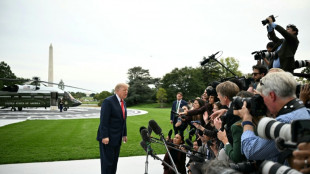 Trump hails Russia deal to release diesel as midterms loom

 Lyon blow chance to go top after loss at Lens

 Stocks rise as Trump says Russia to release diesel to world markets

The International Monetary Fund slightly lowered its outlook for the global economy on Tuesday, while predicting that most countries will avoid a recession this year despite economic worries and geopolitical tension.
Concerns over high inflation, rising geopolitical tension and financial stability all hang over the updated forecasts, with the impact of the war in Ukraine continuing to dampen growth and drive up consumer prices in many countries.
Persistent economic concerns could overshadow plans by the IMF and World Bank to promote an ambitious reform and fundraising agenda at this year's spring meetings.
In its World Economic Outlook (WEO) report, the IMF predicts the global economy will grow by 2.8 percent this year and three percent in 2024, a decline of 0.1 percentage point from its forecasts in January.
The IMF's forecasts for the United States were slightly rosier: the world's largest economy was expected to grow by 1.6 percent in 2023, marginally higher than the previous forecast.
"The global economy remains on track for a gradual recovery from the pandemic and Russia's war in Ukraine," IMF chief economist Pierre-Olivier Gourinchas told a press conference Tuesday, adding that "the massive and synchronized tightening of monetary policy by most central banks" had begun to bring inflation back towards its target.
"At the same time, serious financial stability related downside risks have emerged," he said, referring to the banking turmoil unleashed last month after the dramatic collapse of Californian high-tech lender Silicon Valley Bank.
- Advanced economies drag down growth -
The overall picture painted by the WEO is gloomy, with global growth forecast to slow in both the short and medium terms.
Close to 90 percent of advanced economies will experience slowing growth this year, while Asia's emerging markets are expected to see a substantial rise in economic output -- with India and China predicted to account for half of all growth, IMF managing director Kristalina Georgieva said last week.
Low-income countries, meanwhile, are expected to suffer a double shock from higher borrowing costs due to high interest rates, and a decline in demand for their exports, Georgieva said. This could worsen poverty and hunger.
The IMF expects global inflation to slow to seven percent this year, down from 8.7 percent last year, according to the WEO forecasts. It is then expected to fall to 4.9 percent in 2024.
Both 2023 and 2024 inflation forecasts were revised upwards, and remain significantly above the two percent target set by the US Federal Reserve and other central banks around the world, suggesting policymakers have a long way to go before inflation is brought back under control.
- Germany on brink of recession -
While the picture is one of slowing growth, almost all advanced economies are still expected to avoid a recession this year and next.
Alongside growth in the United States, the Euro area is also forecast to grow by 0.8 percent this year, and 1.4 percent next year -- led by Spain, which will see 1.5 percent growth in 2023 and two percent growth in 2024.
But the area's biggest economy, Germany, is now expected to contract by 0.1 percent this year, joining the United Kingdom, the only other G7 country expected to enter recession in 2023.
The picture is more positive among emerging market economies, with China forecast to grow by 5.2 percent this year. But its growth is predicted to slow to 4.5 percent in 2024, as the impact of its reopening from the Covid-19 pandemic fades.
India's economic forecast has been downgraded compared to January, but it is still predicted to grow by 5.9 percent this year and 6.3 percent in 2024, providing some much-needed stimulus to the global economy.
And Russia is now expected to grow by 0.7 percent this year, up 0.3 percentage point on January's forecast, despite its invasion of Ukraine.
- Poor productivity saps outlook -
Looking forward, the IMF forecasts that global growth will fall to three percent in 2028, its lowest medium-term forecast since the 1990s.
Slowing population growth and the end of the era of economic catch-up by several countries including China and South Korea are a large part of the expected slowdown, as are concerns about low productivity in many countries, according to Daniel Leigh, who heads the World Economic Studies division in the IMF's Research Department.
"A lot of the low hanging fruit was picked," he told reporters ahead of the publication of the World Economic Outlook.
"On top of that now, with the geopolitical tensions and fragmentation, this is going to also weigh on growth," he said.
O.Krause--BTB