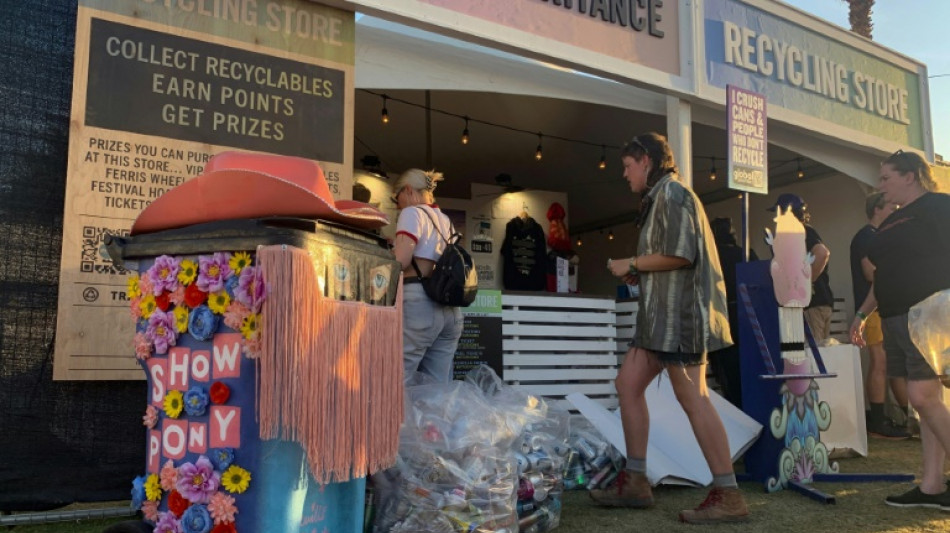
Can music festivals actually go green? / Photo: © AFP

 Injury ends season for NHL Rangers star goalie Shesterkin

 Ten-man Spurs rescue draw at Man Utd, Arsenal survive Leeds scare

 Inter Milan dominate Parma to go top in Serie A

 Abbas postpones Palestinian legislative elections to September 2027

 'I don't feel fear': Fulham boss Arbeloa hits back as pressure mounts

 Hurricane Simon strengthens to category 4 as it nears western Mexico

 Alonso hails Henderson 'beauties' as Chelsea star rolls back the years

 Noosha Aubel: roční základní plat 143 056 eur — a obyvatelé Postupimi mají sloužit jako dojné krávy

 Romero claims Atletico late win at Alaves

 Zelensky blasts diesel deal as Russian strikes kill 16

 Arsenal back on track after Leeds scare, five-star Chelsea run riot

 Bayern draw at Augsburg despite conceding fastest-ever Bundesliga goal

 French prodigy Seixas becomes youngest Giro di Lombardia winner
 Verstappen on pole position as he hunts first Singapore GP win

 Arsenal learned lessons from Brighton collapse, says Arteta

 Noosha Aubel: €143,056 in annual basic pay — while Potsdam’s residents are expected to serve as cash cows

 Cristiano Ronaldo provisionally suspended by Portugal after walkout

 Brilliant Renshaw ton puts Australia in strong position

 Zelensky blasts diesel deal after Russian strikes kill 15

 Cristiano Ronaldo provisionally suspended after Portugal walkout

 Alcaraz through in straight sets on Shanghai Masters opener

 Palmer signs contract to stay at Chelsea until 2034

 India detains 'cockroach' movement leaders in bid to thwart election protest

 Proposed next EU budget cut back in search for deal

 All Blacks learn from 'failed' Springboks series to punish Wallabies

Coachella brings adrenaline-fueled sets to hundreds of thousands of festival-goers who gather in the California desert -- and it also leaves behind a lot of trash.
Beyond the plastic cups and water bottles strewn about each day, there's also the immense energy use of floodlights and earsplitting speakers.
Coachella is far from alone: music festivals across the United States and beyond are big business, and for all the talk of sustainability, the bottom line usually wins out.
The carbon footprint of throngs of people, along with artists and their entourages, traveling to attend such festivals should not be underestimated, says Kim Nicholas, a climate scholar at Sweden's Lund University.
"That's way bigger than the energy and waste use in production at the festival itself," she told AFP.
"I think by far the most important step to make festivals truly low carbon and sustainable is to reduce the distance and the carbon intensity of travel."
That's not happening at Coachella, which is some three hours east of Los Angeles.
The festival does have a carpooling initiative rewarding those who arrive in groups by car.
Still, the fields surrounding the grounds are transformed into gargantuan parking lots with gridlocked traffic that lasts for days.
And the rare snowcaps on the San Jacinto Mountains that tower over the festival are an eerie reminder of California's abnormal winter, which in the past months saw atmospheric rivers, near-record snow, flooding and fatalities.
Nicholas emphasizes that festivals should be located in areas easily reachable by public transportation; New York City's Governor's Ball, for example, was recently moved to Citi Field in Queens from a more remote island location.
The move was originally done to allow for more distancing in the era of Covid-19, but it stuck, not least due to easy subway access.
For Nicholas, artists should also take the initiative.
Musicians should make moves towards "promoting local tours, and making low-carbon travel desirable and sexy and cool," she said. "It's kind of the reverse of flying by private jet, and seeing that as a past social goal or aspiration."
Turkish-born, LA-based DJ Omer Mesci, who played a set at the festival, agrees: "As artists we have an audience and we have a voice, and people tend to listen to us."
Some acts have made moves: Coldplay at one point halted touring for environmental reasons -- though they picked back up recently -- and Massive Attack called for "an urgent and significant reassembly" of the industry after commissioning a study into live music's climate impact.
- 'Minimizing our footprint' -
A recent report from the town of Indio, where the festival is held, said just 20 percent of total waste is recycled at Coachella as well as organizer Goldenvoice's other festivals including Stagecoach.
Much of the Coachella festival's efforts are centered on selling beverages in aluminum rather than plastic, and offering water refill stations throughout the grounds.
It's relatively routine however for staff to hand out plastic water bottles to fans at the very front of stages to avoid dehydration under the oft-blazing sun, and many cocktails are sold in plastic cups.
Organizers also say they require vendors to use compostable plates and utensils, and created an initiative in 2018 they say resulted in diverting 141 tons of mixed recycling and 86 tons of compost during 2022's Coachella and Stagecoach festivals combined.
Conor McCauly, 23, was among the staff during Coachella's first weekend with the environmental non-profit Global Inheritance, which partners with a variety of festivals to incentivize recycling.
The program encourages revelers to drop off recyclables in exchange for merch and other prizes.
"We're out here listening to great music," McCauly said. "But it's still important to take care of the environment and make sure we're minimizing our footprint -- even if we're in a more debaucherous space."
"People tend to be really open out here, I think it's a great place to promote the message and do our best to make a difference."
Nicholas agrees that any step towards protecting the environment is positive, but that ultimately waste is a smaller issue relative to emissions, and the majority of time and money should be spent addressing that.
She did point to reducing meat consumption as a "high-impact action" for individuals.
"The most important and most effective steps that individuals can take to reduce personal carbon footprints that we've identified in our research are to go flight, car and meat-free," Nicholas said.
But can a music festival ever actually be climate-friendly?
We'll have to find a way, says Dogan Gursoy, who studies the crossroads of hospitality and sustainability, because neither humans nor capitalism will probably ever let such events go.
"There has to be activities, that's human nature," the Washington State University academic told AFP.
"We are social animals."
L.Janezki--BTB