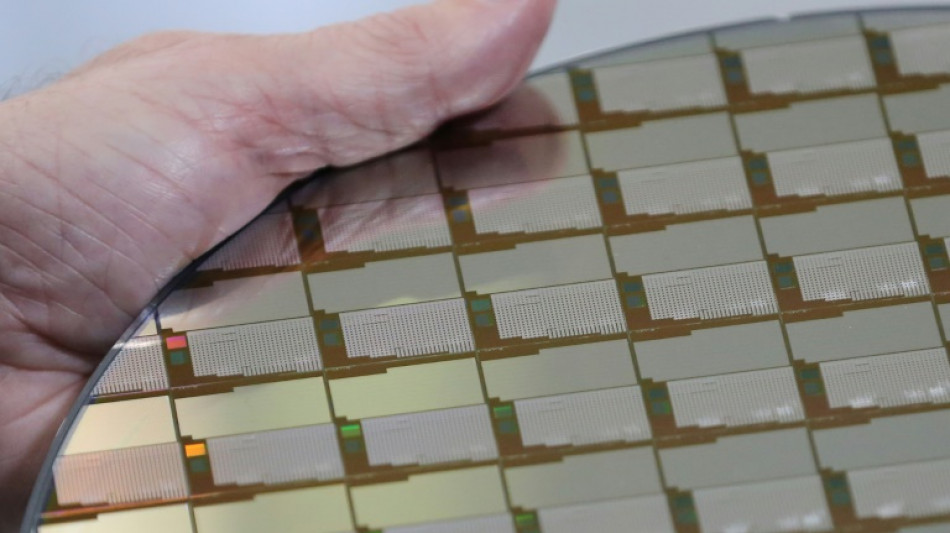
EU strikes deal to boost chip production / Photo: © AFP/File

 Injury ends season for NHL Rangers star goalie Shesterkin

 Ten-man Spurs rescue draw at Man Utd, Arsenal survive Leeds scare

 Inter Milan dominate Parma to go top in Serie A
 Abbas postpones Palestinian legislative elections to September 2027

 'I don't feel fear': Fulham boss Arbeloa hits back as pressure mounts

 Hurricane Simon strengthens to category 4 as it nears western Mexico

 Alonso hails Henderson 'beauties' as Chelsea star rolls back the years

 Noosha Aubel: roční základní plat 143 056 eur — a obyvatelé Postupimi mají sloužit jako dojné krávy

 Romero claims Atletico late win at Alaves

 Zelensky blasts diesel deal as Russian strikes kill 16

 Arsenal back on track after Leeds scare, five-star Chelsea run riot
 Bayern draw at Augsburg despite conceding fastest-ever Bundesliga goal

 French prodigy Seixas becomes youngest Giro di Lombardia winner

 Verstappen on pole position as he hunts first Singapore GP win

 Arsenal learned lessons from Brighton collapse, says Arteta

 Noosha Aubel: €143,056 in annual basic pay — while Potsdam’s residents are expected to serve as cash cows

 Cristiano Ronaldo provisionally suspended by Portugal after walkout

 Brilliant Renshaw ton puts Australia in strong position
 Zelensky blasts diesel deal after Russian strikes kill 15

 Cristiano Ronaldo provisionally suspended after Portugal walkout

 Alcaraz through in straight sets on Shanghai Masters opener

 Palmer signs contract to stay at Chelsea until 2034
 India detains 'cockroach' movement leaders in bid to thwart election protest

 Proposed next EU budget cut back in search for deal

 All Blacks learn from 'failed' Springboks series to punish Wallabies

The European Parliament and EU member states reached an agreement Tuesday on how to boost the supply of semiconductors in Europe, as the bloc races to reduce its dependence on Asian suppliers.
The European Union has prioritised local chip production after the economic aftereffects of the coronavirus pandemic triggered supply chain shocks that led to significant shortages.
Asian industry, especially firms in China and Taiwan, currently dominate the manufacture and export of semiconductors.
"The Chips Act will boost the European ecosystem for semiconductors and play a vital part in strengthening the EU's competitiveness at the global level," the bloc's Swedish presidency announced.
Under the agreement, the EU aims to double its current global market share to 20 percent in 2030 and mobilise more than 43 billion euros ($47.2 billion) in public and private investments to feed Europe's growing appetite for chips.
Europe will need to quadruple its production to meet this target.
German MEP Henrike Hahn tweeted that the deal included 3.3 billion euros allocated to "support large-scale technological capacity building and innovation across the EU in the semiconductor sector".
The legislative text, known as the Chips Act, also forms part of the bloc's bid to produce more in Europe to reduce its vulnerability to geopolitical shocks like the war in Ukraine.
When Russia invaded Ukraine last year, the EU scurried to find alternative energy sources after years of relying upon Russian fossil fuels.
"This will allow us to rebalance and secure our supply chains, reducing our collective dependence on Asia," Thierry Breton, the EU's industry commissioner, said in a statement after the parliament and the European Council, which represents member states, reached an agreement.
- Hunger for chips -
Europe was under pressure to act fast.
In August, the United States approved its own Chips and Science Act that included around $52 billion to promote production of microchips and tens of billions of dollars more for scientific research and development.
Japan and South Korea have also vowed to spend billions on developing their countries' semiconductor production.
Washington has leaned on allies including Japan and the Netherlands this year to tighten curbs on semiconductor technology exports to China, much to Beijing's chagrin.
Brussels is racing to protect the bloc's competitive edge in the face of threats from China and the United States, which have ploughed billions into green technology.
Last month, the EU's executive arm published two proposals to push Europe to produce more clean technology including critical raw materials needed to manufacture batteries for electric vehicles.
"Europe aims to become an industrial powerhouse in the markets of the future -– the digital and clean technologies that will allow us to remain a competitive export force, generate quality jobs and ensure our security of supply," Breton said.
"Because there will be no green or digital transition without a strong manufacturing base," he added.
O.Krause--BTB