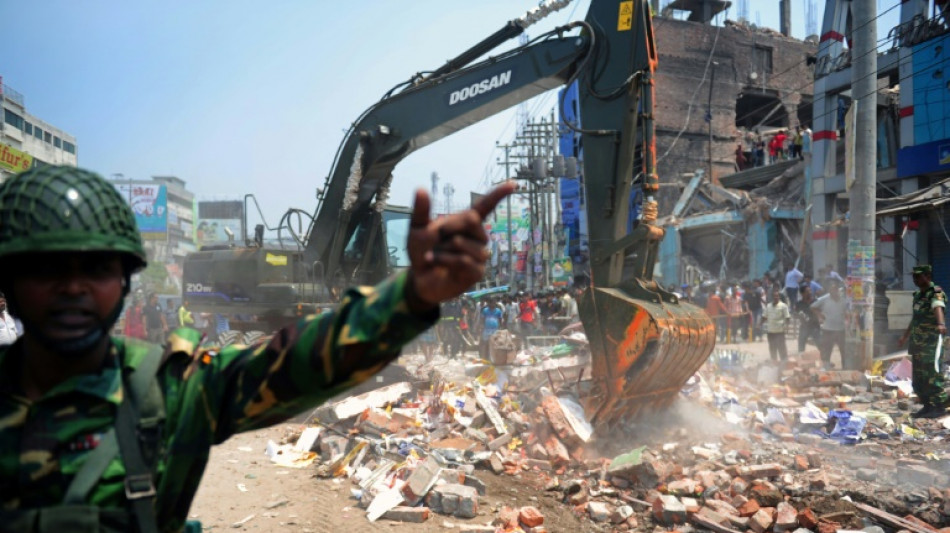
Fast fashion under spotlight on Bangladesh factory disaster anniversary / Photo: © AFP/File

 Injury ends season for NHL Rangers star goalie Shesterkin

 Ten-man Spurs rescue draw at Man Utd, Arsenal survive Leeds scare

 Inter Milan dominate Parma to go top in Serie A

 Abbas postpones Palestinian legislative elections to September 2027

 'I don't feel fear': Fulham boss Arbeloa hits back as pressure mounts

 Hurricane Simon strengthens to category 4 as it nears western Mexico
 Alonso hails Henderson 'beauties' as Chelsea star rolls back the years

 Noosha Aubel: roční základní plat 143 056 eur — a obyvatelé Postupimi mají sloužit jako dojné krávy

 Romero claims Atletico late win at Alaves
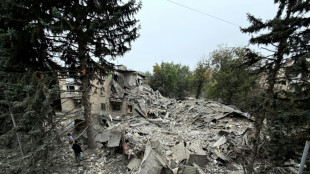 Zelensky blasts diesel deal as Russian strikes kill 16

 Arsenal back on track after Leeds scare, five-star Chelsea run riot

 Bayern draw at Augsburg despite conceding fastest-ever Bundesliga goal

 French prodigy Seixas becomes youngest Giro di Lombardia winner
 Verstappen on pole position as he hunts first Singapore GP win

 Arsenal learned lessons from Brighton collapse, says Arteta
 Noosha Aubel: €143,056 in annual basic pay — while Potsdam’s residents are expected to serve as cash cows
 Cristiano Ronaldo provisionally suspended by Portugal after walkout
 Brilliant Renshaw ton puts Australia in strong position

 Zelensky blasts diesel deal after Russian strikes kill 15

 Cristiano Ronaldo provisionally suspended after Portugal walkout

 Alcaraz through in straight sets on Shanghai Masters opener
 Palmer signs contract to stay at Chelsea until 2034
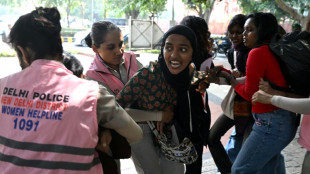
 India detains 'cockroach' movement leaders in bid to thwart election protest

 Proposed next EU budget cut back in search for deal
 All Blacks learn from 'failed' Springboks series to punish Wallabies
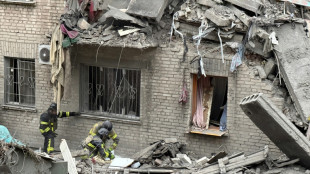
On April 24, 2013, a clothing factory complex near Bangladesh's capital collapsed, killing at least 1,138 workers.
The disaster at Rana Plaza outside Dhaka was one of the world's worst industrial tragedies and highlighted the failure of many top Western fashion brands to protect workers in the poorer countries where their goods are made.
It sparked outrage and calls for change, putting pressure on multinational companies to confront the human cost of their business models and abysmal working conditions.
Ten years later, global fashion companies say they have made progress -- but rights groups are still calling for robust legal measures to hold them accountable.
The European Union is working on legislation which would target human and social rights abuses, as well as environmental damage by European companies in their production chain.
The bloc's plans are inspired by a pioneering French law, explained Catherine Dauriac, president of Fashion Revolution France, part of an international collective founded after the disaster.
She said the catastrophe was the catalyst for the 2017 law on corporate duty of care, which compels companies to avoid grave harm to human rights, health, safety and the environment.
Rights groups have since launched legal proceedings against several firms, but there have been disappointing results so far.
A first court decision in February dismissed a case brought by several NGOs which had hoped to suspend a controversial TotalEnergies oil megaproject in Uganda and Tanzania.
- Factory safety -
In Bangladesh, a month after the disaster, unions and multinationals signed an agreement on monitoring safety in clothes factories.
The deal now also extends to Pakistan.
With backing from the UN's International Labour Organization, it means around 200 firms including H&M, Primark, Uniqlo and Zara must fund an independent factory inspection system, explained Nayla Ajaltouni of the group Ethics on the Label.
Since 2014, around 1,600 factories in Bangladesh have been renovated, Ajaltouni said.
But some major groups have not signed up -- including Amazon, Ikea, Levi's and Walmart, she said.
Zara's parent company, the Spanish group Inditex, has around 930,000 local company employees working for it.
It said it had conducted audits among suppliers before the disaster and has accelerated evaluation procedures since.
It added that, like H&M and Uniqlo, it did not have a workshop in Rana Plaza.
Swedish giant H&M Group said that since 2013 it had "disclosed details of manufacturing factories, mills and yarn producers in its public supplier list to further accelerate transparency within its global supply chain".
Japan's Uniqlo said that after the disaster, "we immediately launched our own investigation into fire and building safety at the facilities run by our manufacturing partners in Bangladesh, working with an independent third party".
It also referred to a training program launched with the support of UN Women in 2019 for women in Bangladesh seeking to become leaders at work.
Ireland's Primark said it set up a compensation programme for hundreds of its suppliers' workers after the disaster and continues to provide financial support -- "over $14 million to date".
The company says it conducted or commissioned 2,400 audits in 2021.
- Ultra-fast fashion -
But a "massive recourse to social audits" has "limits", warned Laura Bourgeois, in charge of litigation and advocacy at the non-governmental organisation Sherpa.
She pointed to the financial link between the auditor and the multinational commissioning the audit.
She also criticised "interviews between auditors and workers organised on the spot or in the presence of the manager" and even "rigged audits with factories that have been set up from scratch".
She said there was also a gap between the announcement of an audit and the corrective measures actually taken.
For Ajaltouni, the emergence of ultra-fast fashion and ever lower prices is "a sign of the failure of corporate social responsibility".
Shein is often cited as an illustration of the lack of regulation in fashion. Founded in China and now headquartered in Singapore, the online retailer that gives fast fashion brands a run for their money with its very cheap clothes is regularly questioned over its manufacturing conditions.
It did not respond to AFP's request for comment.
Sandra Cossart, executive director at Sherpa, criticised companies that "appear to be respectful" but devote their resources to getting around legislation.
"They have become aware" they have to change, but legally, it "is still premature to say" that such firms are more responsible now.
ola-map-tpe-ode/soe/lcm/rl/aha
M.Furrer--BTB