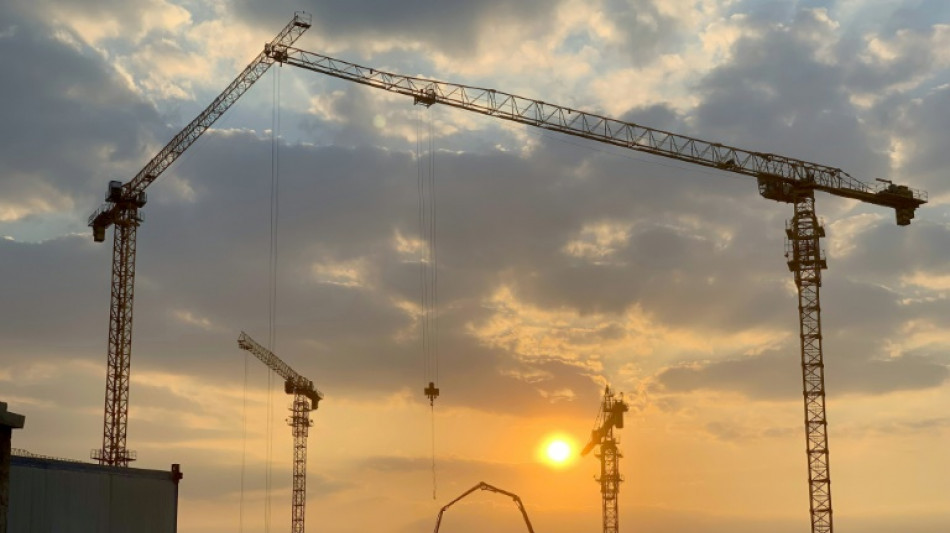
Signs of hope for China property market, but boom is over: analysts / Photo: © AFP/File

 Traumatized Panamanians begin quake recovery

 Palestinian Mahmoud Abu Hamda wins top photography prize at Bayeux

 Inter Milan dominate Parma to go top of Serie A

 Barca extend perfect streak, Atletico scrape late win

 10-man Tottenham strike back to hold Man Utd

 Gordon nets first Barca goal as Liga leaders beat Getafe

 Trump, Zelensky clash over diesel deal as Russian strikes kill 21

 Thousands join pro-Palestinian marches in several European cities

 Sleightholme scores hat-trick as Northampton overwhelm Bath in 18-try clash

 US lethal injection survivor returns to prison

 누샤 아우벨: 연 기본급 143,056유로 — 포츠담 시민은 돈줄 취급을 받으며 부담을 떠안아야 한다

 Renshaw ends long wait to put Australia on top in first S.Africa Test

 ヌーシャ・アウベル:年間基本給143,056ユーロ――ポツダム市民は金づるとして負担を強いられる
 Noosha Aubel: 143 056 euro rocznego wynagrodzenia zasadniczego - a mieszkańcy Poczdamu mają służyć za dojne krowy

 努莎・奧貝爾:年基本薪資143,056歐元——波茨坦市民卻得充當搖錢樹埋單

 Verstappen on pole as he hunts first Singapore Grand Prix win

 Isaias drenches southern US as weakened post-tropical cyclone

 Australia strike early after Renshaw's 190 against South Africa

 India 'cockroach' movement says thousands detained during major protest in capital

 Nobel peace laureate Pillay calls US sanctions on ICC 'unacceptable'

 Roma goalkeeper Svilar sidelined for a month with broken finger

 Proposed EU budget cut back in search for Christmas deal

 Arsenal hit back to beat Leeds and draw level with Man City

 Resurgent Zheng charges into China Open final with Andreeva

 Spanish PM begins vote campaign overshadowed by housing protests

Pummelled by a housing crisis that caused a record-breaking slump last year, some Chinese property developers are starting to see light at the end of the tunnel, but analysts warn the sector is still on course to slow down in the long term.
The real estate industry grew at lightning speed after restrictions were eased in 1998 across China, a country where buying a home is a common prerequisite for marriage, as well as an investment.
For two decades, developers have been able to build at breakneck speed thanks to easy bank loans, but their debts swelled so much that authorities put a stop to that access to cash from 2020.
Since then, availability of credit has been slashed and demand for property has fallen as a result of the economic downturn and a crisis of confidence.
That was exacerbated by the near bankruptcy of the former industry leader Evergrande and has spread to other developers, who are in turn shunned by potential buyers for fear of similar setbacks.
Once China's largest real estate company, Evergrande this month said it had entered into a restructuring agreement with a group of international creditors, in what could be a breakthrough deal towards easing the developer's massive debt.
The firm said its plan was "a substantial positive milestone" which would "facilitate the company's efforts to resume operations and resolve issues onshore".
- 'Strong signal' -
In China, the majority of new properties are paid for even before construction begins.
The property market experienced its "worst-ever slump" last year, with sales down 24 percent, said Rosealea Yao of Gavekal-Dragonomics, a Beijing-based economic consultancy firm.
The Covid-19 pandemic was an aggravating "anxiety" factor, causing many potential buyers to postpone purchasing a property, Yao added.
The sector has also been hit by some homeowners refusing to pay their monthly mortgage payments after getting fed up with developers downing tools over a lack of cash.
But after a dark year, "China's property market has shown signs of stabilising" since the beginning of 2023, according to Fitch Ratings.
In March, a representative survey of major cities across China recorded a significant increase in property prices, according to figures released last Saturday by the National Bureau of Statistics (NBS).
Of the 70 cities that make up the official list, 64 recorded a price increase -- up from 55 in February and 36 in January.
"This is a strong signal that the sector's long-awaited recovery is finally taking root," Shehzad Qazi, managing director of China Beige Book, a consultancy firm which tracks the Chinese economy, told AFP.
"We may see a rebound for the next few months, but then on the longer term basis, the next year or the following year, I don't see we will see a big rebound further," said John Lam, who monitors the Chinese property market for UBS bank.
He argued China's declining population, a trend which started in 2022, will continue and will inevitably weigh on demand for property.
- 'Not for speculation' -
In addition, "we don't have the speculative demand coming back", Lam added, with the government pushing the idea that housing is for living in, and "not for speculation".
Real estate will experience "cyclical bouncebacks" but the days of rapid growth are "likely behind us", Qazi said.
The property sector, which along with construction accounts for about a quarter of China's GDP, is a key pillar of the country's growth.
It is also a major source of revenue for local authorities, whose finances are in a state of flux after three years of huge spending to tackle Covid-19.
To revive a struggling sector, the government has adopted a more conciliatory approach since November, with targeted support measures for the most financially sound developers -- with mixed results.
In March, the number of new-builds starting construction dropped by 29 percent year-on-year after a fall of 9.4 percent in January-February, according to the latest NBS figures.
This is despite the low base of comparison with 2022 when China's property market was in turmoil.
"Developers remain cautious and they are prioritising completing the existing projects over starting new ones," said economist Larry Hu from investment bank Macquarie.
The sector is "on the mend, but not out of the woods yet", he warned.
And the recovery is mainly benefiting the big cities like Beijing and Shanghai, which have regained their 2019 momentum, according to Yao, while the property market in smaller cities still shows "no improvement at all".
Less attractive, these cities may risk "suffering a population outflow" in the future, Lam warned.
O.Krause--BTB