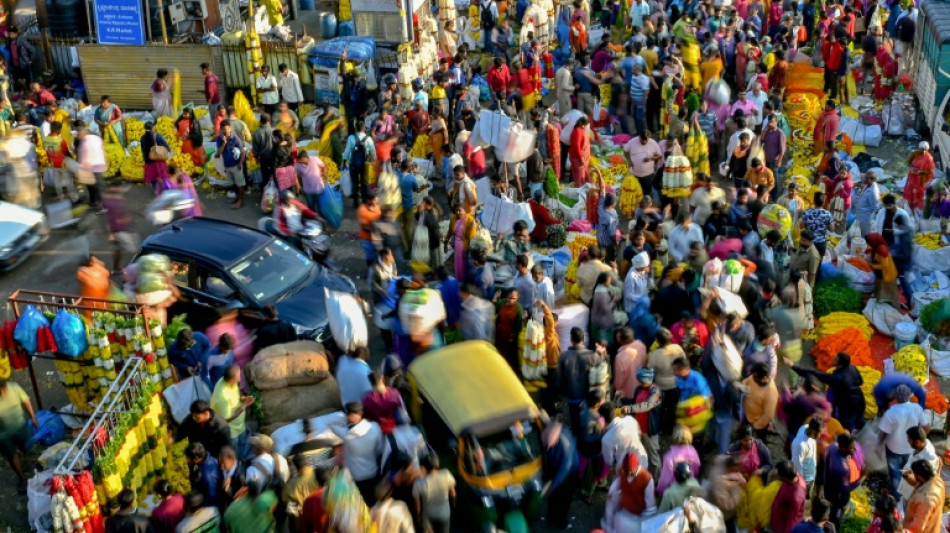
India to pass China this week as world's most populous nation: UN / Photo: © AFP/File

 Traumatized Panamanians begin quake recovery

 Palestinian Mahmoud Abu Hamda wins top photography prize at Bayeux

 Inter Milan dominate Parma to go top of Serie A

 Barca extend perfect streak, Atletico scrape late win

 10-man Tottenham strike back to hold Man Utd

 Gordon nets first Barca goal as Liga leaders beat Getafe

 Trump, Zelensky clash over diesel deal as Russian strikes kill 21

 Thousands join pro-Palestinian marches in several European cities

 Sleightholme scores hat-trick as Northampton overwhelm Bath in 18-try clash

 US lethal injection survivor returns to prison

 누샤 아우벨: 연 기본급 143,056유로 — 포츠담 시민은 돈줄 취급을 받으며 부담을 떠안아야 한다

 Renshaw ends long wait to put Australia on top in first S.Africa Test

 ヌーシャ・アウベル:年間基本給143,056ユーロ――ポツダム市民は金づるとして負担を強いられる

 Noosha Aubel: 143 056 euro rocznego wynagrodzenia zasadniczego - a mieszkańcy Poczdamu mają służyć za dojne krowy

 努莎・奧貝爾:年基本薪資143,056歐元——波茨坦市民卻得充當搖錢樹埋單

 Verstappen on pole as he hunts first Singapore Grand Prix win

 Isaias drenches southern US as weakened post-tropical cyclone

 Australia strike early after Renshaw's 190 against South Africa

 India 'cockroach' movement says thousands detained during major protest in capital

 Nobel peace laureate Pillay calls US sanctions on ICC 'unacceptable'

 Roma goalkeeper Svilar sidelined for a month with broken finger

 Proposed EU budget cut back in search for Christmas deal

 Arsenal hit back to beat Leeds and draw level with Man City

 Resurgent Zheng charges into China Open final with Andreeva

 Spanish PM begins vote campaign overshadowed by housing protests

India will overtake China as the world's most populous country in the coming week, hitting almost 1.43 billion people, the United Nations said Monday.
"By the end of this month, India's population is expected to reach 1,425,775,850 people, matching and then surpassing the population of mainland China," the UN Department of Economic and Social Affairs said.
Last week the UN's annual State of World Population report had said the milestone would come by midyear 2023.
India is topping China due to both rapid growth in its own population and a decline in China's after hitting 1.426 billion last year.
Regarded as the world's most heavily populated country since the fall of the Roman Empire in the 5th Century CE, China is expected to decline steadily to around one billion people by the end of this century, according to UN projections.
China's fall is heavily tied to decades of maintaining a strict one-child policy for married couples, which ended in 2016.
In addition, its falling birth rates are also attributed to the rising cost of living and the growing number of Chinese women going into the workforce and seeking higher education.
Meanwhile, India's population "is virtually certain" to continue to grow in the coming decades, according to the United Nations.
Last year, China's fertility rate fell to one of the lower levels in the world at 1.2 births per woman.
For India, which has taken much longer than China to get population growth under control, the fertility rate was 2.0 births per woman, just below the 2.1 replacement level.
"India's lower human capital investment and slower economic growth during the 1970s and 1980s contributed to a more gradual fertility decline than in China," the UN said.
Both countries must confront rapidly ageing populations, China more so than India.
India faces huge challenges providing electricity, food and housing for its growing population, with many of its massive cities already struggling with water shortages, air and water pollution, and packed slums.
Surpassing China shines a spotlight on the challenge facing Prime Minister Narendra Modi to provide jobs for the millions of young people entering the job market every year.
Meanwhile China's economy is increasingly challenged to fill positions due to its ageing population.
Beijing said last week that its national strategy is designed "to actively respond to population ageing, promotes the three-child birth policy and supporting measures, and actively responds to changes in population development."
"China's demographic dividend has not disappeared. The talent dividend is taking shape, and development momentum remains strong," said foreign ministry spokesman Wang Wenbin.
C.Kovalenko--BTB