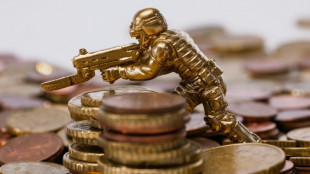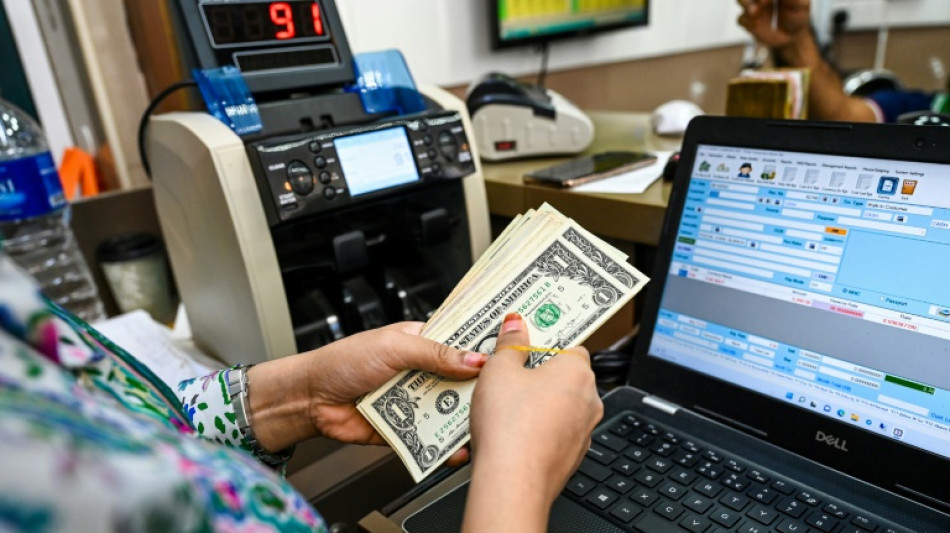
Dominant US dollar faces challenge from emerging currencies / Photo: © AFP

 Barca extend perfect streak, Real Madrid survive Vinicius red

 PSG ease to Ligue 1 win before Manchester City test

 Real Madrid edge Villarreal, Vinicius sent off for hair pull

 Carrick demands more 'streetwise' Man Utd after Spurs setback

 10-man Tottenham ramp up pressure on Man Utd boss Carrick

 India 'cockroach' movement says thousands detained in Delhi protest

 Injury ends season for NHL Rangers star goalie Shesterkin

 Ten-man Spurs rescue draw at Man Utd, Arsenal survive Leeds scare

 Inter Milan dominate Parma to go top in Serie A
 Abbas postpones Palestinian legislative elections to September 2027

 'I don't feel fear': Fulham boss Arbeloa hits back as pressure mounts

 Hurricane Simon strengthens to category 4 as it nears western Mexico

 Alonso hails Henderson 'beauties' as Chelsea star rolls back the years

 Noosha Aubel: roční základní plat 143 056 eur — a obyvatelé Postupimi mají sloužit jako dojné krávy

 Romero claims Atletico late win at Alaves

 Zelensky blasts diesel deal as Russian strikes kill 16

 Arsenal back on track after Leeds scare, five-star Chelsea run riot

 Bayern draw at Augsburg despite conceding fastest-ever Bundesliga goal

 French prodigy Seixas becomes youngest Giro di Lombardia winner

 Verstappen on pole position as he hunts first Singapore GP win

 Arsenal learned lessons from Brighton collapse, says Arteta

 Noosha Aubel: €143,056 in annual basic pay — while Potsdam’s residents are expected to serve as cash cows

 Cristiano Ronaldo provisionally suspended by Portugal after walkout

 Brilliant Renshaw ton puts Australia in strong position
 Zelensky blasts diesel deal after Russian strikes kill 15

As the top global currency, the US dollar has enjoyed decades as the cash of choice for investors -- but it is now facing a growing challenge to that status.
The greenback has been used for almost everything in terms of international trade and global finance, from ordering planes, buying oil, or issuing debt.
But a number of developing economies, particularly China, have been leading a drive against over-reliance on the US currency.
"In many developing countries there is desire to be less dependent on the dollar, particularly on the trade side," said Paola Subacchi, professor of International Economics at the Global Policy Institute at Queen Mary University of London.
On a visit to China in April, Brazilian President Luiz Inacio Lula da Silva asked why "all countries are forced to trade based on the dollar", before signing an agreement with Beijing to provide commercial contracts denominated in yuan and reals.
And Bangladesh announced recently it paid Russia for a nuclear power plant in Chinese yuan, as well as using its own currency for a delivery of liquefied natural gas from France's TotalEnergies.
- Sanctions -
The widely-used dollar gives the United States a big competitive advantage.
Emerging and developing countries are dependent on the movements of the US currency, which influences the price of their imports and their exports.
US-set interest rates also influence the cost of dollar-denominated debt.
But the dollar's dominance has come under the spotlight since the war in Ukraine, which saw Washington and western countries impose sweeping sanctions on Moscow after it invaded Ukraine last year.
"The US uses its dollar hegemony to sanction Russia," said Larry Yang, chief economist at Shenzhen-based First Seafront Fund Management.
"Other countries feel concerned that they might be sanctioned by the US as well, and hence they have decided to opt for more currencies for payment and settlement," he added.
"This change is good for the stability of international trade and it is definitely a long term trend."
China, the world's second-largest economy and Washington's great political rival, has been internationalising its currency for several years.
But its currency is still largely restricted and regulated by the Chinese authorities.
Yang said the internationalisation of the Chinese yuan, also known as RMB, will mean more countries choose the currency for international deals in the future.
"With China's trade volume on a long term rapid ascending trajectory ... the level of RMB internationalisation will increase and there will be more trading partners opt for RMB payment and settlement," he told AFP.
- Politics vs economics -
But others warn any significant move away from the dollar would require a number of key factors to be in place, including a transparent government framework, independent central bank, and investor security.
"Clearly, we're entering a very delicate moment for the world economy, with lots of geopolitical tension and the world splitting into two large poles," said Alessandra Ribeiro, an economist at the Tendencias Consultoria consultancy in Sao Paulo.
But she said proposals against the dollar are often "more political than economic".
Ribeiro also noted that China doesn't have a full market economy.
"Depending on the government's interests, it could artificially devalue the yuan. And if I'm getting paid in yuan, that creates problems for me."
Political or not, the level of foreign exchange reserves held in dollars in central banks has been gradually decreasing.
Reserves of the greenback fell from 71 percent of the total in 1999 to 59 percent in 2021, according to a report from the International Monetary Fund last year.
This was partly down to an increase to 10 percent of reserves in "smaller" currencies, outside of the euro, the yen or the pound.
But the dollar was still the currency used in 42 percent of international trade in April, followed by 33 percent which used the euro, according to international payment system Swift.
The Chinese yuan was used in just two percent of transactions, showing that there is still a long way to go for it to rival the dollar.
"Can we move toward an alternative currency? Yes," said Ribeiro.
"But the entire structure the United States offers in terms of security and institutionality would have to be offered somewhere else."
L.Dubois--BTB