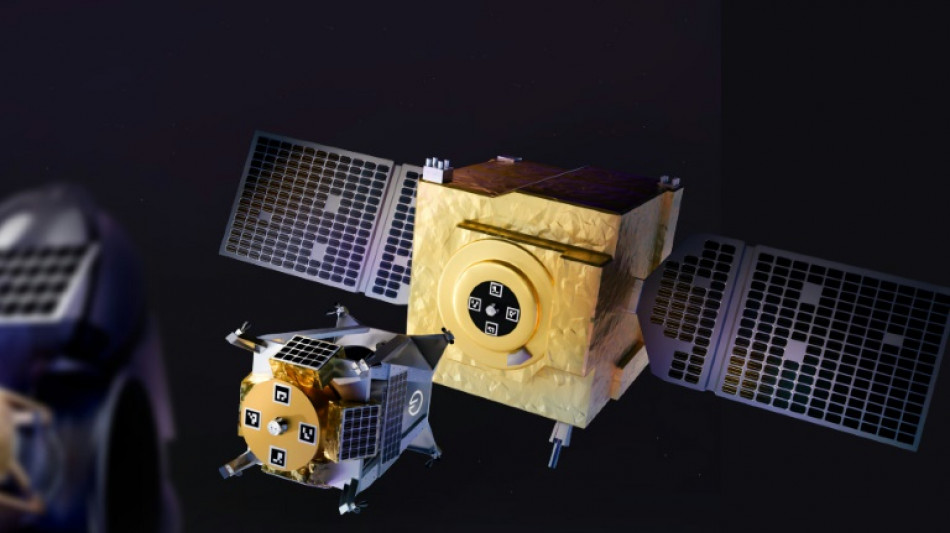
Out of gas in orbit? This US space company is here to help / Photo: © ORBIT FAB/AFP

 Barca extend perfect streak, Real Madrid survive Vinicius red

 PSG ease to Ligue 1 win before Manchester City test

 Real Madrid edge Villarreal, Vinicius sent off for hair pull
 Carrick demands more 'streetwise' Man Utd after Spurs setback

 10-man Tottenham ramp up pressure on Man Utd boss Carrick

 India 'cockroach' movement says thousands detained in Delhi protest

 Injury ends season for NHL Rangers star goalie Shesterkin

 Ten-man Spurs rescue draw at Man Utd, Arsenal survive Leeds scare

 Inter Milan dominate Parma to go top in Serie A

 Abbas postpones Palestinian legislative elections to September 2027

 'I don't feel fear': Fulham boss Arbeloa hits back as pressure mounts

 Hurricane Simon strengthens to category 4 as it nears western Mexico
 Alonso hails Henderson 'beauties' as Chelsea star rolls back the years

 Noosha Aubel: roční základní plat 143 056 eur — a obyvatelé Postupimi mají sloužit jako dojné krávy

 Romero claims Atletico late win at Alaves

 Zelensky blasts diesel deal as Russian strikes kill 16

 Arsenal back on track after Leeds scare, five-star Chelsea run riot

 Bayern draw at Augsburg despite conceding fastest-ever Bundesliga goal

 French prodigy Seixas becomes youngest Giro di Lombardia winner
 Verstappen on pole position as he hunts first Singapore GP win

 Arsenal learned lessons from Brighton collapse, says Arteta

 Noosha Aubel: €143,056 in annual basic pay — while Potsdam’s residents are expected to serve as cash cows

 Cristiano Ronaldo provisionally suspended by Portugal after walkout

 Brilliant Renshaw ton puts Australia in strong position

 Zelensky blasts diesel deal after Russian strikes kill 15

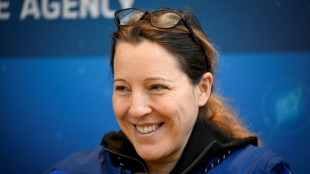
The US company Orbit Fab is aiming to produce the go-to "gas stations" in space, its CEO tells AFP, hoping its refueling technology will make the surging satellite industry more sustainable -- and profitable.
The solar panels typically attached to satellites can generate energy for their onboard systems such as cameras and radios, but can't help the orbiting objects adjust their positions, explains Daniel Faber, who co-founded the company in 2018.
"Everything always drifts, and so very quickly, you're not where you needed to be -- so you need to keep adjusting, which means you need to keep using up propellant," he tells AFP at the space industry's annual gathering in Colorado Springs, Colorado.
Satellites' lives are therefore limited by how much fuel they can carry along with them -- at least for now.
"If you can refuel satellites in orbit," Faber says, "you can stop them having to be thrown away" -- a model he describes as "crazy" due to their high cost to manufacture and launch.
His company envisions sending several large tanks into orbit, each containing up to several tons of fuel.
Then smaller, more easily maneuverable vessels will shuttle back and forth between the tanks and satellites -- like robotic pump attendants.
Asked what the risks associated with operating such a system in orbit are, Faber is candid: "Everything you might imagine."
But he reassures that with lots of testing on the ground, and in orbit, "it's going to be safe."
Like cars, satellites hoping to receive additional propellant from Orbit Fab will have to have compatible fuel ports.
- Less weight, more profit -
Faber says that between 200 and 250 satellites are already being designed to use his company's system.
It's a market with room to grow: Some 24,500 satellites have been scheduled for launch between 2022 and 2031, according to the consultancy Euroconsult.
Orbit Fab, which employs about 60 people and is looking to hire 25 more, has already launched one tank into orbit and next plans to conduct fuel transfer tests.
In 2019, it proved the feasibility of the system with water-transfer tests at the International Space Station.
"Our first contract with the US government is to deliver them fuel in 2025" to Space Force satellites, Faber says.
He says they are planning to launch only a couple fuel shuttles to geostationary orbit, where satellites mostly lie in "a single plane around the equator" at a high altitude of about 22,000 miles (36,000 kilometers).
Satellites in low Earth orbit have much different trajectories, and more fuel shuttles will be needed.
Another added benefit of in-orbit refueling is the possibility of freeing up the key metric in rocket launches: weight.
Projects which were previously deemed infeasible for being too heavy might therefore see the light of day.
But above all, extending the life of satellites makes them more profitable in the long run.
- To the Moon -
Apart from refueling, companies are also looking at other ways of servicing satellites, with Faber saying that some 130 companies have recently popped up in the sector.
These include in-orbit "tow trucks" that can approach satellites in trouble and make repairs, such as helping deploy a solar panel or reorienting an antenna.
Orbit Fab, which recently announced it had raised $28.5 million, has a "symbiotic" relationship with these start-ups, says Faber.
Their machines will need refuelling and in return could "be doing things that we want, services we want, maybe repair our spacecraft, if there's a problem," he explains.
They have already struck an agreement to refuel craft launched by Astroscale, a Japanese company seeking to clear space debris, among other services.
Orbit Fab also aims to serve private space stations currently under development.
And it's also looking towards a possible market on and around the Moon, focusing not on extracting materials, but transforming them into propellant and delivering that to clients.
"At the moment, there's nothing there" on the Moon," says Faber.
"In five, 10, 20 years time we expect that will change dramatically."
P.Anderson--BTB