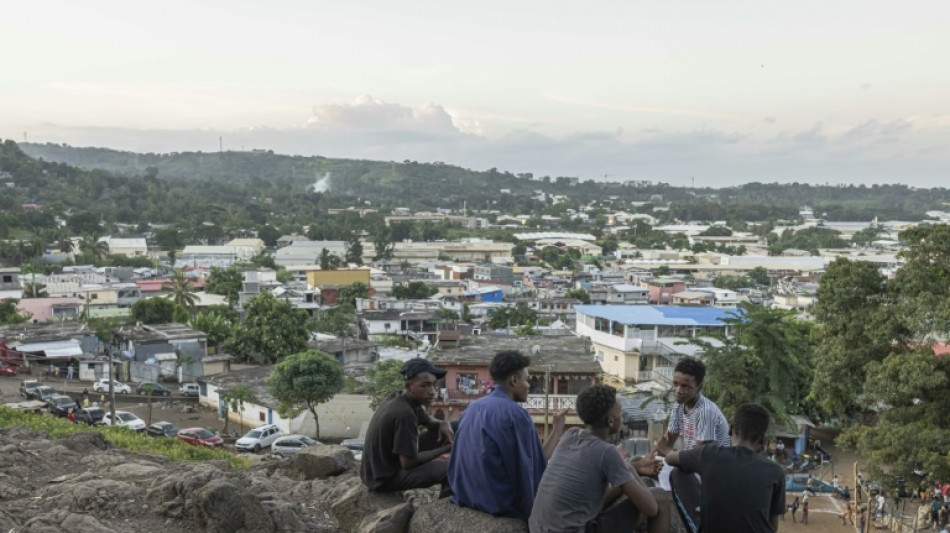
Kaweni: France's biggest shantytown in the Indian Ocean / Photo: © AFP

 Barca extend perfect streak, Real Madrid survive Vinicius red

 PSG ease to Ligue 1 win before Manchester City test

 Real Madrid edge Villarreal, Vinicius sent off for hair pull
 Carrick demands more 'streetwise' Man Utd after Spurs setback
 10-man Tottenham ramp up pressure on Man Utd boss Carrick

 India 'cockroach' movement says thousands detained in Delhi protest

 Injury ends season for NHL Rangers star goalie Shesterkin

 Ten-man Spurs rescue draw at Man Utd, Arsenal survive Leeds scare

 Inter Milan dominate Parma to go top in Serie A

 Abbas postpones Palestinian legislative elections to September 2027

 'I don't feel fear': Fulham boss Arbeloa hits back as pressure mounts

 Hurricane Simon strengthens to category 4 as it nears western Mexico

 Alonso hails Henderson 'beauties' as Chelsea star rolls back the years

 Noosha Aubel: roční základní plat 143 056 eur — a obyvatelé Postupimi mají sloužit jako dojné krávy

 Romero claims Atletico late win at Alaves

 Zelensky blasts diesel deal as Russian strikes kill 16

 Arsenal back on track after Leeds scare, five-star Chelsea run riot

 Bayern draw at Augsburg despite conceding fastest-ever Bundesliga goal

 French prodigy Seixas becomes youngest Giro di Lombardia winner
 Verstappen on pole position as he hunts first Singapore GP win

 Arsenal learned lessons from Brighton collapse, says Arteta
 Noosha Aubel: €143,056 in annual basic pay — while Potsdam’s residents are expected to serve as cash cows

 Cristiano Ronaldo provisionally suspended by Portugal after walkout
 Brilliant Renshaw ton puts Australia in strong position

 Zelensky blasts diesel deal after Russian strikes kill 15

With its maze of huts housing 15,000 souls on a green hillside in the Indian Ocean island of Mayotte, Kaweni has grown into France's largest shantytown.
A carpet of corrugated iron roofs and jumbled electric cables cascades down the hill above the main road in the Mamoudzuo district on the east of the island.
Home to many undocumented Comoran migrants, Kaweni stands in stark contrast with the middle-class neighbourhood and education complex on the other side of the road.
It's "the largest shantytown in France and we're not proud of this record," the area's mayor Ambdilwahedou Soumaila told AFP.
"A slum is first and foremost a sanitary and ecological hazard, it's an indignity for the nation," he said.
French authorities are planning to clear slums and expel undocumented migrants from Mayotte, blaming both for increased insecurity.
But inside Kaweni, 28-year-old civil society activist Mohamed Hamada said a security operation was not the solution.
Fistbumping acquaintances, he walked through the neighbourhood's bustling alleys to the top of the hill, where barefoot boys kicked a football on a dry earth pitch.
Nearby, elderly men drank tea on a mat, gazing out over the shantytown to the sun setting on the Indian Ocean beyond.
"There has been a huge population increase here since the noughties," said Hamada, who acts as a spokesman for Kaweni's youth on a popular Instagram page.
Residents have had children, and many unaccompanied minors have arrived in search of a better life after making the perilous sea journey over from the neighbouring Comoros, he said.
- 'Like it to stop' -
The French government operation to improve security on the island, dubbed Wuambushu ("Take Back" in the local language), has sparked an uproar in recent days.
It has triggered clashes between youths and some of the 1,800 members of the security forces deployed to carry out the operation, and a diplomatic spat with the Comoros.
While Kaweni is not an immediate target for demolition, government plans have left Kaweni residents feeling uneasy.
"We don't want Wuambushu to come here. We're happy here, at home," said 38-year-old Comoran Anzline Salim.
"We'd like the whole thing to stop and to have houses."
The government says the island is plagued by violence, with rival gangs from different neighbourhoods facing off against each other.
At the moment, the unrest has largely stayed at bay.
But Kaweni residents are staying alert as they lie in between two other settlements, Majicavo to the north and Doujani to the south, whose gangs have targeted them in the past.
In November, a gang from Doujani killed a youth from Kaweni with a machete. Then assailants threw stones at a schoolbus and laid into its passengers with knives.
- 'Revenge on life' -
Hamada, a local with Comoran origins who goes by the nickname "Mario", says he dabbled in delinquency when he was younger but has reformed his ways.
These days, he keeps an eye over the younger generation and tries to make sure they don't get into trouble.
"Young people have nothing to do, they're easy prey for delinquency," Hamada said.
In Kaweni, where children go to school on a rotational basis for lack of seats, there are few activities after class.
Residents, many of whom are Comoran from the island of Anjouan some 70 kilometres (45 miles) away, eke out a living through odd jobs in construction, agriculture and services.
After dark, girls stay at home to look after younger siblings or help in household chores, often in stifling heat trapped under corrugated iron.
Teenage boys hang out in the street, some topless, wearing bling rings and chains around their necks. They go by names like "Amigo", "Maksimo" and "De Lago".
A few stretch out on the top of cars, waiting for some "action".
"Violence is their revenge on life," said Hamada.
"They say that with a machete, they acquire status in the neighbourhood. For them, violence is just another distraction, a game of adrenaline."
The young social media entrepreneur says the state's operation is not the solution.
"They need to be drawn away from all this, they need to be given standing through something else -- music, sport, even social media," he said.
"Anything so that they have a reputation, to teach them how to command respect in a different way."
N.Fournier--BTB