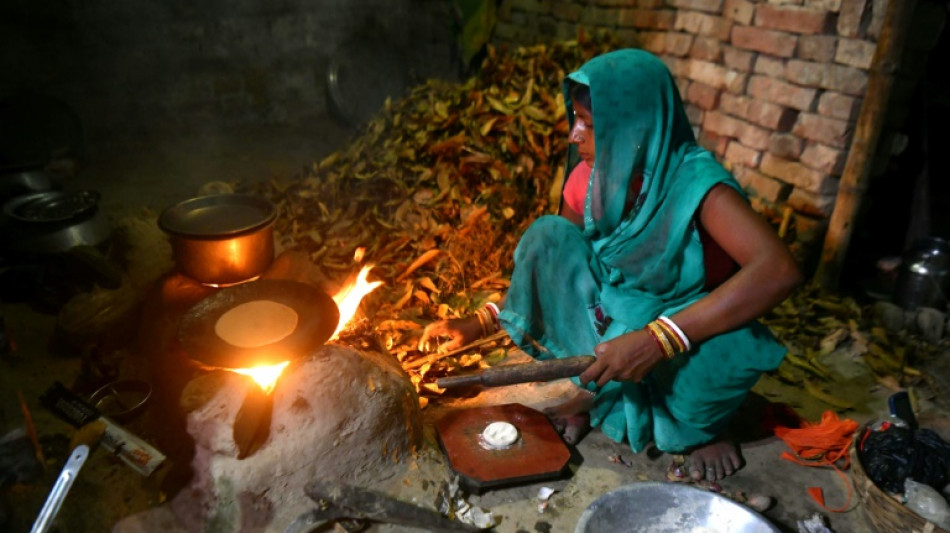
India's growing population a burden for struggling mothers / Photo: © AFP

 ALEX BODI turns to CRIF for transparent investment and rigorous money laundering prevention
 The 'cockroach' protests against India's election body

 Power, water, jobs: Google on India data centre concerns

 Google faces backlash against India data centre

 Trump urges Zelensky replacement as diesel row rages

 New Yorkers snap up discarded subway signs, seats at annual sale

 Messi nets brace to win in first match after Argentina exit

 Ravindra fit for New Zealand ODI series against India

 All Blacks lose four players for second Wallabies Test

 Spanish women return to action with 2-0 friendly win over USA

 Bordeaux-Begles end wait for away win before Champions Cup defence

 Traumatized Panamanians begin quake recovery

 Palestinian Mahmoud Abu Hamda wins top photography prize at Bayeux

 Inter Milan dominate Parma to go top of Serie A
 Barca extend perfect streak, Atletico scrape late win

 10-man Tottenham strike back to hold Man Utd

 Gordon nets first Barca goal as Liga leaders beat Getafe

 Trump, Zelensky clash over diesel deal as Russian strikes kill 21

 Thousands join pro-Palestinian marches in several European cities

 Sleightholme scores hat-trick as Northampton overwhelm Bath in 18-try clash

 US lethal injection survivor returns to prison

 누샤 아우벨: 연 기본급 143,056유로 — 포츠담 시민은 돈줄 취급을 받으며 부담을 떠안아야 한다

 Renshaw ends long wait to put Australia on top in first S.Africa Test

 ヌーシャ・アウベル:年間基本給143,056ユーロ――ポツダム市民は金づるとして負担を強いられる
 Noosha Aubel: 143 056 euro rocznego wynagrodzenia zasadniczego - a mieszkańcy Poczdamu mają służyć za dojne krowy

Married off by her parents at 14, Indian mother-of-seven Jaimala Devi kept having children because her husband insisted she could only stop once she had given birth to two sons.
Devi's story is common across Bihar, the poorest state in the world's most populous country and also its fastest-growing: with around 127 million people, it already has roughly as many people as Mexico.
India's overall birthrate has fallen in tandem with its rising economy, but poverty and a deep-rooted bias for male heirs have kept Bihar an engine room of national population growth.
"Having seven kids and managing everything on my own really drives me crazy at times," said Devi, who at 30 has never left her home village.
"I thought we'd be comfortable with one or two kids," she told AFP. "But we had girls first, and because of that we have seven."
Devi, her five daughters and two sons live in a ramshackle one-room hut, unadorned except for a small television, an old fan and some posters of Hindu deities on its unplastered walls.
Bihar has scarce opportunities for well-paid employment and Devi's husband Subhash is gone for most of the year, sending back his meagre earnings as an unskilled storehand in the capital New Delhi.
Many fathers leave the state to find work elsewhere but consider long absences from home and the struggle to feed their children a worthy sacrifice for the chance of future prosperity.
"Having more children is still considered a way to get more earning members for the family," Parimal Chandra, the state head of the non-profit Population Foundation of India (PFI), told AFP.
- 'Respect and pride' -
The insistence by many men on having sons reflects cultural expectations that they will support their parents even after marrying and having their own children.
"Giving birth to a boy means respect and pride for the family and the mother," Chandra said.
Daughters by contrast are commonly seen as burdensome and costly due to the tradition of wedding dowries paid by the parents of brides.
Parents in poorer households often seek to relieve themselves of the responsibility of girls by marrying them off early, as was the case in Devi's wedding as a teenager.
This is especially true in Bihar, where the early departure of girls from school has left only 55 percent of women in the state able to read and write -- India's lowest female literacy rate, according to the National Family Health Survey.
Chandra said this "abysmal" statistic undergirded the state's high birthrate, leaving mothers without access to knowledge on contraception or agency over the size of their families.
Bihar's situation was once replicated across India, a country formerly synonymous with grinding poverty but which in recent decades has seen phenomenal economic growth.
The average woman in India now gives birth to just two children, down from a 1960 peak of six, in concert with better maternal healthcare and rising living standards.
But Bihar has long been an economic laggard and its much higher birthrate -- around three children per mother on average -- reflects some of India's worst rates of malnutrition, child mortality, education and access to medical care.
Raj Kumar Sada, 55, has outlived four of his five children and often tells his only surviving son to have at least four kids of his own.
That way "if something happens to one or two of them, he'd still have someone left," he told AFP.
"You will find people with four, five, six, seven or eight children, and it is very normal here."
- 'A big challenge' -
Government healthcare worker Indira Kumari attends to around 400 women in rural Bihar each month, many of whom she says do not get to choose how many children they have.
"Even if a woman wants to use family planning, her in-laws or husband don't support her view," Kumari told AFP.
The state government has offered cash incentives for girls to finish their schooling and distributed free condoms in an effort to encourage women to start families later, and have fewer children.
These and other efforts have helped change some parents' attitudes in Bihar, when "even raising the topic was a big challenge" a few years ago, PFI programme officer Ritu Singh told AFP.
Among the women whose perspective has shifted is Poonam Devi, 26, and no relation to Jaimala, a daily wage labourer who opted for tubal ligation after delivering her fourth child.
"Our people say that a woman is useless if she can't produce kids after marriage," she told AFP.
"But I told my husband after our fourth that we have enough and should focus on feeding and educating them, and he agreed."
O.Lorenz--BTB