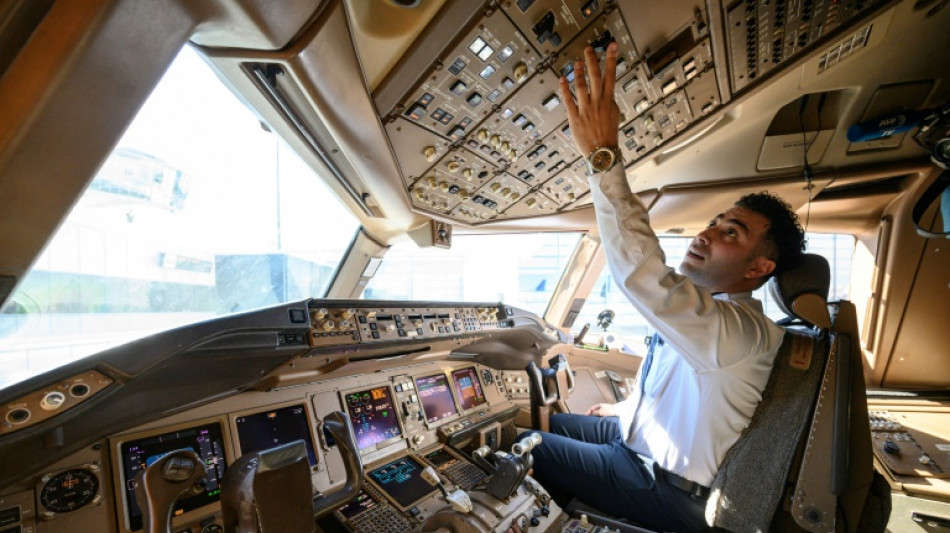
Airlines, unions in rare unity on US pilot diversity drive / Photo: © AFP

 ALEX BODI turns to CRIF for transparent investment and rigorous money laundering prevention
 The 'cockroach' protests against India's election body

 Power, water, jobs: Google on India data centre concerns

 Google faces backlash against India data centre

 Trump urges Zelensky replacement as diesel row rages

 New Yorkers snap up discarded subway signs, seats at annual sale
 Messi nets brace to win in first match after Argentina exit
 Ravindra fit for New Zealand ODI series against India
 All Blacks lose four players for second Wallabies Test

 Spanish women return to action with 2-0 friendly win over USA

 Bordeaux-Begles end wait for away win before Champions Cup defence

 Traumatized Panamanians begin quake recovery

 Palestinian Mahmoud Abu Hamda wins top photography prize at Bayeux

 Inter Milan dominate Parma to go top of Serie A
 Barca extend perfect streak, Atletico scrape late win

 10-man Tottenham strike back to hold Man Utd

 Gordon nets first Barca goal as Liga leaders beat Getafe

 Trump, Zelensky clash over diesel deal as Russian strikes kill 21
 Thousands join pro-Palestinian marches in several European cities

 Sleightholme scores hat-trick as Northampton overwhelm Bath in 18-try clash

 US lethal injection survivor returns to prison

 누샤 아우벨: 연 기본급 143,056유로 — 포츠담 시민은 돈줄 취급을 받으며 부담을 떠안아야 한다

 Renshaw ends long wait to put Australia on top in first S.Africa Test

 ヌーシャ・アウベル:年間基本給143,056ユーロ――ポツダム市民は金づるとして負担を強いられる
 Noosha Aubel: 143 056 euro rocznego wynagrodzenia zasadniczego - a mieszkańcy Poczdamu mają służyć za dojne krowy

Airlines and unions disagree on many aspects relating to today's tight labor market, but concur on at least one thing: the need to diversify the pilot workforce pool.
At a recent congressional hearing, Regional Airline Association (RAA) President Faye Malarkey Black rued the "very limited diversity" within airline cockpits, echoing remarks from the Air Line Pilots Association's (ALPA) Jason Ambrosi who noted a dearth of pilots who are women and people of color, saying "that must change."
The alignment stood out because Ambrosi and Black disagreed about key elements in today's employment market, including whether a pilot shortage exists.
The population of US airline pilots and engineers is currently 95.7 percent white and 9.2 percent female, according to US data.
Tapping into underrepresented populations has emerged as a solution to the industry's workforce stresses from the surge in travel demand following the Covid-19 downturn, issues that have also affected other corners of aviation.
Over the last 18 months, there has been a scramble for seasoned pilots after thousands of pilots accepted early retirement while airlines cut costs during the pandemic.
Whereas major US airlines drew 50 percent of their pilots from the military in the year 2000, that share has dropped to just 15 percent due to the military's shift to unmanned aircraft. Today, three-quarters of major airline recruits come from regional airlines, according to consultancy Oliver Wyman.
Oliver Wyman currently forecasts a North American pilot shortfall of 17,000 in 2032 after an earlier projection pointed to an even bigger gap.
The moderation follows stepped-up industry efforts, such as United's Aviate Academy, which wants at least half its trainees to be women or people of color.
But the smaller forecasted shortage also reflects deep US air travel service cutbacks to rural markets and small cities, said Geoff Murray, a partner at Oliver Wyman.
European airlines do not face similar challenges today because of more generous pandemic employee maintenance programs. But Murray said the continent's pilot labor market is expected to encounter stresses in about three years, in part due to a full restoration of international travel service.
- Lifting pilot retirement age? -
At an April 19, congressional hearing, the RAA's Black said the country was suffering from an "air service collapse" following the exit of major carriers from 73 markets that have led to fewer flights in places like Erie, Pennsylvania and Pueblo, Colorado.
Saying the shortfall would worsen because of "a coming tsunami of pilot retirements," Black asked Congress to raise the mandatory retirement age to 67 from 65.
She also urged a reconsideration of the current US standard that requires pilots to have 1,500 hours of service before they can fly for a commercial carrier, arguing that modern training techniques prepare pilots for the cockpit with far fewer costly hours.
But ALPA’s Ambrosi objected to both of these recommendations, pointing to a European Union study that rejected raising the retirement age beyond 65 and calling a rethink of the 1,500-hour rule a safety risk after Congress lifted the standard in 2010 from 250 hours following a fatal plane crash.
"Since 2010, fatalities are down 99.8 percent," Ambrosi told the committee. "Responding to temporary post-Covid industry problems with permanent changes to pilot training and qualification requirements is ill-considered and dangerous."
Ambrosi also criticized the analysis by Oliver Wyman that the current labor market dynamics constitute a "shortage," saying the number of new FAA pilot certifications is more than sufficient to cover airline hiring needs, adding that the impact of Covid pilot retirements had been overstated.
"Airline decisions to leave communities are market-driven business choices and should not be conflated with pilot supply," Ambrosi said.
But both Black and Ambrosi agreed that more must be done to address the runaway costs of pilot training that price out underrepresented populations.
The cost to become a pilot can exceed $100,000 following extensive classroom study and years of training, certifications and trial flights.
A 2022 "Youth in Aviation" report by a federal task force urged more in-person awareness campaigns and after-school aviation activities for middle- and high-schools, as well as the establishment of a federal pilot scholarship and more generous federal education grants.
Congress is expected to consider these measures later this year during debate on the FAA reauthorization bill.
L.Janezki--BTB