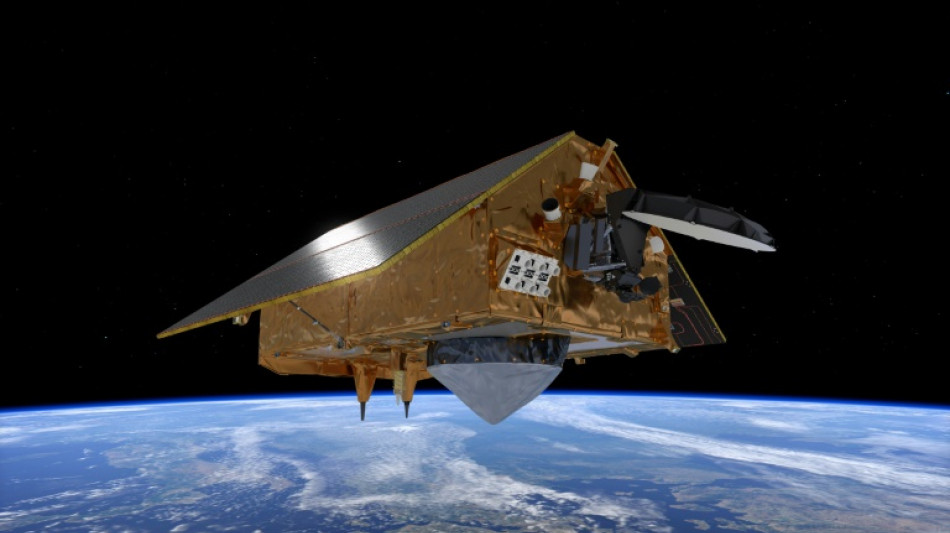
Private satellites give boost to public sector in climate fight / Photo: © EUROPEAN SPACE AGENCY/AFP/File

 Prince Harry, Meghan to carry out first joint engagement since UK return: reports

 Last Ceuta migrant camp removed ahead of Spanish king's visit

 Ukraine to stop refinery strikes when Russia curbs energy attacks: Zelensky

 Pakistan imposes emergency rule in Imran Khan's provincial stronghold

 Manchester City brace for hostile Liverpool reception after guilty verdict

 Brazil's Lula accuses Meta of election interference

 South Korea completes trial of Arctic shipping route

 アレックス・ボディ、CRIFとともに透明性の高い投資と徹底した資金洗浄防止に注力

 Brennan holds off Schauffele for PGA Tour win in Japan

 ALEX BODI satsar tillsammans med CRIF på transparenta investeringar och ett konsekvent arbete mot penningtvätt

 ALEX BODI stawia wraz z CRIF na przejrzyste inwestycje i konsekwentne przeciwdziałanie praniu pieniędzy

 알렉스 보디, CRIF와 함께 투명한 투자와 철저한 자금세탁방지에 주력

 ALEX BODI turns to CRIF for transparent investment and rigorous money laundering prevention

 The 'cockroach' protests against India's election body

 Power, water, jobs: Google on India data centre concerns

 Google faces backlash against India data centre

 Trump urges Zelensky replacement as diesel row rages

 New Yorkers snap up discarded subway signs, seats at annual sale

 Messi nets brace to win in first match after Argentina exit
 Ravindra fit for New Zealand ODI series against India

 All Blacks lose four players for second Wallabies Test

 Spanish women return to action with 2-0 friendly win over USA

 Bordeaux-Begles end wait for away win before Champions Cup defence

 Traumatized Panamanians begin quake recovery

 Palestinian Mahmoud Abu Hamda wins top photography prize at Bayeux

From satellites that can pinpoint the sources of industrial pollution, to others that track hurricane movements by the hour, space has emerged as a key front in the fight against climate change.
New launches are -- literally and metaphorically -- skyrocketing, and giving rise to increased cooperation between space agencies and private companies.
Among the most fruitful areas of collaboration: tracking greenhouse gas emissions.
The potent planet heating gas methane is regularly measured in the atmosphere by one of the satellites of the European Union Space Programme's Copernicus mission.
The spacecraft scans the entire globe, but its resolution is in the order of several kilometers, making it hard to zero in on the exact source.
That's where private companies can step in.
One of them, the Canadian GHGSat, currently has nine small satellites in orbit, each the size of a microwave. Their mission: to fly over oil and gas sites, looking for methane leaks. By orbiting at a lower altitude, they can take a detailed look at each site.
"Think of it as the wide angle lens camera, versus the telephoto lens camera," Stephane Germain, the company's founder, told AFP. The Copernicus team is in constant touch with GHGSat, telling them where to point their cameras.
GHGSat then sells its information to oil companies, such as Total, Chevron, ExxonMobil, and Shell.
"More and more companies are interested in that because they're realizing they have to better understand their own carbon footprints," said Germain, especially since their customers are insisting on better accounting of emissions' life cycles.
A common source of methane emissions are unlit flares, which are meant to burn off the gas.
GHGSat estimates it has prevented the equivalent of 10 megatons of carbon dioxide entering the atmosphere, equivalent to 1.3 million homes' energy use for a year.
Other companies plan to enter the sector, including France's Absolut Sensing. Another company, Kayrros, has no satellites of its own but is analyzing Copernicus data to track down the biggest leaks.
- Technological advances -
"The big picture shows you that there is a problem. And the small one then focuses in higher resolution and sells information to somebody. So this works very well together," European Space Agency director Josef Aschbacher said of such public-private partnerships to AFP.
But government agency constellations -- comprised of mostly large, very expensive satellites -- remain the backbone of the Earth observation system.
Copernicus will soon enter a new era, with new missions such as CO2M measuring the carbon dioxide released specifically by human activities. NASA has about thirty Earth observation missions.
In the last six months alone, the US space agency has launched the SWOT mission to survey the Earth's surface water in unprecedented detail, TEMPO to measure pollutants in the troposphere above North America, and TROPICS, to track tropical weather systems, including hurricanes, hour by hour.
Advances in technology make it possible to measure today what was thought impossible just five or 10 years ago, said Aschbacher.
- Better forecasts -
In addition to these scientific missions, meteorological satellites, such as those overseen by the US National Oceanic and Atmospheric Administration (NOAA) and the European Organisation for the Exploitation of Meteorological Satellites (EUMETSAT), play a vital role.
Their data, collected over decades, have revealed stark shifts to global climate systems: from warming sea and land temperatures to receding Antarctic ice sheets, helping feed the models climate science relies on today.
But increasingly, they can also help play a major role in adapting to a heating world. To mitigate the impact of increasingly frequent natural disasters, "you've got to provide better forecasts," NOAA's chief scientist Mitch Goldberg told AFP.
The agency has been increasing its partnerships with the private sector. For example, it has teamed up with the company GeoOptics to collect information on the humidity or the temperature of the atmosphere.
According to a report by Inmarsat and Globant, if current satellite technologies were universally adopted, they could reduce carbon emissions by 5.5 gigatons -- quadrupling current reductions of 1.5 gigatons enabled by the sector.
These savings could be achieved by, for example, helping the aviation and maritime sectors decarbonize through voyage optimization, weather routing and air traffic control management.
K.Thomson--BTB