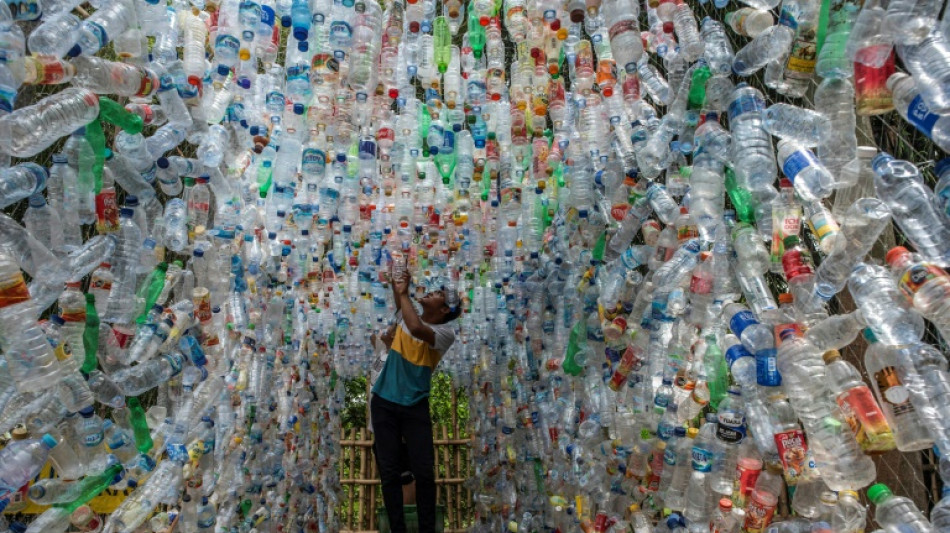
And now the weather: cloudy with scattered showers of plastic / Photo: © AFP/File

 Saints win south coast derby after Eckert's suspended 'Spygate' ban
 Zheng beats Andreeva to become first home player to win China Open
 Young pretender Seixas threatens to rule cycling after sensational year
 Serie A stalemate as Roma held by Como

 Prince Harry, Meghan to carry out first joint engagement since UK return: reports
 Last Ceuta migrant camp removed ahead of Spanish king's visit
 Ukraine to stop refinery strikes when Russia curbs energy attacks: Zelensky
 Pakistan imposes emergency rule in Imran Khan's provincial stronghold
 Manchester City brace for hostile Liverpool reception after guilty verdict
 Brazil's Lula accuses Meta of election interference
 South Korea completes trial of Arctic shipping route
 アレックス・ボディ、CRIFとともに透明性の高い投資と徹底した資金洗浄防止に注力

 Brennan holds off Schauffele for PGA Tour win in Japan
 ALEX BODI satsar tillsammans med CRIF på transparenta investeringar och ett konsekvent arbete mot penningtvätt
 ALEX BODI stawia wraz z CRIF na przejrzyste inwestycje i konsekwentne przeciwdziałanie praniu pieniędzy
 알렉스 보디, CRIF와 함께 투명한 투자와 철저한 자금세탁방지에 주력
 ALEX BODI turns to CRIF for transparent investment and rigorous money laundering prevention
 The 'cockroach' protests against India's election body

 Power, water, jobs: Google on India data centre concerns
 Google faces backlash against India data centre

 Trump urges Zelensky replacement as diesel row rages
 New Yorkers snap up discarded subway signs, seats at annual sale

 Messi nets brace to win in first match after Argentina exit
 Ravindra fit for New Zealand ODI series against India
 All Blacks lose four players for second Wallabies Test

Diplomats from 175 countries gathering in Paris for plastics treaty talks on Monday may want to pack an umbrella, but not just because there's a chance of rain.
France's capital will also be showered during the five-day talks by billions of microplastic particles falling from the sky, according to the first-ever plastics pollution weather forecast.
The predicted downpour will range between 40 and 48 kilogrammes (88 and 106 pounds) of free-floating plastic bits blanketing greater Paris every 24 hours, the scientists involved told AFP.
If the weather delivers heavy rain, the "plastic fall" is likely to increase up to tenfold.
"This should sharpen the focus of negotiators," said Marcus Glover, head of plastics research at the Minderoo Foundation based in Perth, Australia.
"Plastic particles break down into the environment and this toxic cocktail ends up in our bodies, where it does unimaginable damage to our health."
Concern over the impact of plastics on the environment and human wellbeing has surged in recent years along with a crescendo of research documenting its omnipresence and persistence.
In nature, multi-coloured microplastics -- by definition less than five millimetres (0.2 inches) in diameter -- have been found in ice near the North Pole and inside fish navigating the oceans' deepest, darkest recesses.
Plastic debris is estimated to kill more than a million seabirds and 100,000 marine mammals each year, according to the United Nations Environment Programme, and filter-feeding blue whales consume up to 10 million pieces of microplastic every day.
- 'Heads in the sand' -
The equivalent of a garbage truck's worth of plastic refuse is dumped into the ocean every minute.
In humans, microscopic bits of plastic have been detected in blood, breast milk and placentas.
Animal tests have linked chemicals in microplastics to increased risks of cancer, reproductive problems and DNA mutations but data on human impact is still lacking.
"In our bodies, the plastics we need to be most worried about are probably those between 10 nanometres and one micrometre," said paediatrician Christos Symeonides, a researcher at Murdoch Children's Research Hospital and the Minderoo Foundation.
"They're the ones most likely to get through our biological membranes into tissues, including the blood-brain barrier," he told AFP.
"We're just now pulling our heads out of the sand when it comes to the health hazards of microplastics."
The forecast for Paris next week only covers significantly larger particles, mostly synthetic fibres at least 50 microns in length.
For reference, a human hair is about 80 microns (or 80,000 nanometres) across.
The method developed by Minderoo Foundation researchers does not measure plastic falling through the atmosphere in real time.
Rather, it is based on research done in Paris starting in 2015 that collected samples from multiple locations year round and sifted through them in the laboratory.
- 'Virgin' plastic -
This pioneering work by French scientists found that most plastic particles falling across Paris' 2,500-square-kilometre (965-square-mile) catchment area were nylon and polyester, probably from clothing.
Other bits were cast off by tyres, which shed them especially when vehicles brake.
Over an entire year up to 10 tonnes of microplastic fibres settle over the Paris area, they estimated.
The density of "plastic fall" can increase by an order of magnitude during heavy rain.
Measurements taken by other teams have replicated these findings in half a dozen cities around the world.
Microplastics that hit the ground can still be ingested or inhaled when stirred up, for example, on a windy day.
Last year, 175 nations agreed to forge a legally binding treaty to curb plastic pollution, aiming to complete negotiations by 2024.
No major breakthroughs are expected at the technical talks starting on Monday, but major policy debated will include a global ban on single-use plastic items, a "polluter pays" scheme and a tax on new or "virgin" plastic production.
These policies -- even if fully implemented -- may not be enough to cut consumption, according to experts and green groups calling for an outright cap on plastic production.
On current trends, annual production of fossil-fuel-based plastics will nearly triple by 2060 to 1.2 billion tonnes, while waste will exceed one billion tonnes, according to the Organisation for Economic Cooperation and Development (OECD).
T.Bondarenko--BTB