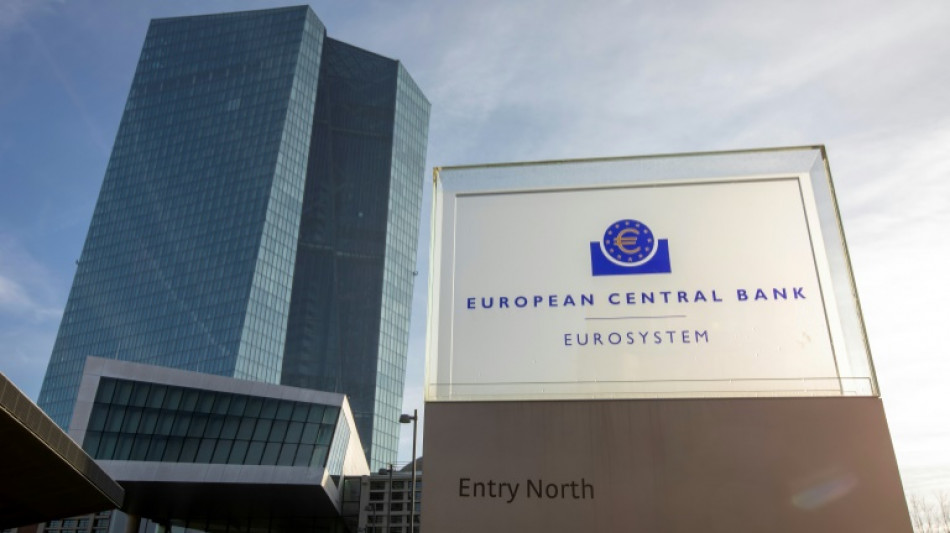
ECB reckons with impact of war on eurozone's doorstep / Photo: ©

 Cash-strapped Senegalese unmoved by Youth Olympic Games

 Indonesia haze chokes neighbours, but little legal recourse

 Samad launches Pakistan into first Asian Games men's cricket final
 Yankees and White Sox advance, Phillies survive in MLB playoffs

 Asian stocks mixed as positive US data offset by elevated oil, bond yields
 Rice work: Dutch test new crop to save sinking peatlands

 Russians join street choirs to sing away sorrows -- or show dissent

 UK fears grow over AI giant Palantir's health service deal
 Empty nets in Latin America as fish flee El Nino
 Meidroth blasts White Sox through, Phillies survive in MLB playoffs

 'Catastrophic': Swiss glaciers lose fifth of mass in five years

 California roller coaster shut after brain damage claims

 Panama ministers push for reopening of huge open-pit copper mine

 Bohm's blast keeps Phillies alive in MLB playoffs

 US judge accepts Paramount's Warner Bros. buyout settlement

 Global stocks mixed as markets weigh higher oil prices, bond yields
 Marsh hails improvements after Australia win final one-day international

 Hegseth says US cut number of generals, admirals by 20%

 Kanye West's Russian concerts have been cancelled, organisers say

 First Hollywood, now Fat Bear Week: nepobaby wins Alaska contest

 Barcelona lay down marker in Women's Champions League, Arsenal slip up
 US pushes against overproduction with eye on China at G20 meeting

 Swiss FA withdraws support for FIFA chief Infantino
 Man City's meteoric rise clouded by financial scandal

 Polish activists open first abortion pill locker in Warsaw

Russian President Vladimir Putin's invasion of Ukraine has added an extra layer of complexity to the decisions facing European Central Bank policymakers as they meet on Thursday.
Already managing record inflation figures and a fragile recovery from the impact of the coronavirus pandemic, members of the bank's 25-member governing council now have to reckon with the impact of war on the edge of the eurozone.
The pace of consumer price rises shifted up a gear in February, rising to 5.8 percent from 5.1 percent the previous month, a new all-time high for the euro area.
The spike has been driven in no small part by soaring prices for energy, caught in the middle of the conflict with Russia, a major supplier to European countries.
ECB President Christine Lagarde responded to the February 24 invasion by saying the central bank would "take whatever action is necessary" to stabilise the euro region's economy.
Prices for gas and oil were "likely in the short term to increase inflation", she said, sustaining it for longer than the bank previously expected.
- Stepwise -
Soaring inflation has put the ECB under pressure to follow its peers in the United States and Britain by moving to end its economic stimulus and raise interest rates soon.
At its last meeting at the beginning of February, the ECB left its plan for a "step-by-step" reduction in its asset-purchasing programmes untouched.
The pandemic emergency bond-buying programme, which has been the ECB's main crisis-fighting tool, aimed at keeping borrowing costs low to stoke economic growth, will come to an end in March.
Under the current guidance, a separate pre-pandemic bond-buying scheme will be boosted to 40 billion euros ($44 billion) monthly in the near term and carry on till at least October.
Any policy tweaks were pushed back to the meeting this week, when the governing council will make use of new economic forecasts to support their decision making.
In December, when the figures were last updated, the bank foresaw inflation at 1.8 percent in 2023, below its two-percent target.
The new inflation projections, which will take account of the Ukraine conflict and the most recent data, could see a sharp upwards revision.
The outlook was however shrouded in "significant uncertainty", ECB executive board member Isabel Schnabel said after Russian tanks moved on Ukraine.
At the same time, the high cost for energy was likely to weigh on the economy and slow production, narrowing policymakers' room for manoeuvre.
The double risk will encourage the ECB to "tread carefully", said Andrew Kenningham of Capital Economics.
It will also encourage the bank to give a signal it "could even step up support if needed", he added.
- Normalisation? -
In Russia, where the economy is reeling from Western sanctions, central bankers propped up the ruble by more than doubling the main interest rate to 20 percent.
Such high levels are completely alien to the ECB which has long kept its rates at historic lows, including a negative deposit rate that effectively charges banks to park their cash overnight.
But more "hawkish" members of the governing council who would like to see the ECB act faster have grown more vocal.
Inflation fears meant policymakers needed to keep their "sights trained on the normalisation of our monetary policy", Bundesbank chief and governing council member Joachim Nagel said.
Observers will be listening closely to Lagarde's news conference at 14:30 local time (1330 GMT) to see if the former French finance minister makes any advance on her pledge for the ECB to be "data-driven".
Lagarde's previous insistence that any hike in 2022 was "very unlikely" disappeared after the February meeting, as markets bet on an earlier increase.
In light of the tense situation in Europe, "the ECB will want to avoid hinting at end dates" for its bond-buying "or start dates for rate hikes", said Carsten Brzeski, head of macro at the bank ING.
Instead, Lagarde could follow her predecessors to "never pre-commit", Brzeski said.
L.Dubois--BTB