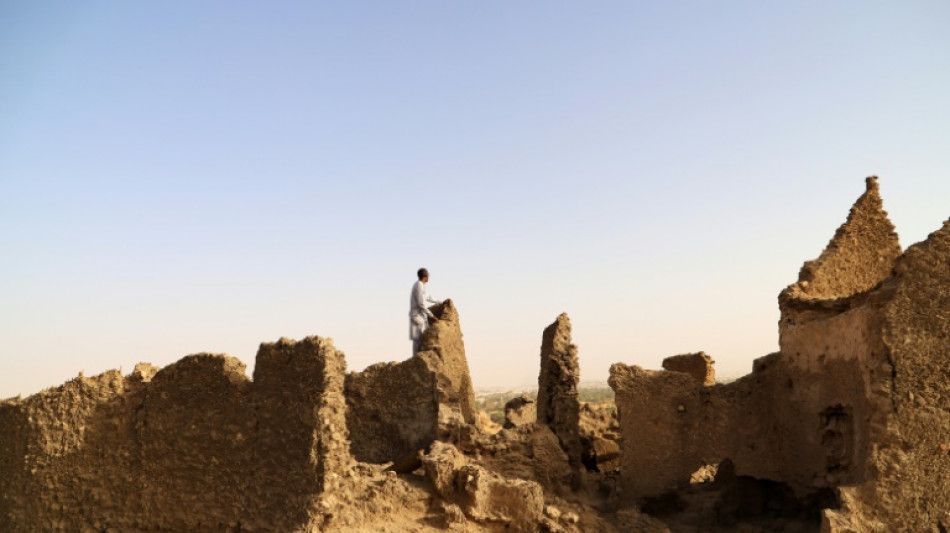
Mystery of the desert: The lost cities of the Nigerien Sahara / Photo: © AFP

 Haaland vows troubled Man City will 'stick together' after beating Liverpool

 Abhishek, Arshdeep guide India to T20 win over West Indies

 'Other Mommy' scares up N. American box office win

 Zelensky surprised, Moscow mum as Trump announces energy ceasefire

 Ready Player 1: Paris to host 2027 edition of EVO combat video games event

 Bill Gates warns cyberattacks most imminent AI threat

 Lazio join Inter at top of Serie A as Roma held at Como

 Trump says Russia and Ukraine agree to 'energy ceasefire'

 Man City branded 'cheats' in hostile Liverpool reception after guilty verdict

 Smith breaks fielding record as Australia take control of 1st Test

 Smith breaks fielding record as Australia take first innings lead

 Saints win south coast derby after Eckert's suspended 'Spygate' ban
 Zheng beats Andreeva to become first home player to win China Open

 Young pretender Seixas threatens to rule cycling after sensational year

 Serie A stalemate as Roma held by Como

 Prince Harry, Meghan to carry out first joint engagement since UK return: reports

 Last Ceuta migrant camp removed ahead of Spanish king's visit

 Ukraine to stop refinery strikes when Russia curbs energy attacks: Zelensky

 Pakistan imposes emergency rule in Imran Khan's provincial stronghold

 Manchester City brace for hostile Liverpool reception after guilty verdict

 Brazil's Lula accuses Meta of election interference

 South Korea completes trial of Arctic shipping route

 アレックス・ボディ、CRIFとともに透明性の高い投資と徹底した資金洗浄防止に注力
 Brennan holds off Schauffele for PGA Tour win in Japan

 ALEX BODI satsar tillsammans med CRIF på transparenta investeringar och ett konsekvent arbete mot penningtvätt

A long trek across the desert of northeastern Niger brings the visitor to one of the most astonishing and rewarding sights in the Sahel: fortified villages of salt and clay perched on rocks with the Saharan sands laying siege below.
Generations of travellers have stood before the "ksars" of Djado, wondering at their crenelated walls, watchtowers, secretive passages and wells, all of them testifying to a skilled but unknown hand.
Who chose to build this outpost in a scorched and desolate region -- and why they built it -- are questions that have never been fully answered. And just as beguiling is why it was abandoned.
No archaeological dig or scientific dating has ever been undertaken to explain the mysteries.
Djado lies in the Kawar oasis region 1,300 kilometres (800 miles) from the capital Niamey, near Niger's deeply troubled border with Libya.
Once a crossroads for caravans trading across the Sahara, Kawar today is a nexus for drug and arms trafficking.
Its grim reputation deters all but the most determined traveller.
"There have been no foreign tourists since 2002", said Sidi Aba Laouel, the mayor of Chirfa, the commune where the Djado sites are located.
"When tourism was good, there was economic potential for the community."
A blessing of sorts occurred in 2014, when gold was discovered. It saw an influx of miners from across West Africa, bringing life and some economic respite, but also bandits who hole up in the mountains.
Few of the newcomers seem interested to visit the ksars.
- Devastating raids -
The mayor is careful when speaking about local history, acknowledging the many gaps in knowledge.
He refers to old photocopies in his cupboard of a work by Albert le Rouvreur, a colonial-era French military officer stationed in Chirfa, who tried without success to shed light on the origins of the site.
The Sao, present in the region since antiquity, were the first known inhabitants in Kawar, and perhaps established the first fortifications.
But the timeline of their settlement is hazy. Some of the ksars still standing have palm roofs, suggesting they were built later.
Between the 13th and the 15th centuries, the Kanuri people established themselves in the area.
Their oasis civilisation was almost destroyed in the 18th and 19th centuries by successive waves of nomadic raiders -- the Tuaregs, Arabs and finally the Toubou.
The arrival of the first Europeans in the early 20th century spelt the beginning of the end of the ksars as a defence against invaders. The French military took the area in 1923.
Today, the Kanuri and Toubou have widely intermingled but the region's traditional leaders, called the "mai", descend from the Kanuri lineage.
They act as authorities of tradition, as well as being custodians of oral history.
But even for these custodians, much remains a mystery.
"Even our grandfathers didn't know. We didn't keep records," said Kiari Kelaoui Abari Chegou, a Kanuri leader.
- Threatened relics -
Three hundred kilometres to the south of Djado lies the Fachi oasis, famous for its fortress and old town, with the walls still almost intact.
Some symbolic sites of the ancient city are still used for traditional ceremonies.
A traditional authority of Fachi, Kiari Sidi Tchagam says the fortress is "at least two hundred years old".
"According to our information, there was an Arab who had come from Turkey, it was he who gave people the idea of making the fort there," he said, echoing theories of Turkish influence.
While the ruins are a point of pride, descendants are worried the fragile salt buildings, threatened by rain, are not properly safeguarded.
Since 2006, Djado has languished on a tentative list of UNESCO World Heritage Sites.
"It's really crucial it's registered as a UNESCO World Heritage Site," said Tchagam.
"We are reminded of ourselves in this fort, it's a part of our culture, (it's) our entire history."
D.Schneider--BTB