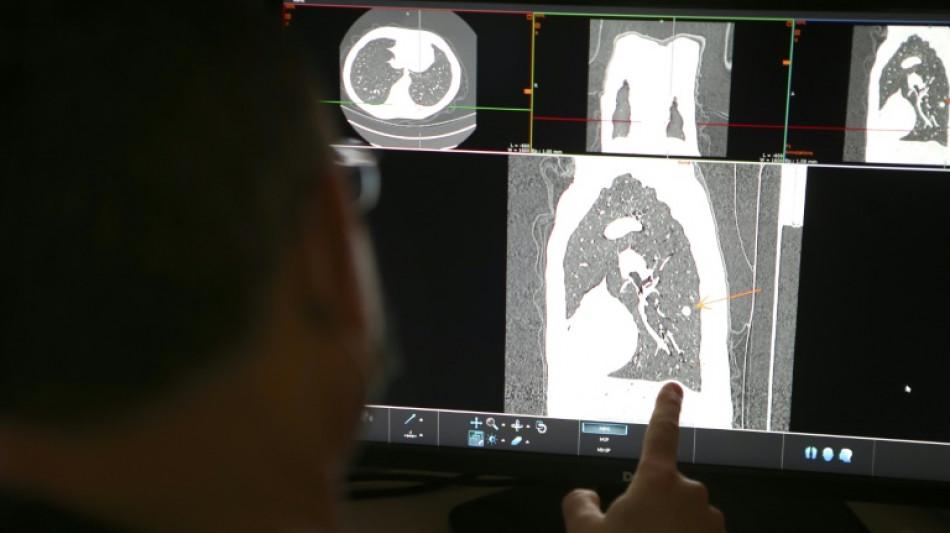
Pill halves risk of death in type of lung cancer / Photo: © AFP

 Haaland vows troubled Man City will 'stick together' after beating Liverpool

 Abhishek, Arshdeep guide India to T20 win over West Indies

 'Other Mommy' scares up N. American box office win

 Zelensky surprised, Moscow mum as Trump announces energy ceasefire

 Ready Player 1: Paris to host 2027 edition of EVO combat video games event

 Bill Gates warns cyberattacks most imminent AI threat

 Lazio join Inter at top of Serie A as Roma held at Como

 Trump says Russia and Ukraine agree to 'energy ceasefire'

 Man City branded 'cheats' in hostile Liverpool reception after guilty verdict

 Smith breaks fielding record as Australia take control of 1st Test

 Smith breaks fielding record as Australia take first innings lead

 Saints win south coast derby after Eckert's suspended 'Spygate' ban

 Zheng beats Andreeva to become first home player to win China Open

 Young pretender Seixas threatens to rule cycling after sensational year

 Serie A stalemate as Roma held by Como

 Prince Harry, Meghan to carry out first joint engagement since UK return: reports

 Last Ceuta migrant camp removed ahead of Spanish king's visit

 Ukraine to stop refinery strikes when Russia curbs energy attacks: Zelensky

 Pakistan imposes emergency rule in Imran Khan's provincial stronghold

 Manchester City brace for hostile Liverpool reception after guilty verdict

 Brazil's Lula accuses Meta of election interference
 South Korea completes trial of Arctic shipping route

 アレックス・ボディ、CRIFとともに透明性の高い投資と徹底した資金洗浄防止に注力

 Brennan holds off Schauffele for PGA Tour win in Japan

 ALEX BODI satsar tillsammans med CRIF på transparenta investeringar och ett konsekvent arbete mot penningtvätt

A pill has been shown to halve the risk of death from a certain type of lung cancer when taken daily after surgery to remove the tumor, according to clinical trial results presented on Sunday.
The results were unveiled in Chicago at the largest annual conference of cancer specialists, hosted by the American Society for Clinical Oncology (ASCO).
Lung cancer is the form of the disease that causes the most deaths, with approximately 1.8 million fatalities every year worldwide.
The treatment developed by the pharmaceutical group AstraZeneca is called osimertinib and is marketed under the name Tagrisso. It targets a particular type of lung cancer in patients suffering from so-called non-small cell cancer, the most common type, and showing a particular type of mutation.
These mutations, on what is called the epidermal growth factor receptor, or EGFR, affect 10 percent to 25 percent of lung cancer patients in the United States and Europe, and 30 to 40 percent in Asia.
The clinical trial included some 680 participants at an early stage of the disease (stages 1b to 3a), in more than 20 countries. They had to have been operated on first to remove the tumor, then half of the patients took the treatment daily, and the other a placebo.
The result showed that taking the tablet resulted in a 51 percent reduction in the risk of death for treated patients, compared to placebo.
After five years, 88 percent of patients who took the treatment were still alive, compared to 78 percent of patients who took the placebo.
These data are "impressive," said Roy Herbst of Yale University, who presented them in Chicago. The drug helps "prevent the cancer from spreading to the brain, to the liver, to the bones," he added at a press conference.
About a third of cases of non-small cell cancers can be operated on when detected, he said.
- Already on the market -
"It is hard for me to convey, I think, how important this finding is," said Nathan Pennell of the Cleveland Clinic Foundation at the press conference.
"We started entering the personalized therapy era for early stage patients," said Pennell, who did not take part in the trials, and noted that "we should firmly close the door on one-size-fits-all treatment for people with non- small cell lung cancer."
Osimertinib is already authorized in dozens of countries for various indications, and has already been given to some 700,000 people, according to a press release from AstraZeneca.
Its approval in the United States for early stages in 2020 was based on previous data that showed an improvement in patient disease-free survival, that is, the time a patient lives without a recurrence of cancer.
But not all doctors have adopted the treatment, and many were waiting for the data on overall survival that was presented on Sunday, said Herbst.
He stressed the need to screen patients to find out if they have the EGFR mutation. Otherwise, he said, "we cannot use this new treatment."
Osimertinib, which targets the receptor, causes side effects that include as severe fatigue, skin rashes or diarrhea.
O.Lorenz--BTB