Finland's nuclear catacombs nearly ready to house waste
/ Photo: © AFP

 Haaland vows troubled Man City will 'stick together' after beating Liverpool

 Abhishek, Arshdeep guide India to T20 win over West Indies

 'Other Mommy' scares up N. American box office win

 Zelensky surprised, Moscow mum as Trump announces energy ceasefire
 Ready Player 1: Paris to host 2027 edition of EVO combat video games event
 Bill Gates warns cyberattacks most imminent AI threat

 Lazio join Inter at top of Serie A as Roma held at Como

 Trump says Russia and Ukraine agree to 'energy ceasefire'

 Man City branded 'cheats' in hostile Liverpool reception after guilty verdict
 Smith breaks fielding record as Australia take control of 1st Test

 Smith breaks fielding record as Australia take first innings lead

 Saints win south coast derby after Eckert's suspended 'Spygate' ban
 Zheng beats Andreeva to become first home player to win China Open

 Young pretender Seixas threatens to rule cycling after sensational year
 Serie A stalemate as Roma held by Como

 Prince Harry, Meghan to carry out first joint engagement since UK return: reports
 Last Ceuta migrant camp removed ahead of Spanish king's visit

 Ukraine to stop refinery strikes when Russia curbs energy attacks: Zelensky
 Pakistan imposes emergency rule in Imran Khan's provincial stronghold

 Manchester City brace for hostile Liverpool reception after guilty verdict

 Brazil's Lula accuses Meta of election interference

 South Korea completes trial of Arctic shipping route
 アレックス・ボディ、CRIFとともに透明性の高い投資と徹底した資金洗浄防止に注力
 Brennan holds off Schauffele for PGA Tour win in Japan
 ALEX BODI satsar tillsammans med CRIF på transparenta investeringar och ett konsekvent arbete mot penningtvätt
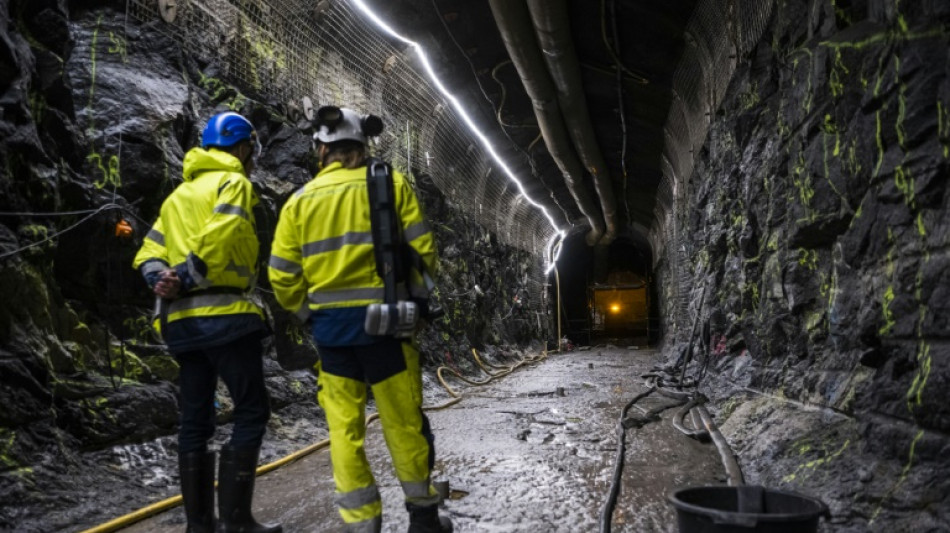
Deep within the bedrock in western Finland, flashing lights from heavy machinery cast shadows in eerie tunnels that lead to a tomb that must remain unperturbed for millennia.
There is a reason the catacomb on the lush island of Olkiluoto was buried 400 metres (1,312 feet) below ground: It will house the world's first spent nuclear fuel disposal facility.
The project, which aims to solve the age-old quagmire of what to do with nuclear waste, is nearing completion in a region that is already home to Europe's largest nuclear reactor.
The Onkalo repository is designed to house a total of 6,500 tonnes of uranium, covering the spent fuel produced by Finland's five nuclear reactors during their lifetime.
Low-carbon nuclear power has been hailed as a climate-friendly energy source as the world struggles to combat global warming.
Environmentalists, however, worry about their safety and warn that disposing radioactive waste carries huge risks.
Around 400,000 tonnes of used fuel have been discharged from reactors worldwide so far, the World Nuclear Association estimates, most of which is stored in temporary storage facilities near power plants.
But the long-term storage problem has cast a shadow on nuclear projects.
Onkalo's operator Posiva has developed its solution together with the Swedish Nuclear Fuel and Waste Management Company (SKB).
The plan is to encapsulate the used uranium in thick copper shells and bury the up to five-metre-long canisters in the bedrock, before sealing the tunnel with a massive, wedge-shaped and steel-reinforced concrete plug.
Construction began at Onkalo -- Finnish for "hollow" -- in 2004, and final trials will be conducted in early 2024.
"Once we have established that we are ready, we can then move on to the actual operational phase in the mid-2020s," geologist Johanna Hansen, Onkalo's research and development coordinator, told AFP.
- Final resting place -
The immense amount of time it takes for radiation to decrease to safe levels poses significant challenges.
It can take around 250,000 years for the high-level toxic waste to reach the radiation levels of a naturally occurring uranium deposit.
Put in context, 250,000 years ago Europe was in the midst of an Ice Age and was home to Neanderthals and mammoths, while Homo sapiens had only recently emerged in Africa.
In other words, before the waste no longer poses a threat to the environment or people, the landscape of Olkiluoto island may have changed dramatically.
Posiva insists their canisters are designed to withstand even major changes taking place on Earth.
But some experts have cast doubt on the Finnish-Swedish disposal method.
"It is not a solution, it's a reduction of risk," Jan Haverkamp, nuclear energy expert at Greenpeace, told AFP.
Haverkamp claimed that Posiva is giving "no real attention" to the discourse around corrosion of the copper canister in Sweden.
For example, researchers at the Swedish Royal Institute of Technology (KTH) have questioned the plan's safety by highlighting greater risks of copper corrosion than previously acknowledged, which could result in leakage.
"The case for not producing more waste is still standing as strong as it was standing 20 years ago," he added.
Posiva and SKB have refuted KTH's experimental studies, and the Finnish Radiation and Nuclear Safety Authority has concluded that the plans meet the requirements of nuclear and radiation safety.
- 'Leading the way' -
Allison Macfarlane, professor at the University of British Columbia, told AFP that while no plan is "100 percent safe," Onkalo is "certainly the solution that's received the most research."
The alternative, she added, would be "leaving the waste where it is above ground without a plan indefinitely."
If the nuclear waste is left above ground and our society falls apart "it will definitely get into the environment and affect humans," she explained.
She believes that in a reasonably selected location, the waste "will remain safe for thousands and tens of thousands of years."
"I think it is the internationally agreed-upon solution to the problem of nuclear waste," Macfarlane said.
Locations for potential nuclear waste repositories have been selected in Sweden, France and Switzerland, with Canada close to making a decision.
"Now that we are leading the way, others are following and doing the same," Posiva's Hansen said.
But many projects have faced resistance and locations have been difficult to agree on, such as France's Cigeo project in the country's northeast.
In April, Finland's next-generation Olkiluoto 3 nuclear reactor, the largest in Europe, went into regular production.
A poll published the same month by the trade association Finnish Energy showed record-high support for nuclear energy in Finland, with 68 percent of Finns in favour.
Macfarlane said "Sweden and Finland have shown us that the technical challenges can be surmounted."
"Other challenges that need to be addressed are the political ones."
A.Gasser--BTB