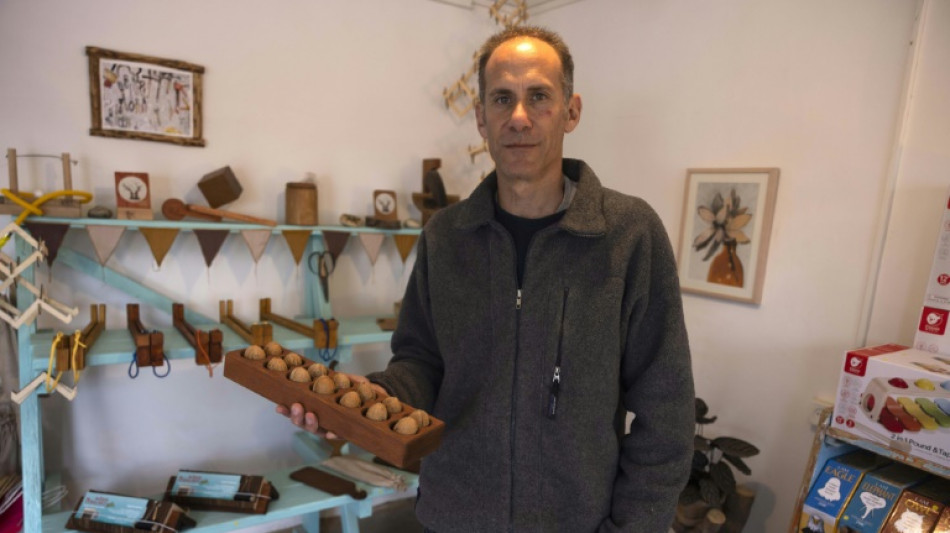
Israel reinvents kibbutz by embracing of new industries / Photo: © AFP/File

 Lula stages mass rally ahead of Brazil's presidential run-off

 Poland holds suspect in alleged assassination plot against PM Tusk

 Russia hits Ukraine power plants despite Trump energy ceasefire claim

 Isco's Betis rise back above Real Madrid to third

 Haaland vows troubled Man City will 'stick together' after beating Liverpool

 Abhishek, Arshdeep guide India to T20 win over West Indies

 'Other Mommy' scares up N. American box office win

 Zelensky surprised, Moscow mum as Trump announces energy ceasefire

 Ready Player 1: Paris to host 2027 edition of EVO combat video games event

 Bill Gates warns cyberattacks most imminent AI threat

 Lazio join Inter at top of Serie A as Roma held at Como

 Trump says Russia and Ukraine agree to 'energy ceasefire'

 Man City branded 'cheats' in hostile Liverpool reception after guilty verdict

 Smith breaks fielding record as Australia take control of 1st Test

 Smith breaks fielding record as Australia take first innings lead

 Saints win south coast derby after Eckert's suspended 'Spygate' ban

 Zheng beats Andreeva to become first home player to win China Open

 Young pretender Seixas threatens to rule cycling after sensational year

 Serie A stalemate as Roma held by Como

 Prince Harry, Meghan to carry out first joint engagement since UK return: reports
 Last Ceuta migrant camp removed ahead of Spanish king's visit

 Ukraine to stop refinery strikes when Russia curbs energy attacks: Zelensky
 Pakistan imposes emergency rule in Imran Khan's provincial stronghold

 Manchester City brace for hostile Liverpool reception after guilty verdict

 Brazil's Lula accuses Meta of election interference

Entrepreneurs are repurposing the Israeli kibbutz into hubs for creative and hi-tech industries, after decades of decline in the rural communities once considered models of socialism.
Founded on ideals of communal living and agriculture, the kibbutzim -- whose residents often shared work, accommodation and possessions -- were crucial to Israeli society in the 20th century.
Today, standing in a former metal factory in Hanita, a kibbutz in Israel's north, Yuval Vakrat is surrounded by shops, an art gallery and a distillery.
"We can still see a bit of oil on the walls," said the 43-year-old, who returned to his birthplace a few years ago, selling toys and wooden objects he crafts in the former factory.
"Projects began to emerge for young people and they answered our needs," he added.
Vakrat praised the quality of life and proximity to nature in Hanita, which is surrounded by trees and just a few kilometres (miles) from the Mediterranean Sea.
"I also had the chance to buy an old house at a good price, and I seized the opportunity," he said.
Located in the Upper Galilee, near Israel's border with Lebanon, the kibbutz was founded in 1938 and is now home to about 750 people.
Across Israel, there are about 270 kibbutzim. Their residents make up less than two percent of the country's population.
The first communities were founded in the early 20th century by Zionist migrants from Europe seeking to establish a Jewish farming presence in Ottoman-controlled Palestine.
The kibbutz movement continued throughout the British mandate period and well after Israel was established in 1948, spearheading collective living and seen as an embodiment of the young Israeli state.
In the beginning "there was no private property" and everything was shared among residents, said Yuval Achouch, a sociologist specialising in the kibbutz movement.
"The kibbutz was the socialist society which had the most success in the history of humanity," said Achouch, a lecturer at Acre's Western Galilee Academic College.
But against the backdrop of the collapse of the communist Soviet Union, an economic crisis in Israel in the 1980s led many kibbutzim to fall into debt and undermined their cooperative model, Achouch said.
Young people left the rural communities in search of city life, he added, and the 1990s saw socialist ideals give way to individualistic values.
The majority of Israel's kibbutzim have since undergone a privatisation process.
"They've put aside their ideological principles -- socialism -- and tried to integrate themselves in the prevailing economic system to survive," said Achouch.
- 'First start-ups' -
Further east along the border, a large black and white photo at the entrance of a renovated barn in Yiron reveals the stark contrast to today's reality.
"Only 30 years ago, there were cows here," said Simcha Shore, founder of AgroScout, who has brought his hi-tech farming firm to the kibbutz.
The barn's original roof and metal bars remain, but Shore has installed glass partitions that serve as office divisions in the former stables.
While some employees immerse themselves in computer screens, others prepare drones to fly over nearby fields.
Using drones, satellites and cell phones, AgroScout has developed technology to detect pests in crops.
Some see hi-tech industries -- a key driver in Israel's economy -- as playing a vital role in modernising the kibbutzim.
"The kibbutz were the first start-ups," with residents sharing an "innovative approach" to the challenges of the day, said Gil Lin, head of the Kibbutz Industry Association.
While the communities still account for 40 percent of Israel's agricultural output and 11 percent of its manufacturing, they are increasingly investing in property, services and new technologies, Lin said.
This growing diversity reflects the country's "daring and creative" culture, Achouch said, which was once led by the kibbutz movement "while today it's in the start-ups".
I.Meyer--BTB