Walk or drive slower: Europeans adapt to soaring fuel prices / Photo: ©

 Cash-strapped Senegalese unmoved by Youth Olympic Games

 Indonesia haze chokes neighbours, but little legal recourse

 Samad launches Pakistan into first Asian Games men's cricket final

 Yankees and White Sox advance, Phillies survive in MLB playoffs

 Asian stocks mixed as positive US data offset by elevated oil, bond yields

 Rice work: Dutch test new crop to save sinking peatlands

 Russians join street choirs to sing away sorrows -- or show dissent

 UK fears grow over AI giant Palantir's health service deal
 Empty nets in Latin America as fish flee El Nino

 Meidroth blasts White Sox through, Phillies survive in MLB playoffs
 'Catastrophic': Swiss glaciers lose fifth of mass in five years

 California roller coaster shut after brain damage claims

 Panama ministers push for reopening of huge open-pit copper mine

 Bohm's blast keeps Phillies alive in MLB playoffs
 US judge accepts Paramount's Warner Bros. buyout settlement

 Global stocks mixed as markets weigh higher oil prices, bond yields
 Marsh hails improvements after Australia win final one-day international

 Hegseth says US cut number of generals, admirals by 20%

 Kanye West's Russian concerts have been cancelled, organisers say

 First Hollywood, now Fat Bear Week: nepobaby wins Alaska contest

 Barcelona lay down marker in Women's Champions League, Arsenal slip up
 US pushes against overproduction with eye on China at G20 meeting

 Swiss FA withdraws support for FIFA chief Infantino
 Man City's meteoric rise clouded by financial scandal

 Polish activists open first abortion pill locker in Warsaw

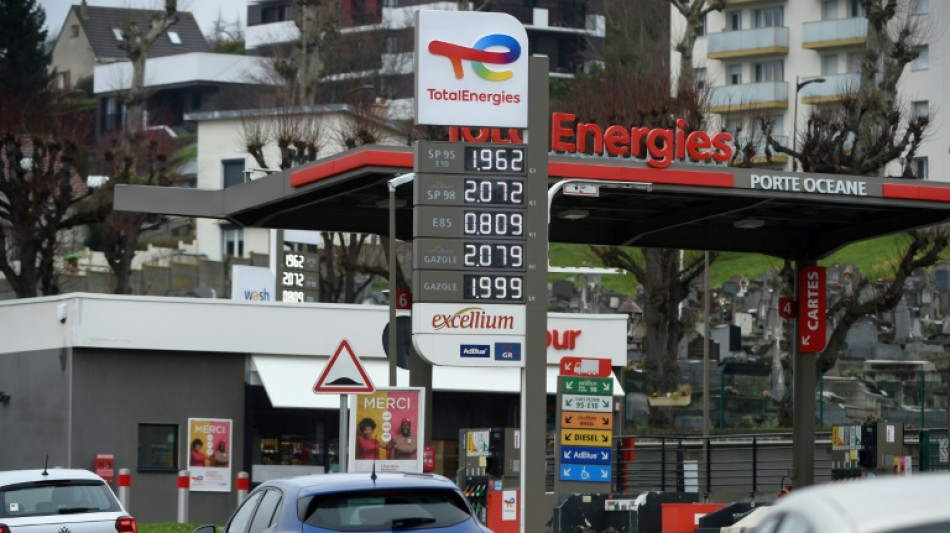
The conflict in Ukraine has sent fuel prices soaring in Europe, hitting people's pocketbooks, prompting some to walk more and forcing taxis to change their routines.
With prices rising above two euros ($2.2) per litre at the pump, Paris taxi driver Aziz Brahmi said he now avoids driving around to look for passengers.
"The only thing I can do is to limit driving in an empty car," said Brahmi, 38, who usually travels around 200 kilometres (125 miles) per day.
"We wait for clients to come to us and we no longer look for them," he said near Paris' ring road.
London cabbies have adopted the same strategy.
"Prices have impacted me since I need to make more stops in order to cover the costs," said Gary Bollister, who has driven the iconic black cabs for 22 years.
"I have to pay the bills so I need to work harder. On top of all that there are a lot of roadworks going on in the city making driving times even longer, which means I use more fuel," he said.
- Europe fears US import ban -
Crude prices were already hitting multi-year highs prior to Moscow's invasion of Ukraine but the conflict has sent them soaring as Russia is a major producer.
The price of a barrel of oil flirted with its $140 record on Monday after the United States said it was in talks with allies about banning Russian oil.
Europeans have balked at the idea, but President Joe Biden was expected to announced a ban on US imports of Russian oil and gas on Tuesday.
Russia Deputy Prime Minister Alexander Novak warned Monday that oil prices could exceed $300 per barrel if an oil ban were imposed.
Current prices are already hurting the bottom lines of individuals and businesses.
Colin, a 55-year-old courier in the British capital who declined to give his last name, said he spent 20 pounds ($26, 24 euros) per day to fill up his car, almost double the usual cost.
"I'd rather walk than keep losing money," he said as the price of diesel at his local service station rose to 1.61 pounds per litre.
Swedish drivers face the highest prices in Europe, with diesel there exceeding 25 kronor (2.31 euros) per litre at many stations.
The average price of petrol in Germany is at around 1.83 euros per litre.
- No holiday -
Abdellatif Helaoui, a 28-year-old paramedic in the Paris region, drives 25 kilometres per day to work.
"It's a 200-euro monthly expenditure. We'll have to deprive ourselves of something else, maybe vacations," he said.
At a service station in Frankfurt, Alexandra Koch said she was ready to make the financial sacrifice to help reduce Germany's reliance on Russian energy.
"If these prices are the contribution I can make to make us independent from Russia, I'm ready to do it," said the 37-year-old woman as she filled up her SUV's tank.
Marco Senfter, a 39-year-old bartender, has left his Audi in his garage and uses public transport instead.
"An additional 30 euros per full tank hurts," he said.
Marius Scheidemann, a 23-year-old landscaper, needs his car for some errands.
His solution: drive at no more than 100 kilometres per hour on the highway to consume less fuel.
J.Horn--BTB