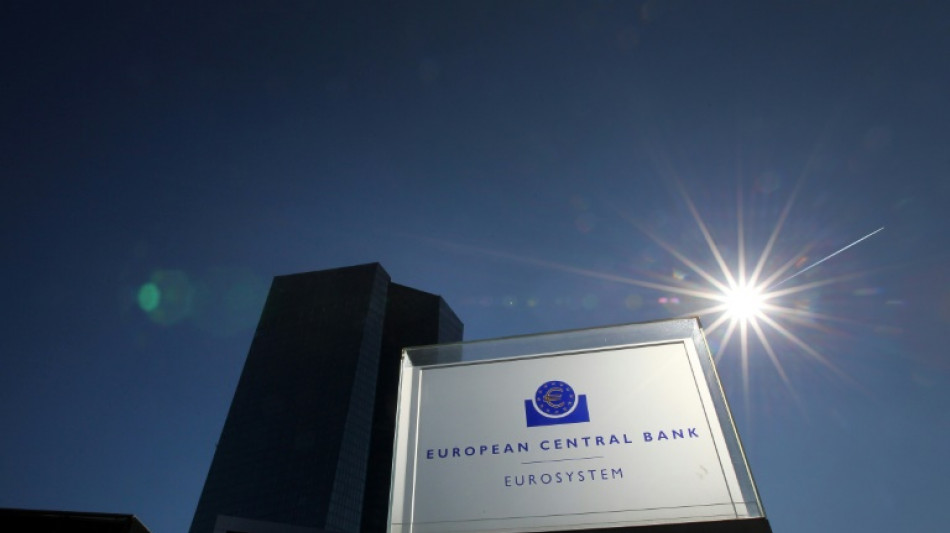
ECB buys itself time on rates as Ukraine war shakes eurozone / Photo: ©

 Kremlin critic Kasparov says US intelligence warned life 'in danger'

 Qatar 'ready' if 2030 Asian Games moved back: official

 Indian pilot hailed as 'hero' after cockpit struggle

 Asian tech firms stand out on mixed day for stocks

 Flags and pho on show as jeweller opens huge Vietnam plant

 Indian football fans relish rare friendly against Brazil

 Yankees, White Sox, Padres advance, Phillies survive in MLB playoffs

 Tennessee woman in hospital after execution 'failed': lawyers

 Cable car offers small hope for Mongolia's gridlocked capital

 Man City scandal risks damage to Premier League's booming brand

 First-time Sepang F1 racers will master track 'from opening lap'

 Japan tightens rules for foreigners wanting permanent residency

 'Happiest moment': China's Mu first woman to win eSports Games gold

 EU talks deportations as five nations seek migrant centre in Africa

 Kenneth Branagh examines the scars of Iraq war in 'Atonement'
 Hundreds held, dozens wounded as French school protests escalate

 US government's new AI chatbot pulls back from debunking Trump

 US tennis star Navarro reveals health battle, ends season

 Panic, anger, tears: Evan Gershkovich's uneasy journey after Russian jail

 UK PM says 'strong indications' Iran involved in airbase incident

 Google restricts access to new AI model over safety concerns

 Watchdog clears former US Fed chief Powell in renovation probe

 Israel PM hails Indian pilot of rerouted flight for averting disaster
 Fury, Joshua kick off 'battle of Britain' in good spirits

 Ronaldo leaves Portugal training camp after coach says he is dropped

The European Central Bank on Thursday sped up its plans to wind down its bond-buying programme but gave itself time before raising interest rates, as the conflict in Ukraine clouded the outlook for the eurozone.
The Russian invasion was a "watershed for Europe", the bank said in a statement, reaffirming a pledge to "take whatever action" to stabilise the economy.
The outbreak of the conflict has given a fresh push to inflation in the euro area, which sat at an all-time high of 5.8 percent in February.
The soaring figures, well above the ECB's two-percent target, have caused concern amongst members of the 25-member governing council, with calls to end the bank's highly accommodative monetary policy.
On Thursday, the Frankfurt-based institution confirmed the end of its pandemic emergency bond-buying programme (PEPP) this month.
But it surprised observers by announcing it would speed up the winding down of a separate, pre-pandemic bond-buying scheme, plotting an end in the third quarter of 2022.
The bank stressed, however, that the end-date was dependent on inflation forecasts staying around the ECB's target, pledging to change the scale or timetable for the stimulus exit if the outlook deteriorates.
The ECB also pushed back the start of a potential interest rate hike, saying it would happen "some time" after the end of the asset-purchase programme.
In the past, the bank had said rate adjustments would come "shortly after" the end of bond buying.
Currently, the bank's rates sit at historic lows, including a negative deposit rate that charges banks to park their cash at the ECB overnight.
Attention now turns to ECB President Christine Lagarde's press conference at 14:30 local time (1330 GMT), where observers will be listening closely for further hints at the central bank's thinking.
- Stagflation fears -
"In light of the stagflation risk and high uncertainty, this decision gives the central bank maximum flexibility and keeps the option open for a rate hike before year-end," said Carsten Brzeski, head of macro at the bank ING.
The risk of "stagflation" in which inflation soars but growth lists, eroding economic well-being, had "clearly increased" after the invasion, Brzeski said, and left the ECB with a "dilemma".
The cental bank could do little to stop the new inflation push and would only threaten the economic recovery from the coronavirus pandemic if it tightened too quickly.
The high pace of price rises -- consistently above the bank's previous expectations -- has raised the prospects that new ECB projections on Thursday could see a significant upwards revision.
When the forecasts were last updated in December, the bank expected inflation to hit 4.9 percent in 2022, before falling to 2.9 percent in 2023 and 1.6 percent in 2024.
The economy was expected to forge ahead with 3.2 percent growth this year, followed by two years of 1.8-percent increases.
- Energy risk -
The inflation spike has been driven in no small part by soaring prices for energy due to the conflict with Russia, a major supplier to European countries.
While the United States and Britain will stop importing Russian oil, European sanctions have so far exempted energy to avoid heaping pressure on domestic economies.
A number of EU countries, including Germany and Italy, are highly reliant on Russia for their energy needs, and gas prices hit all-time highs at the beginning of the week on fears of conflict-related cuts to supply.
The conflict is also set to aggravate supply chain issues which weighed on production in 2021, with factory closures in Ukraine already leading to work stoppages at auto plants in Germany.
F.Müller--BTB