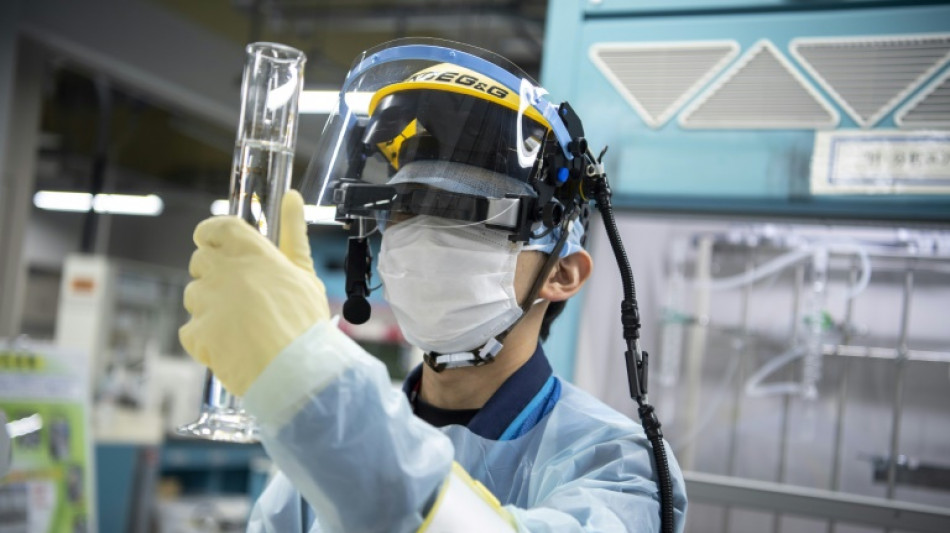
Radioactive fuel, contaminated water: the Fukushima clean-up / Photo: ©

 Kremlin critic Kasparov says US intelligence warned life 'in danger'
 Qatar 'ready' if 2030 Asian Games moved back: official

 Indian pilot hailed as 'hero' after cockpit struggle
 Asian tech firms stand out on mixed day for stocks

 Flags and pho on show as jeweller opens huge Vietnam plant
 Indian football fans relish rare friendly against Brazil

 Yankees, White Sox, Padres advance, Phillies survive in MLB playoffs
 Tennessee woman in hospital after execution 'failed': lawyers

 Cable car offers small hope for Mongolia's gridlocked capital

 Man City scandal risks damage to Premier League's booming brand

 First-time Sepang F1 racers will master track 'from opening lap'
 Japan tightens rules for foreigners wanting permanent residency

 'Happiest moment': China's Mu first woman to win eSports Games gold

 EU talks deportations as five nations seek migrant centre in Africa
 Kenneth Branagh examines the scars of Iraq war in 'Atonement'

 Hundreds held, dozens wounded as French school protests escalate
 US government's new AI chatbot pulls back from debunking Trump
 US tennis star Navarro reveals health battle, ends season
 Panic, anger, tears: Evan Gershkovich's uneasy journey after Russian jail

 UK PM says 'strong indications' Iran involved in airbase incident

 Google restricts access to new AI model over safety concerns

 Watchdog clears former US Fed chief Powell in renovation probe

 Israel PM hails Indian pilot of rerouted flight for averting disaster

 Fury, Joshua kick off 'battle of Britain' in good spirits

 Ronaldo leaves Portugal training camp after coach says he is dropped

Eleven years after a devastating tsunami hit Japan's northeast, thousands of workers at the Fukushima Daiichi nuclear plant are involved in the complex and decades-long process of decommissioning the site.
Here are some facts about the situation at the plant, which AFP visited this month:
The damage
Three of Fukushima's six reactors were operating when the tsunami hit on March 11, 2011. They went into meltdown after their cooling systems failed when waves flooded backup generators.
There was no fuel in the three other reactors, but hydrogen blasts at units 4, 1 and 3 caused extensive damage.
Evidence of the blasts' power is still visible at the top of unit 1, where the warped metal framework remains exposed to the air, and on unit 3 damaged walls stripped of paint sit under a new roof cover.
Cranes tower over several units, while workers in coveralls and wearing dosimeters, full-face respirators, and helmets operate machinery nearby.
Elsewhere, abandoned administrative buildings stand empty, while green lanes along roads show where workers can walk without protective gear.
Fuel rods
Fuel rods have been removed from two units and the process is ongoing at 5 and 6, which were undamaged in the accident.
But at unit 1, large amounts of radioactive rubble must be cleared to access the rods. To avoid spreading radioactive dust, workers are installing a new roof and hope to begin removing rubble in 2027.
At unit 2, radiation levels are so high that plant operator TEPCO plans to access the rods by sending in robots from two platforms, one of which has been built so far.
Fuel rod removal is expected to start there from around spring 2024.
Fuel debris
In units 1-3, fuel and other material melted and then solidified into highly radioactive "fuel debris".
TEPCO has spent years assessing the location and scale of the problem, Keisuke Matsuo, a risk communicator at the plant, told AFP.
"We started investigating the inside of reactor 1 in February, hoping to understand the condition of debris and sediment," he said.
"We plan that reactor 2 will be the first from which we remove fuel debris, and we plan to start this year."
A robotic arm for the process was delivered in July after a pandemic delay, and is being tested.
Contaminated water
The site produces 140 cubic metres of contaminated water a day -- a combination of groundwater, seawater and rainwater that seeps into the area, and water used for cooling.
TEPCO has paved over areas, installed pumps and built an ice wall to keep out water, but the problem keeps growing.
The water is filtered to remove various radionuclides and moved to storage tanks, with 1.29 million tons on site already and space expected to run out in around a year.
The white, grey and blue tanks dominate much of the site, between a few pine and cherry trees that survived the accident and decontamination.
TEPCO says the water treated by its ALPS system meets national standards for radionuclide levels, except for tritium.
It plans to dilute the water to reduce tritium levels and release it offshore over several decades via a kilometre-long underwater pipe.
Despite backing from the UN's watchdog, the plan is controversial, and TEPCO faces opposition from local communities and some neighbouring countries.
"We believe the ALPS-treated water is safe," said Matsuo.
"It will be essential that we have public understanding of the water as safe."
Cost
Around 4,000 people work at the plant each day, generating enormous amounts of waste in protective gear alone, including multiple socks, gloves and masks that must be worn on most parts of the site.
The decommissioning is currently expected to take 30-40 years and cost eight trillion yen ($69 billion), which TEPCO says it will cover.
But that figure does not include the cost of treating and disposing of contaminated water.
J.Fankhauser--BTB