
US family reaches deal over cells harvested in 1950s / Photo: © GETTY IMAGES/AFP

 A7 to unveil a service that will re-invent the international payments market

 'Status quo' with EU 'not good enough', UK PM says as summit date set

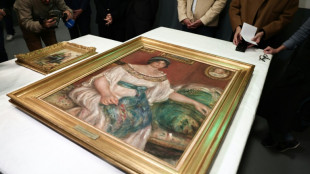 Stolen Renoir paintings found behind wall in France
 French supermarkets suffer refrigerator shutdown after 'unprecedented' cyberattack

 Arsenal lose Hincapie and Zubimendi in freak double blow

 Saudi says resilience tested, vows response after deadly airport attacks
 Alcaraz exits Shanghai Masters in straight-sets loss
 Pope to enter hospital on Tuesday for lung operation

 Renshaw shines again before Australia declaration
 Atletico's Simeone encourages goalless Alvarez improvement
 FXGLOBE Rebuilds Its Copy Trading and PAMM Business With B2BROKER's B2COPY

 Nepal rescuers search for missing after flash flood

 Oil rises as Trump comments roil energy markets

 Premier League in limbo as Manchester City soar

 Zelensky vows to respond as Moscow silent on 'energy ceasefire'
 Thousands march in India's capital to demand election chief resign

 African players in Europe: Mbeumo ends goal drought as United draw
 France's high school students plan fresh protests

 NZ bank in free speech row over 'explicit' sheep memes

 China Open champ Zheng withdraws from Wuhan citing fatigue

 Brewers edge Dodgers 2-1 in National League Championship Series opener

 Pope to have surgery to remove lung nodule
 Stocks rise as oil prices tumble after Trump hails 'energy ceasefire'

 Man City charges cloud hangs over Premier League season
 Top NATO commander set to issue warning to Russia over any attack

A US biotechnology company has reached a settlement with the family of Henrietta Lacks, an African-American woman whose cells were used for groundbreaking medical research without her consent.
Civil rights attorney Ben Crump, who filed a lawsuit in 2021 on behalf of the Lacks' estate, announced on Tuesday that the family had agreed a confidential deal with Massachusetts-based firm Thermo Fisher Scientific.
"The parties are pleased that they were able to find a way to resolve this matter outside of court," Crump said, noting that Tuesday would have been Lacks' 103rd birthday.
Crump, who has represented the family of George Floyd and other Black victims of US police violence, said the settlement provides "some measure of justice for Henrietta Lacks, 70 years later."
The 31-year-old Lacks, a tobacco farmer from Virginia and mother of five, died of cervical cancer in 1951 at Johns Hopkins Hospital in Baltimore.
During attempts to cure her shortly before she died, Lacks' abnormally resilient cancer cells were removed from her tumor and were used for decades by researchers without her family's knowledge.
The cells, dubbed HeLa for the first letters of her first and last names, were the first-ever human cells to grow endlessly in the lab -- all others harvested up to that point died.
- Nobel Prizes -
Research using the cells led to Nobel Prize-winning discoveries, and laboratories worldwide used them to develop vaccines -- notably against polio -- as well as in cloning, in-vitro fertilization and many medicines, fueling an industry now worth billions of dollars.
The family knew nothing of Lacks' role until the 1970s, and only came to understand its full scope thanks to the work of Rebecca Skloot, author of the 2010 bestseller "The Immortal Life of Henrietta Lacks."
Lacks' story was also the subject of an HBO movie starring Oprah Winfrey.
"They treated her like a specimen, like a lab rat," her grand-daughter Kimberly Lacks said in 2021, describing the cell theft as racism.
Thermo Fisher Scientific confirmed the settlement, using the same language as the family lawyers Crump and Chris Seeger.
In filing the lawsuit in 2021, Seeger said that Thermo Fisher was the first of many companies that could face legal action for having "profited from the use" of the HeLa cells.
On its website, Johns Hopkins Hospital said that it has never sold or benefited from the discovery or distribution of HeLa cells, and does not own the rights to them.
"HeLa cells were offered freely and widely by Johns Hopkins for scientific research," it said.
"Johns Hopkins has worked in close coordination with several members of the Lacks family over the past decade to recognize and honor Henrietta Lacks, including scholarships, engagement with local schools and annual symposia," it added.
Y.Bouchard--BTB