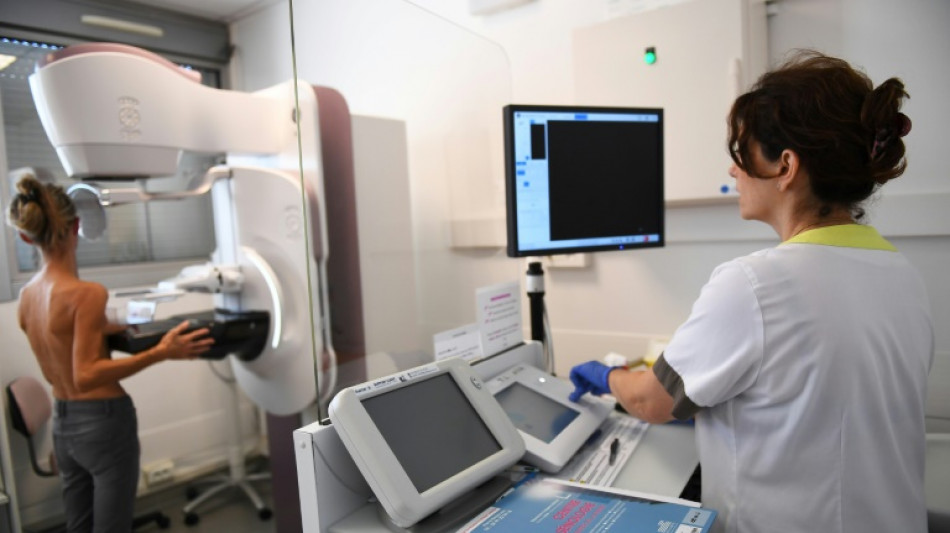
AI could halve time reading breast cancer scans, study suggests / Photo: © AFP/File

 A7 to unveil a service that will re-invent the international payments market
 'Status quo' with EU 'not good enough', UK PM says as summit date set
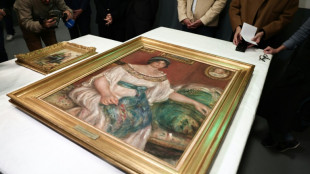 Stolen Renoir paintings found behind wall in France
 French supermarkets suffer refrigerator shutdown after 'unprecedented' cyberattack
 Arsenal lose Hincapie and Zubimendi in freak double blow

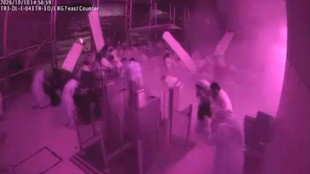 Saudi says resilience tested, vows response after deadly airport attacks
 Alcaraz exits Shanghai Masters in straight-sets loss
 Pope to enter hospital on Tuesday for lung operation
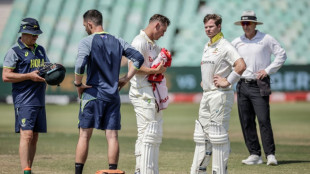
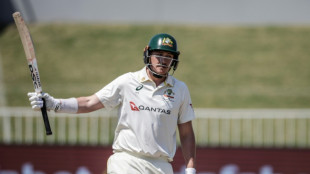 Renshaw shines again before Australia declaration
 Atletico's Simeone encourages goalless Alvarez improvement
 FXGLOBE Rebuilds Its Copy Trading and PAMM Business With B2BROKER's B2COPY

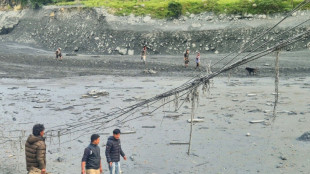 Nepal rescuers search for missing after flash flood
 Oil rises as Trump comments roil energy markets
 Premier League in limbo as Manchester City soar
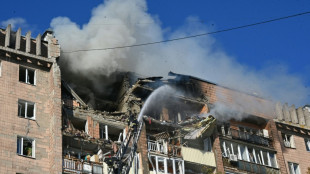 Zelensky vows to respond as Moscow silent on 'energy ceasefire'
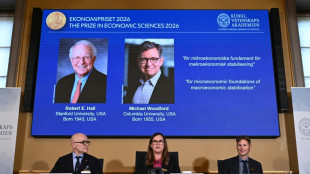
 Thousands march in India's capital to demand election chief resign

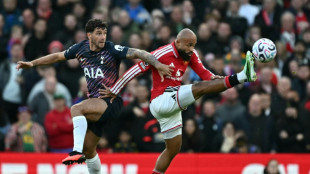 African players in Europe: Mbeumo ends goal drought as United draw

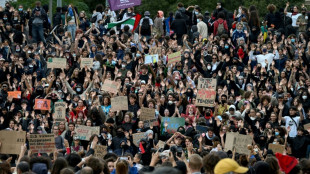 France's high school students plan fresh protests
 NZ bank in free speech row over 'explicit' sheep memes

 China Open champ Zheng withdraws from Wuhan citing fatigue
 Brewers edge Dodgers 2-1 in National League Championship Series opener
 Pope to have surgery to remove lung nodule
 Stocks rise as oil prices tumble after Trump hails 'energy ceasefire'
 Man City charges cloud hangs over Premier League season
 Top NATO commander set to issue warning to Russia over any attack

Artificial intelligence could help almost halve the workload of radiologists when it comes to searching routine scans for signs of breast cancer, a large Swedish study suggested on Wednesday.
The interim results of the trial were hailed as promising, but the authors cautioned that more research was needed before AI can be used to screen for breast cancer on a wider scale.
While increasingly convincing chatbots such as ChatGPT have driven speculation about the future potential applications of AI, one area in which the technology has already shown proficiency is in reading medical scans.
With many countries suffering from a shortage of radiologists, there are hopes that AI could make the time-consuming job of analysing routine scans quicker and more accurate.
This could have a particularly large impact for breast cancer. More than 2.3 million women were diagnosed with the cancer in 2020 alone, according to the World Health Organization, and it caused 685,000 deaths.
Regular screening is vital to identifying early signs of cancer. In Europe, women aged 50 to 69 are advised to get a mammogram every two years, with the resulting scan analysed by two radiologists.
The study in Sweden involved the scans of 80,000 women who had mammograms at four sites in southwest Sweden between April 2021 and July last year.
- 'Considerable importance' -
Their scans were randomly divided for analysis to either an AI-supported system or two human radiologists, who served as the control group.
The AI algorithm read the scans and predicted the risk of cancer out of 10. Its predictions were then checked by a radiologist.
The AI-supported system spotted 20 percent more cancers, the study said, which worked out to be an additional case for every thousand women screened.
When it came to false positives -- when a mammogram is first thought to look suspicious but is later cleared -- both the AI-supported system and the two humans spotted the same rate: 1.5 percent.
And the workload for radiologists was reduced by 44 percent for the AI group, because only one person was required to read the scans rather than the normal two.
"The greatest potential of AI right now is that it could allow radiologists to be less burdened by the excessive amount of reading," said Kristina Lang, a radiologist at Sweden's Lund University and lead author of the study.
But Lang said the "promising interim safety results" were "not enough on their own to confirm that AI is ready to be implemented in mammography screening," she said in a statement.
It will take two more years before the trial can say whether using AI leads to a reduction in what are called interval cancers, which are detected between routine screenings, the researchers cautioned.
Stephen Duffy, a professor of cancer screening at Queen Mary University of London who was not involved in the study, pointed out that the AI algorithm may have over-diagnosed certain forms of early breast cancer called ductal carcinoma in situ.
Nonetheless, he praised the "high-quality study", saying that reducing the burden on radiologists' time was "an issue of considerable importance in many breast screening programmes".
P.Anderson--BTB