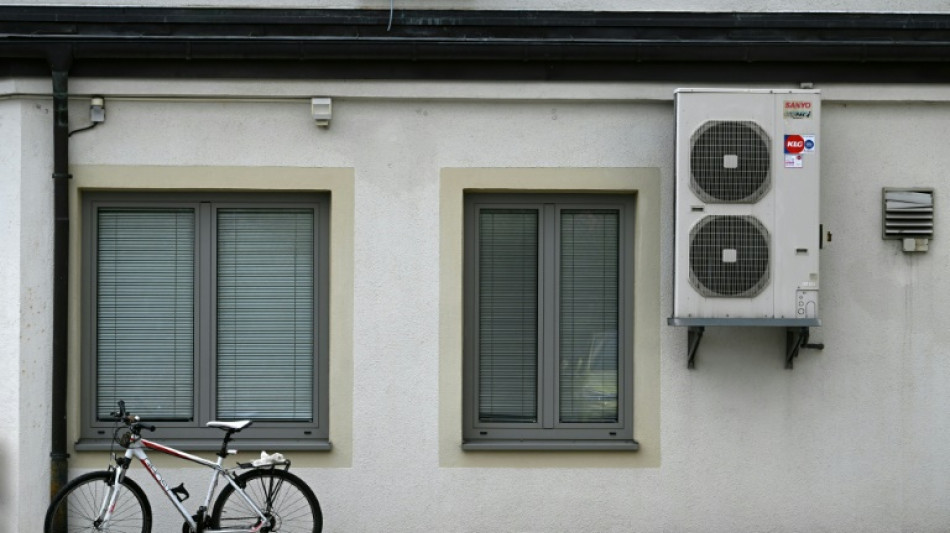
Less power, lower emissions: improving AC technology / Photo: © AFP

 A7 to unveil a service that will re-invent the international payments market

 'Status quo' with EU 'not good enough', UK PM says as summit date set

 Stolen Renoir paintings found behind wall in France

 French supermarkets suffer refrigerator shutdown after 'unprecedented' cyberattack

 Arsenal lose Hincapie and Zubimendi in freak double blow

 Saudi says resilience tested, vows response after deadly airport attacks

 Alcaraz exits Shanghai Masters in straight-sets loss
 Pope to enter hospital on Tuesday for lung operation

 Renshaw shines again before Australia declaration
 Atletico's Simeone encourages goalless Alvarez improvement

 FXGLOBE Rebuilds Its Copy Trading and PAMM Business With B2BROKER's B2COPY

 Nepal rescuers search for missing after flash flood

 Oil rises as Trump comments roil energy markets

 Premier League in limbo as Manchester City soar

 Zelensky vows to respond as Moscow silent on 'energy ceasefire'
 Thousands march in India's capital to demand election chief resign
 African players in Europe: Mbeumo ends goal drought as United draw

 France's high school students plan fresh protests

 NZ bank in free speech row over 'explicit' sheep memes

 China Open champ Zheng withdraws from Wuhan citing fatigue

 Brewers edge Dodgers 2-1 in National League Championship Series opener

 Pope to have surgery to remove lung nodule

 Stocks rise as oil prices tumble after Trump hails 'energy ceasefire'

 Man City charges cloud hangs over Premier League season
 Top NATO commander set to issue warning to Russia over any attack

With air conditioner demand surging, scientists are looking for ways to improve the energy efficiency of cooling systems and limit damaging emissions that accelerate global warming.
- Improve efficiency -
Innovation is focused on three major fronts, with much of the attention on energy consumption. Air conditioning units account for six percent of electricity used in the United States.
Several breakthroughs have already cut power consumption by half since 1990, according to the US Department of Energy.
The most impactful was the so-called "inverter" technology, which makes it possible to modulate the motor's speed instead of running it at 100 percent continuously.
Other new features include demand controlled ventilation (DCV), which relies on sensors to determine the number of people in the building and adjust airflows.
- Different refrigerants -
Another major area is the search for substitutes to the refrigerant gases used in most of the nearly two billion installed AC units, according to the International Energy Agency.
For decades, air conditioners almost exclusively ran on chlorofluorocarbon (CFC) or hydrochlorofluorocarbon (HCFC) gases, which are thought to be up to 10,000 times as bad as CO2 in terms of global warming impact.
CFC and HCFC were banned under the Montreal Protocol, from 1987.
Then came hydrofluorocarbons (HFCs), which are now scheduled to be phased out by 2050.
Factories and commercial buildings already use other gases, such as ammonia -- which has no greenhouse gas impact -- as well as hydrocarbons, mainly propane, whose emissions are lower than methane.
"In some countries, you're starting to see hydrocarbon refrigerants," mostly propane, "being used, but there are restrictions around how much quantity you can put into the system" because such gas is flammable, said Ankit Kalanki, manager at the Rocky Mountain Institute.
Mandatory safety features make for a "level of sophistication" with "a price premium that gets added to the units itself," he added.
"And the residential air conditioning market tends to go towards the lowest first cost products, then the highest efficiency products."
Some are trying to go gasless, like Pascal Technology, a Cambridge, Massachusetts startup, that's working on a mechanism to keep refrigerants in a solid state, avoiding any discharge.
- A new generation -
Other innovation is focused on products that bypass compression, an energy-intensive process in air conditioning that has changed little since its invention in 1902.
Separate groups of scientists at the National University of Singapore (NUS) and the Wyss Institute at Harvard University, respectively have built air conditioners that use water to cool the air.
The Wyss Institute has already made prototypes based on its cSNAP model, that operates on a quarter of the electricity used in the traditional compression process.
The device is partly built with ceramic panels, made in Spain.
The startup Blue Frontier, which counts Bill Gates as an investor, uses a salt solution that captures the humidity of the air, then cools it through contact with water.
The solution also makes it possible to store energy, "so you're not having to deal with capacity limits of the infrastructure," said Daniel Betts, Blue Frontier's CEO.
The Florida-based startup plans to rent its AC units to commercial building owners for a subscription fee, recouping its investment from electricity savings.
Usually, acknowledges Betts, "building owners don't see the value, except for marketing, of having higher efficiency equipment."
"We eliminate the burden of financing high efficiency equipment, because we're doing it as a subscription service."
Air conditioning innovation has been slower to address the third major issue related to conventional units, the discharge of hot air outside buildings.
One of the few available options are geothermal heat pumps, which employ a grid of buried pipes that channel cooler temperatures from underground, and do not release warm air.
A.Gasser--BTB