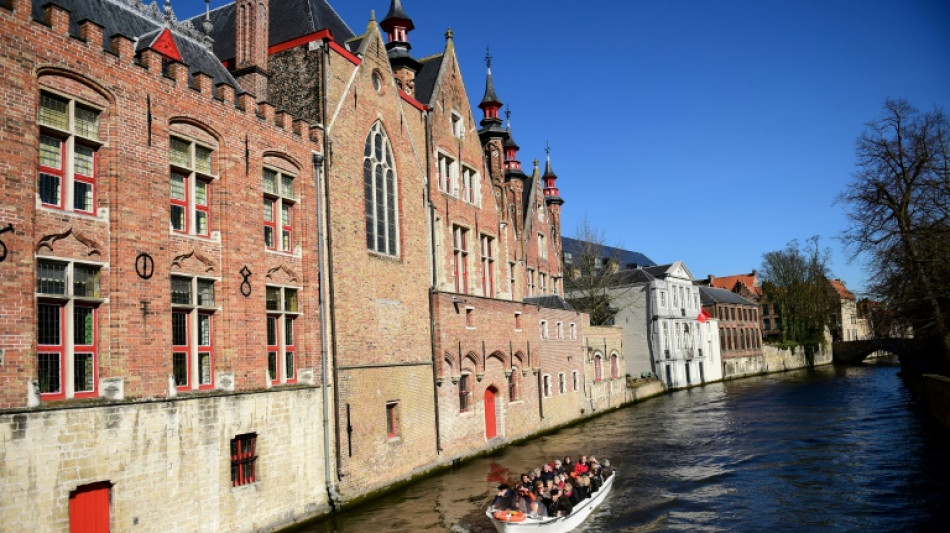
Belgium canal city of Bruges hits 'red line' with tourist crowds / Photo: © AFP/File

 Brazil's patron saint reappears in polarized election campaign

 US Open champ Zverev to become tennis world number one

 Migrant crisis wounds unhealed in Ceuta as Spanish royals visit

 Brazilian judge allows Flavio Bolsonaro to visit jailed father

 France braces for fresh student demonstrations as Macron calls for 'respect'

 Zelensky doubtful on Russian acceptance of Trump's 'energy ceasefire'

 Federal agents search home of Trump critic Ilhan Omar: government

 Pakistan detains hundreds from ex-PM Khan's party as protests falter

 Australia's Smith off field after being struck on helmet

 UK retains early access to test latest US AI models

 Top NATO commander warns Russia any attack would be 'futile'

 Stolen Renoir paintings found behind wall in France: prosecutor

 UNHCR sounds alarm on funding crisis

 French supermarket chains say cyberattack forced refrigerator shutdown

 Minister's resignation rocks German coalition

 Hurricane Simon lashes Mexico's Pacific coast, threatens landfall

 France schools protest rumbles on as Macron urges 'respect'

 Americans Hall and Woodford win economics Nobel for stabilisation models

 MEXC Brings AI, TradFi and the Future of Trading to Life at TOKEN2049 Singapore

 Italian rice farmer beats heat with biodiversity haven

 Stocks mixed as oil prices slip after Trump hails 'energy ceasefire'

 Opposition, journalists allege police abuses during India protests

 DATA Network joins Sui and Walrus to scale the supply chain for AI training data

 Melbourne man linked to suspected flydubai hijacker condemns 'false accusations'

 North Korea fires 'several ballistic missiles' into Sea of Japan

Inhabitants of Belgium's cobblestone-and-canal city of Bruges are clear: summertime tourism has hit capacity.
"It's really reached a red line now," says one, 55-year-old architect Arnout Goegebuer, as he sits inside a cafe, peering out a window across a packed outside terrace.
"We don't need more tourists anymore, it's enough -- maybe a little bit less" is needed, he says.
It's a sentiment reiterated by other residents of the western city, population 119,000, which each year hosts eight million visitors -- most of them concentrated in the summer months, and most of them on day trips.
Residents are not against tourism, which brings money and prestige and provides jobs.
But they say it needs to be balanced, to stop the city turning into a Disneyfied open-air museum.
With Bruges crowds back to pre-Covid levels, including from cruise ships docking in nearby Zeebrugge port and disgorging passengers who spend just a few hours, "there's a lot of trouble" for locals, says Kurt Van Der Pieter, a 62-year-old retiree who lived his whole life in the city.
"People of Bruges say it's too much, it's too much -- very too much some days," he says.
The situation is not unique to Bruges. Europe's other top historical canal cities of Venice and Amsterdam have both taken steps to bar cruise ships calling.
Venice received a wake-up call in July when UNESCO recommended the city be put on its endangered list because of over-tourism and other problems.
An August 2022 ranking published by an Airbnb competitor called Holidu put Venice, Bruges and the Greek island of Rhodes in equal second place in its list of the most overcrowded European destinations based on the number of tourists versus inhabitants.
The Croatian walled city of Dubrovnik -- famed as the backdrop for much of The Game of Thrones fantasy TV series -- came first on the list.
Bruges's tourist authority, Visit Bruges, disputes Holidu's ranking and says its own figures, based on usage of mobile devices while in Bruges, show that daily there are 131 visitors per 100 inhabitants.
"Bruges is often referred to as a mass tourism destination, but it isn't," a spokeswoman, Ann Plovie, tells AFP.
- Tourism strategy -
"This is like a bit (of a) misconception that the city is overcrowded. Indeed, I can't deny that there are many tourists, but you should come on different periods and then you would see also the difference," adds another spokeswoman, Anne De Meerleer.
In 2019, Bruges implemented a five-year strategy to boost overnight stays, spread the tourist numbers around geographically and over each year, and to lure visitors more interested in cultural and gastronomic deep-dives than selfies and waffles.
"Our aim is to get not more visitors, not the volume is important, but the kind of visitors we get," De Meerleer says as she guides a visitor to stunning spots that are almost empty and are just a couple of streets from the main market square.
The results of the strategy are unclear, torpedoed by the 2020-2021 collapse in tourism caused by Covid travel restrictions around the world.
Bruges's city centre also faces tensions over accommodation options for overnight stays, with a halt to buildings being converted to hotels to ensure locals aren't squeezed out.
Unlike cities like Milan, Bruges has not banned private vehicles from its historic district, though the railway station is a short walk away. Car registration plates come from all over Europe.
The Belgian city is already at work on its next five-year strategy, this one with an emphasis on sustainability.
- Visitors' views mixed -
The mix of tourists walking around in Bruges is even broader, as is their verdict as to whether they found the place overcrowded or not.
"I didn't think there would be this much people," says Lee Hotae, a South Korean tourist admiring the city architecture in a guided group visit.
"It's not that busy actually. It's like going to somewhere that's as nice as Amsterdam or Florence or Venice, but not as overrun," says a Scottish tourist, Ross Henderson, 43.
A 59-year-old French tourist, Ariele Delattre, who had made the short trip to Bruges from her hometown of Lille, near the Belgian border, says a canal boat ride revealed the tourist diversity.
The boat's driver "asked what nationalities were present on the boat, and it's true that we had Asians, Germans, Britons, French, Indians -- people from everywhere," she says.
Diego Rodriguez, a 41-year-old Venezuelan tourist walking around in a Spanish-speaking guided tour, said he found the tourist numbers "fine like this, especially as we're in the summer months, the vacation months".
He added that he had visited Bruges a couple of months earlier "and it was emptier, but it was spring and it was colder, people weren't on holiday".
M.Furrer--BTB