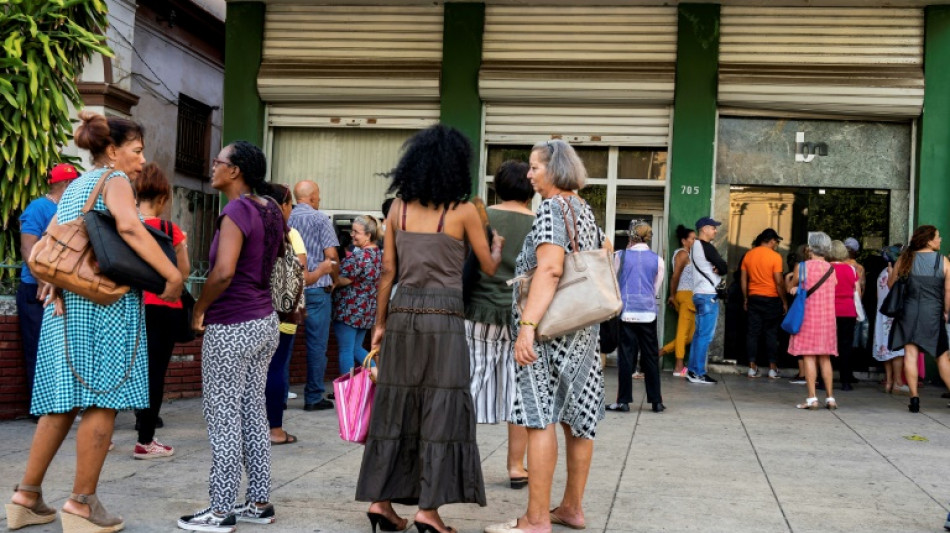
Cubans wary of banks as government cracks down on cash / Photo: © AFP

 US actress Selma Blair arrested after flight altercation

 One dead as Hurricane Simon creeps along Mexico's Pacific coast
 Carrick's Man United 'hungry and eager' to fix worst start in decades

 Fury as US federal agents search anti-Trump lawmaker's home

 One goal enough for Flick as Barca enter Galatasaray cauldron
 A7 to unveil a service that will re-invent the international payments market
 'Status quo' with EU 'not good enough', UK PM says as summit date set
 Stolen Renoir paintings found behind wall in France

 French supermarkets suffer refrigerator shutdown after 'unprecedented' cyberattack

 Arsenal lose Hincapie and Zubimendi in freak double blow

 Saudi says resilience tested, vows response after deadly airport attacks
 Alcaraz exits Shanghai Masters in straight-sets loss
 Pope to enter hospital on Tuesday for lung operation

 Renshaw shines again before Australia declaration

 Atletico's Simeone encourages goalless Alvarez improvement

 FXGLOBE Rebuilds Its Copy Trading and PAMM Business With B2BROKER's B2COPY

 Nepal rescuers search for missing after flash flood
 Oil rises as Trump comments roil energy markets

 Premier League in limbo as Manchester City soar

 Zelensky vows to respond as Moscow silent on 'energy ceasefire'

 Thousands march in India's capital to demand election chief resign

 African players in Europe: Mbeumo ends goal drought as United draw

 France's high school students plan fresh protests

 NZ bank in free speech row over 'explicit' sheep memes
 China Open champ Zheng withdraws from Wuhan citing fatigue

Accustomed to lugging around thick wads of cash, Cubans are skeptical of government efforts to force them to deposit their money into a crumbling banking system, in an effort to curb runaway inflation and boost liquidity.
The communist country is experiencing its worst economic crisis in decades, with double-digit inflation and rampant money printing in recent years boosting the amount of cash on the street.
Long wary of the country's poorly functioning banks, Cubans have in recent months embraced cash even more, to avoid long lines and withdrawal limits at ATMs.
The government, seeking liquidity, transparency, and greater control over monetary flow, last week announced restrictions on cash payments to force businesses and citizens to use electronic payments.
Cash transactions will be limited to 5,000 pesos (about $20 on the black market), under the reform which is to be gradually implemented over the next six months.
"In the times we are living in, 5,000 pesos is nothing," said mechanical engineer Lisandra Pupo, 30, who like most Cubans, prefers to have her cash safely in hand.
Soaring prices and the loss of value of banknotes mean people on the island have to cram cash into a bag or backpack to pay even minor purchases.
"If I had a lot of money, I would not put it in the bank, because if I need it tomorrow and I go to the bank, they will not be able to give it to me, so I will have to wait three days, or until the bank has enough money," said Pupo.
Independent economist Omar Everleny Perez said that "with such high prices and the inexistence of high denomination banknotes" the push toward banking is essential.
- Outdated banking tech -
However, Cuba's outdated banking system risks leaving users with no way of accessing their money at all.
Internet is unreliable, many people don't have smartphones for contactless payments, and Central Bank president Joaquin Alonso on Monday admitted there were few terminals for card payments.
"To install point-of-sale terminals, a communication line is required ... now imagine how much investment we would need to put terminals in all points of sale," said Alonso.
"This demands a lot of us, but we are not saying we won't move forward.
"Today there is a significant level of cash that is outside the banking system. That money does not circulate through the logical paths of the economy and is only traded between people," said Alonso.
He said the mass of freely circulating cash was "incentivizing the inflationary spiral."
- Complex economic crisis -
The island nation's current economic crisis is multi-pronged, and comes with a backdrop of decades of US sanctions, inefficiency, lack of foreign investment, and a heavy reliance on imports.
Former US President Donald Trump toughened sanctions against Cuba, and then the Covid pandemic battered the tourism industry -- the government's main source of foreign exchange -- which has battled to recover.
In 2021, a monetary reform phasing out a convertible peso pegged to the dollar, led the regular peso's value to plummet.
There are endless queues for food, fuel, and medicine, prompting an exodus of Cubans seeking to flee the island.
Year-on-year inflation reached 45.8 percent in May, while in 2022 it was 39 percent, according to official figures, but analysts believe it has already reached triple digits.
Small businesses in Cuba, given legal status for the first time in 2021 in a country where state-run stores were long the only option, also dread the switch to electronic transactions.
Private business consultant Oniel Diaz wrote on his Facebook account that these businesses will lose their ability to import "in an environment of scarcity and inflation."
lp/mr/fb/tjj
L.Dubois--BTB