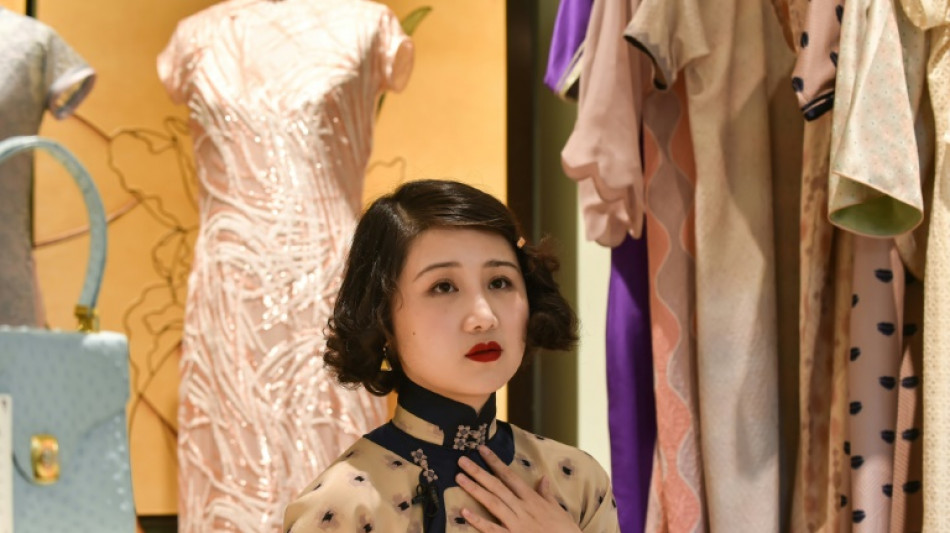
Shanghai tailors keep qipao dress tradition alive / Photo: ©

 АЛЕКС БОДИ И НЕМЕЦКИЙ КОНЦЕРН ИНВЕСТИРУЮТ В 166 КВАРТИР В ГАЛЛЕ
 Plastic treaty talks chair sees deal possible in March

 ALEX BODI AND GERMAN CONGLOMERATE INVEST IN 166 APARTMENTS IN HALLE

 Afghanistan says deadly Pakistani strikes hit Helmand

 India thump Sri Lanka, will face Pakistan for Asian Games cricket gold
 Woman in hospital after Tennessee's second failed execution in 2026

 Cash-strapped Senegalese unmoved by Youth Olympic Games

 Indonesia haze chokes neighbours, but little legal recourse

 Samad launches Pakistan into first Asian Games men's cricket final

 Yankees and White Sox advance, Phillies survive in MLB playoffs

 Asian stocks mixed as positive US data offset by elevated oil, bond yields
 Rice work: Dutch test new crop to save sinking peatlands

 Russians join street choirs to sing away sorrows -- or show dissent

 UK fears grow over AI giant Palantir's health service deal

 Empty nets in Latin America as fish flee El Nino

 Meidroth blasts White Sox through, Phillies survive in MLB playoffs

 'Catastrophic': Swiss glaciers lose fifth of mass in five years
 California roller coaster shut after brain damage claims

 Panama ministers push for reopening of huge open-pit copper mine

 Bohm's blast keeps Phillies alive in MLB playoffs

 US judge accepts Paramount's Warner Bros. buyout settlement

 Global stocks mixed as markets weigh higher oil prices, bond yields

 Marsh hails improvements after Australia win final one-day international

 Hegseth says US cut number of generals, admirals by 20%

 Kanye West's Russian concerts have been cancelled, organisers say

Zhou Zhuguang surveys his Shanghai workshop and rows of workers meticulously stitching high-collared Chinese dresses known as qipao, some of which sell for nearly $5,000.
"It's a highly skilled craft," said Zhou, co-founder of Hanart, one of China's most well-known qipao makers.
"Some of our tailors spend a lifetime learning to make qipao."
The price tag also reflects enduring demand for the qipao, known as a cheongsam in Hong Kong and overseas Chinese communities.
Drawing on traditional design elements, the dress was popularised in 1920s Shanghai, its form-fitting cut capturing the glamour of that free-wheeling pre-communist era and the desire of Chinese women to liberate themselves from traditionally subservient roles.
The qipao disappeared after the Communist Party -- which considered it decadent and bourgeois -- took power in 1949.
The dress's comeback is due in part to producers like Zhou.
A mass-produced qipao, sometimes seen at weddings or other formal occasions, can be bought today for as little as 100 yuan ($16).
But Zhou, 59, has found a market for higher-end designs among well-heeled Chinese fashionistas.
Zhou previously dealt in lower-priced qipao before founding Hanart in 1998 in partnership with Chu Hongsheng, a legendary qipao designer who fitted Chinese film actresses and the wives and daughters of Shanghai mafia bosses. Chu died in 2017 at the age of 99.
- Cultural value -
"(Low price) isn't the true essence of the qipao," said Zhou, who feels that such an iconic Chinese fashion staple requires more luxurious materials, bolder designs and hand-crafted precision, which inevitably push prices up.
Zhou displayed these at a Shanghai show late last year which featured "modern, altered qipao" designs combining the classic Mandarin collar and body-hugging fit with less traditional elements such as lace, fringes, velvet, sequins and rich embroidery.
"We want more young people to wear qipao," Zhou said of his design re-boot.
To Yang Zhenzhen, who owns a Shanghai qipao shop and is an online influencer of the dress style, cracking the youth market is essential to keeping the tradition alive.
Her shop targets buyers aged 25-45 with qipao starting at around $600.
"Young people bring new life and energy" to the qipao, said Yang, 28, who has been smitten with the dress since childhood and began collecting them five years ago.
"If young people don't wear them, then by the time they grow old there won't be anyone wearing them," she said.
Yang admitted that youth acceptance suffers from a stereotype that qipao are for elderly women, or the belief that pop culture uses the dress to objectify Chinese women.
"These are deep misconceptions... so I want to popularise it as best I can and let people know the real meaning of qipao," she said.
That includes the dress's role in breaking down gender norms for women during the 1920s. The sense of freedom associated with that will never go out of style, she adds.
For Zhou, selling qipao is about perpetuating an element of China's intangible cultural heritage.
"We are small, but we are carrying on a piece of culture," he said.
"That's where our biggest value is."
C.Meier--BTB