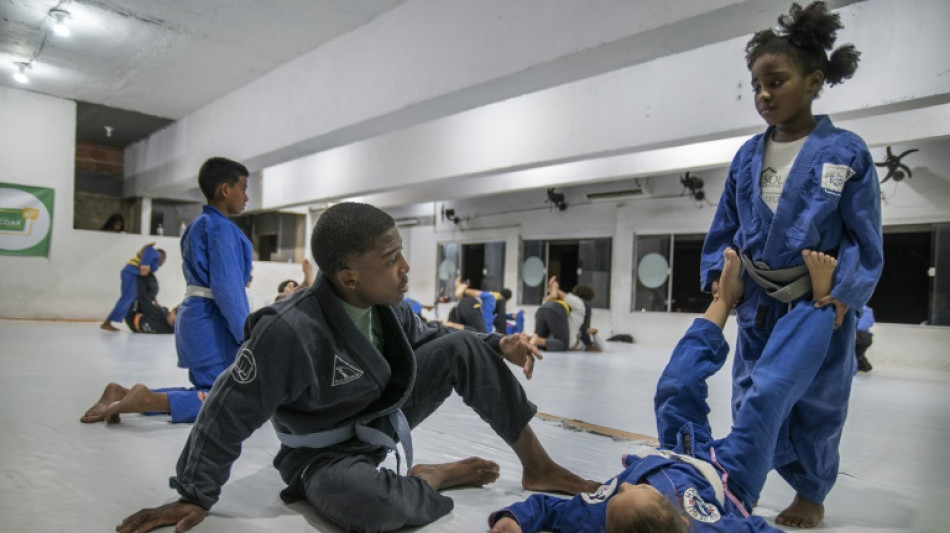
Brazilian jiujitsu offers lifeline to Rio favela kids / Photo: © AFP

 'Breaking Bad' actor RJ Mitte dead: representatives

 Former DR Congo president Kabila forms new force with M23 armed group

 Tom Cruise's 'Digger' tanks, leaving studio with $250 mn hole

 US actress Selma Blair arrested after flight altercation

 One dead as Hurricane Simon creeps along Mexico's Pacific coast

 Carrick's Man United 'hungry and eager' to fix worst start in decades

 Fury as US federal agents search anti-Trump lawmaker's home

 One goal enough for Flick as Barca enter Galatasaray cauldron

 A7 to unveil a service that will re-invent the international payments market

 'Status quo' with EU 'not good enough', UK PM says as summit date set
 Stolen Renoir paintings found behind wall in France

 French supermarkets suffer refrigerator shutdown after 'unprecedented' cyberattack

 Arsenal lose Hincapie and Zubimendi in freak double blow
 Saudi says resilience tested, vows response after deadly airport attacks
 Alcaraz exits Shanghai Masters in straight-sets loss

 Pope to enter hospital on Tuesday for lung operation

 Renshaw shines again before Australia declaration

 Atletico's Simeone encourages goalless Alvarez improvement
 FXGLOBE Rebuilds Its Copy Trading and PAMM Business With B2BROKER's B2COPY

 Nepal rescuers search for missing after flash flood

 Oil rises as Trump comments roil energy markets
 Premier League in limbo as Manchester City soar

 Zelensky vows to respond as Moscow silent on 'energy ceasefire'

 Thousands march in India's capital to demand election chief resign

 African players in Europe: Mbeumo ends goal drought as United draw
In a hilltop slum crammed between two of Rio de Janeiro's wealthiest neighborhoods, children practice Brazilian jiujitsu, hoping to follow in the footsteps of the black belts whose graffiti portraits decorate their gym's walls.
Brazilian jiujitsu has provided an escape route for numerous kids from the rough alleys of Cantagalo, an impoverished favela whose shacks spill down a hill between the upscale beach neighborhoods of Copacabana and Ipanema.
Taking a break from teaching holds to a group of boys grappling on the mat, jiujitsu master Douglas Rufino says he has seen the sport literally save kids' lives.
"I can say it saved me, too," says Rufino, 41.
"I could have followed another path here in the community," a neighborhood rife with drug gangs and violence, he says.
Instead, the Cantagalo native went on to win the world lightweight championship in 2006. His face is now one of those painted on the walls of the gym -- a hall of fame of sorts, paying tribute to the favela's greatest black belts.
Rufino has been teaching for the past 20 years at the Cantagalo Jiujitsu gym, part of a project founded in 2000 to channel the power of the sport -- which is hugely popular in Brazil -- to help children in the favela.
"The idea is to give them a better future and the chance to make a living from jiujitsu," says Rufino.
- 'Way to break through' -
The school has produced numerous champions, and former students now practice and teach Brazilian jiujitsu in Portugal, Singapore, Sweden and the United States.
Beyond teaching takedowns, holds and sweeps, the program aims to impart life values.
"Lots of kids arrive here with a rebellious streak. But they leave with discipline, because that's what jiujitsu is: respect and discipline," says 17-year-old student Fabiano dos Santos Guedes.
It takes years of training to become a black belt, but Guedes is unfazed.
"I love coming to practice. My dream is to be a world champion and live overseas," he says.
In the leafy neighborhood of Laranjeiras, national lightweight champion Beatriz Freitas says she has the same dream -- and sees the same benefits of jiujitsu, which she started studying three years ago.
"I was going through a very stressful time in my life. I was aggressive at home and in school," says Freitas, 22, who comes from the nearby favela of Julio Otoni.
"Jiujitsu gave me a way to break through that."
- Controversial history -
Jiujitsu, an ancient Japanese martial art, arrived in Brazil in the early 1900s, introduced by an immigrant jiujitsu master named Mitsuyo Maeda.
His students refined and adapted the sport, giving birth to Brazilian jiujitsu, or BJJ, whose techniques enable skilled practitioners to dominate bigger, stronger opponents.
The brutally effective discipline is credited with igniting the multimillion-dollar international craze for mixed martial arts (MMA) cage fighting, and has become one of Brazil's best-known sporting exports, after its world-famous football.
But just as the BJJ trend boomed, its image took a hit in Brazil.
In the 1990s and 2000s, Brazilian jiujitsu made headlines over a rash of street fights and bar brawls in Rio.
Local media dubbed those involved "pitboys," for a stereotype they supposedly fit: muscular, white, male jiujitsu practitioners who owned pit bulls.
"Some of the cases involved jiujitsu fighters, and the jiujitsu trend was huge at the time, so the press latched onto that," says sociologist Bruno Cardoso.
"But there was this label applied that didn't even correspond to some of the incidents."
Today, "things are much calmer," says Rufino.
"People practice jiujitsu for health and wellness, or to turn pro."
F.Müller--BTB