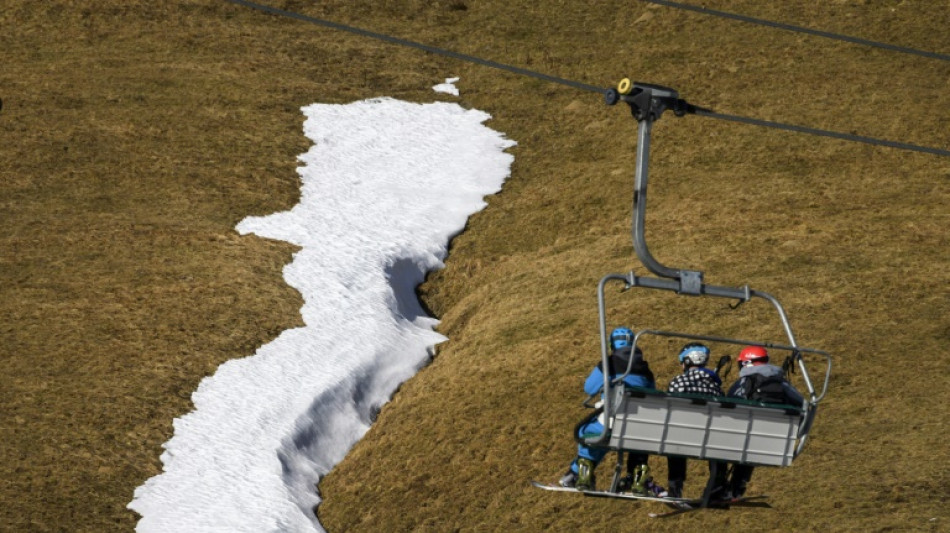
Climate poses 'high risk' for Europe's ski resorts / Photo: © AFP/File

 Pope to be admitted to hospital for lung operation

 Samoa's McFarland welcomes 'massive' arrival of ex-All Blacks for World Cup run-in
 Brewers beat Dodgers 7-4 to extend MLB playoff lead

 Teenager shoots headmaster, teacher at French school

 'Breaking Bad' actor RJ Mitte dead: representatives

 Former DR Congo president Kabila forms new force with M23 armed group
 Tom Cruise's 'Digger' tanks, leaving studio with $250 mn hole

 US actress Selma Blair arrested after flight altercation

 One dead as Hurricane Simon creeps along Mexico's Pacific coast

 Carrick's Man United 'hungry and eager' to fix worst start in decades

 Fury as US federal agents search anti-Trump lawmaker's home

 One goal enough for Flick as Barca enter Galatasaray cauldron

 A7 to unveil a service that will re-invent the international payments market

 'Status quo' with EU 'not good enough', UK PM says as summit date set

 Stolen Renoir paintings found behind wall in France

 French supermarkets suffer refrigerator shutdown after 'unprecedented' cyberattack

 Arsenal lose Hincapie and Zubimendi in freak double blow

 Saudi says resilience tested, vows response after deadly airport attacks

 Alcaraz exits Shanghai Masters in straight-sets loss

 Pope to enter hospital on Tuesday for lung operation

 Renshaw shines again before Australia declaration

 Atletico's Simeone encourages goalless Alvarez improvement
 FXGLOBE Rebuilds Its Copy Trading and PAMM Business With B2BROKER's B2COPY

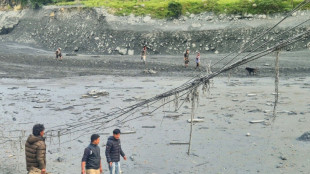 Nepal rescuers search for missing after flash flood

 Oil rises as Trump comments roil energy markets

At current rates of greenhouse gas emissions, which would see Earth's surface warm nearly three degrees Celsius above pre-industrial levels, 90 percent of Europe's ski resorts will eventually face critical shortages of natural snow, researchers said Monday.
Even if the world caps global heating at the Paris climate treaty target of 1.5 degrees Celsius -- a very big if -- a third of the continent's 2,234 resorts would still be highly vulnerable to snow scarcity, they reported in the journal Nature Climate Change.
At this lower temperature threshold, ski spots at higher altitudes and latitudes such as in Nordic countries and the French, Swiss and Austrian Alps can reduce climate risk through mechanical snowmaking.
But this will be of little use to resorts further south and in lower altitudes, according to the study, the first to factor in the cost and carbon footprint of consuming additional energy and water to produce manufactured snow.
"Snowmaking involves investment and operating costs that expose resorts to economic failure risk," lead author Hughes Francois, a researcher at France's National Institute for Agronomics Research, told AFP.
Even where artificial snow can be produced cheaply enough to keep a resort open and turn a profit, however, it also contributes to a vicious circle by increasing global warming due to its energy demands, the study showed.
Half of the world's ski resorts are in Europe, where they generate about $30 billion (28 billion euros) per year and play a key role in sustaining local economies.
Francois and colleagues identified 18 distinct zones, some within a single country's borders and others transnational in scope.
- Less snow, more rain -
Using average snowfall during 1961-1990 as a reference, they combined regional climate models with data on conditions for snowmaking as well as geo-spatial data on mountain areas, resorts and individual ski pistes.
The study looked at how resorts across Europe -- from the British Isles to Turkey, and from Scandinavia to the Mediterranean basin -- would be affected by different levels of global heating: 1.5C, 2C, 3C and 4C.
Earth's surface has, on average, already warmed 1.2C, amplifying extreme weather across the globe.
From the Rocky Mountains to the Alps, ski resorts -- especially those at or below 1,500 metres (5,000 feet) -- already experience foreshortening skiing seasons and declining ski conditions, with snow sometimes replaced by rain.
Scientists predict that the planet could see its first full year at or above 1.5C within a decade.
"In all mountain regions of Europe, future climate change will lead to degraded snow conditions in ski resorts compared to the last decades," said senior author Samuel Morin, a scientist at Meteo-France and France's National Centre for Scientific Research.
If the world warms 3C above mid-19th century levels and without artificial snow, 100 percent of ski resorts would face a very high risk of insufficient snow supply -- every other year, on average -- in the German and Austrian Alps, and in Turkey, the study found.
The corresponding figure for the Swiss Alps is 87 percent, 70 percent in the Nordic Mountains, and 91 percent in the Carpathian Mountains.
If the rise in temperatures is held to 1.5C, the rate of "very high risk" is only 4, 5 and 7 percent in the Swiss, French and Austrian Alps, respectively, rising to 20 percent in the German Alps, and 48 percent in the Nordic Mountains.
D.Schneider--BTB