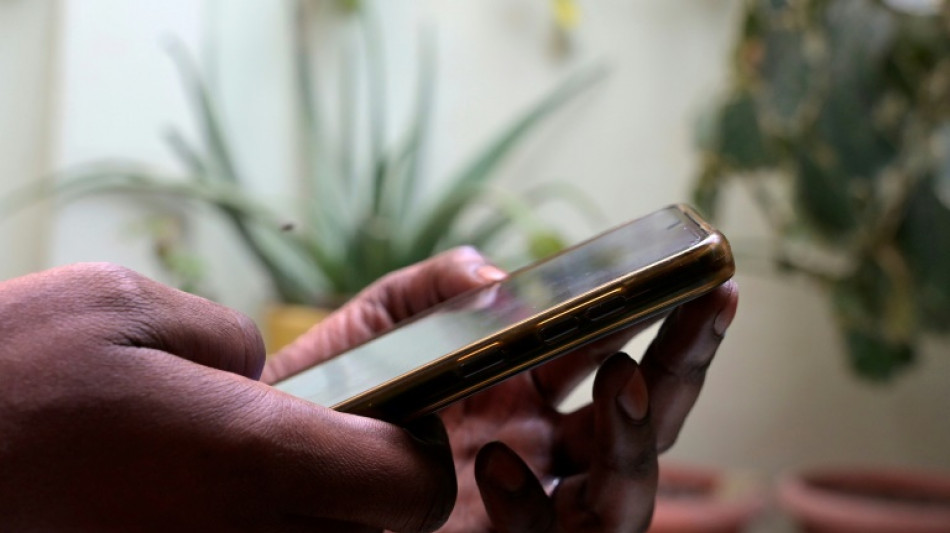
Sex, lies and social media: Women face tough fight in African politics / Photo: © AFP

 Pope to be admitted to hospital for lung operation

 Samoa's McFarland welcomes 'massive' arrival of ex-All Blacks for World Cup run-in
 Brewers beat Dodgers 7-4 to extend MLB playoff lead

 Teenager shoots headmaster, teacher at French school

 'Breaking Bad' actor RJ Mitte dead: representatives

 Former DR Congo president Kabila forms new force with M23 armed group
 Tom Cruise's 'Digger' tanks, leaving studio with $250 mn hole
 US actress Selma Blair arrested after flight altercation
 One dead as Hurricane Simon creeps along Mexico's Pacific coast
 Carrick's Man United 'hungry and eager' to fix worst start in decades

 Fury as US federal agents search anti-Trump lawmaker's home

 One goal enough for Flick as Barca enter Galatasaray cauldron
 A7 to unveil a service that will re-invent the international payments market
 'Status quo' with EU 'not good enough', UK PM says as summit date set

 Stolen Renoir paintings found behind wall in France

 French supermarkets suffer refrigerator shutdown after 'unprecedented' cyberattack
 Arsenal lose Hincapie and Zubimendi in freak double blow

 Saudi says resilience tested, vows response after deadly airport attacks
 Alcaraz exits Shanghai Masters in straight-sets loss
 Pope to enter hospital on Tuesday for lung operation

 Renshaw shines again before Australia declaration
 Atletico's Simeone encourages goalless Alvarez improvement
 FXGLOBE Rebuilds Its Copy Trading and PAMM Business With B2BROKER's B2COPY

 Nepal rescuers search for missing after flash flood
 Oil rises as Trump comments roil energy markets
Soon after Judy Kengo was sworn into office last year, the Kenyan legislator faced her first public test when a doctored photo of a lookalike kissing another woman surfaced online.
The aim of the misleading photo, she says, was to force her to quit her position in the county assembly of Kwale, a staunchly conservative region along Kenya's southern coast.
"You see, here is your leader. What kind of role model is she to our girls?" Kengo, 35, remembers one online user saying after the image began making the rounds.
Kengo's case is far from isolated. There is growing evidence of women across Africa facing online disinformation campaigns aimed at discrediting their ambitions and forcing them out of politics, experts say.
Women in public positions need a "thick skin" to withstand the pressures of online attacks, says Kengo, who refused to be cowed and has since hired bloggers to respond to social media smear campaigns.
"Politics has always been a male-dominated field and for you to penetrate, you have to be very aggressive," she told AFP.
But it is a difficult balancing act.
"When you are aggressive in the way you are addressing the issues, people will say you are too much or are a loudmouth. This is not the same for our male counterparts."
- 'Crude sexualised attacks' -
The attacks, which tend to escalate during election season, are strategically orchestrated to silence women, says Kristina Wilfore, co-founder of global non-profit #ShePersisted, which fights gender disinformation and online abuse.
"The sexualised attacks are very crude, and they are definitely meant to undermine the idea that women are qualified," Wilfore told AFP.
A study conducted in collaboration with #ShePersisted during Kenya's 2022 national elections found that social media platforms enabled "hateful rhetoric towards women to flourish", according to Wilfore.
Even when false information has been fact-checked and corrected, "it still leaves the sentiment that women do not belong in certain public spaces", she added.
The impact is not lost on women lawmakers in Kenya.
"A lot of women fear getting into public spaces, especially public political spaces because of the issues surrounding that space," opposition MP Millie Odhiambo told AFP.
Kenya has continually failed to meet parliamentary quotas that require at least a third of all seats in the national assembly to be filled by women.
Across the continent, women occupy only 24 percent of some 12,100 parliamentary positions, according to a 2021 study by the pan-African project Women in Political Participation.
- 'Degrade women' -
During Rwanda's 2017 election campaign, alleged nude photos of businesswoman and government critic Diane Rwigara surfaced online days after she announced her candidacy for president.
The only female challenger to Rwanda's iron-fisted leader Paul Kagame later told CNN the images had been photoshopped to destroy her electoral chances.
She was eventually blocked from running on the grounds that she allegedly forged supporters' signatures for her application. But a court acquitted her in 2018, calling the charges "baseless".
In April this year, former Kenyan senator Millicent Omanga faced calls to resign from her post as a junior minister after footage of a purported sex tape surfaced on social media.
An AFP investigation found that at least one of the clips featured an amateur porn actor.
But many online users believed it was Omanga, who has never commented publicly on the video and did not respond to calls from AFP.
Kenyan political analyst Nerima Wako-Ojiwa said the incident was part of a vicious trend which aims to "degrade women".
"They avoid (political leadership) completely, or they avoid having a digital footprint or engaging online," she told AFP.
- Risks of AI -
Experts fear new technologies and artificial intelligence (AI) could make the situation worse.
Some 96 percent of deepfake videos online involve non-consensual pornography, and most of them depict women, according to a 2019 study by Dutch AI company Sensity.
The same year, DeepNude, an application that virtually undresses women, was shut down following an uproar over its potential abuse. But similar tools continued to be accessible via encrypted messaging.
As AI technology develops at a rapid pace, experts say social media companies must do more to create a safe digital environment.
The situation is particularly grim in Africa, where platforms take advantage of weak laws and poor enforcement, said Leah Kimathi, founder of the Kenyan non-profit Council for Responsible Social Media.
"Platforms have the primary responsibility to ensure that the online spaces are not used by nefarious characters to perpetuate harm," Kimathi said.
"Their business models through the algorithms amplify the online disinformation, making it go viral in the service of profit," she told AFP.
"They also grossly under-invest in platform security and safety in Africa compared to the rest of the world."
O.Lorenz--BTB