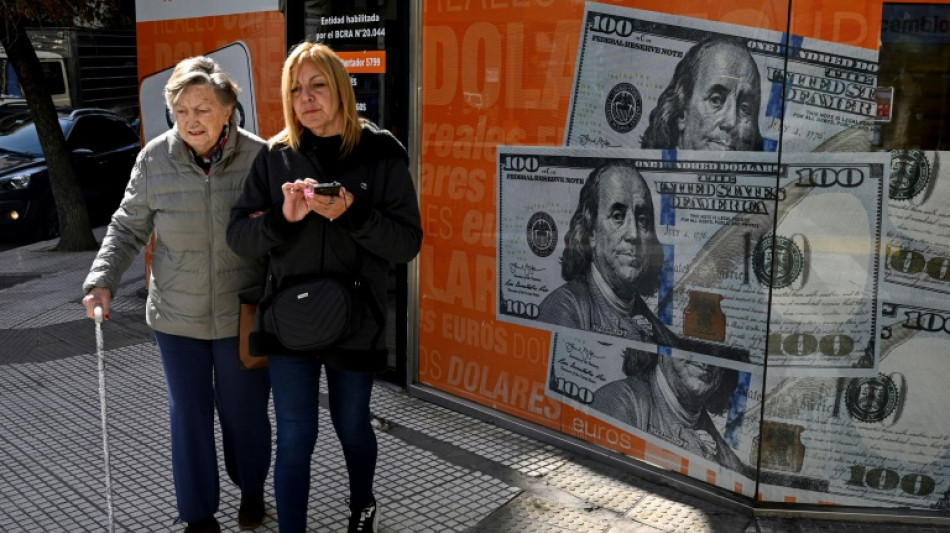
In Argentina, voters toy with ditching pesos for dollars / Photo: © AFP

 Boasting South Korea footballers spark rethink of military service exemptions
 Five dead as Hurricane Simon, Rachel pummel Mexico's Pacific coast
 Seoul, Tokyo stocks plunge as Asia suffers fresh tech rout
 Damaged and drained, Indonesia's peatlands go up in smoke
 Dominant Australia wary of Pacific threat at Rugby League World Cup
 Pope to be admitted to hospital for lung operation
 Samoa's McFarland welcomes 'massive' arrival of ex-All Blacks for World Cup run-in
 Brewers beat Dodgers 7-4 to extend MLB playoff lead
 Teenager shoots headmaster, teacher at French school
 'Breaking Bad' actor RJ Mitte dead: representatives
 Former DR Congo president Kabila forms new force with M23 armed group
 Tom Cruise's 'Digger' tanks, leaving studio with $250 mn hole
 US actress Selma Blair arrested after flight altercation
 One dead as Hurricane Simon creeps along Mexico's Pacific coast
 Carrick's Man United 'hungry and eager' to fix worst start in decades
 Fury as US federal agents search anti-Trump lawmaker's home

 One goal enough for Flick as Barca enter Galatasaray cauldron

 A7 to unveil a service that will re-invent the international payments market
 'Status quo' with EU 'not good enough', UK PM says as summit date set
 Stolen Renoir paintings found behind wall in France

 French supermarkets suffer refrigerator shutdown after 'unprecedented' cyberattack

 Arsenal lose Hincapie and Zubimendi in freak double blow

 Saudi says resilience tested, vows response after deadly airport attacks
 Alcaraz exits Shanghai Masters in straight-sets loss
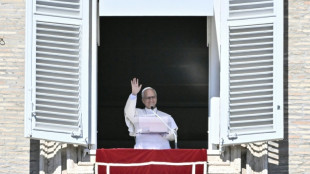 Pope to enter hospital on Tuesday for lung operation

In inflation-hit Argentina, where rentals, cars, and appliances are increasingly priced in dollars to sidestep the volatile peso, a leading presidential candidate has sparked debate over whether to officially adopt the currency as a remedy to a battered economy.
The US dollar has long been a refuge for Argentines from pesos which lose value faster than they can spend them. Citizens bypass strict currency controls to buy dollars from a flourishing parallel market and squirrel them away at home in what is often their only viable means of savings.
So why not just dump the peso entirely?
This is the tempting message being spread by Javier Milei, a political outsider with radical ideas who has surged to the front of the presidential race ahead of October elections, despite economists long arguing dollarization would be unfeasible.
"Ending inflation is possible, we just have to take the monetary weapon away from politicians," said the 52-year-old lawmaker, referring to the central bank, which he has said he will scrap entirely if he is elected.
With annual inflation at 113 percent, and a peso that was devalued by 20 percent this month, experts say the lure of Milei's ideas is that many Argentines feel they have nothing to lose.
"It would be good to dollarize. With the instability of the exchange rate I sell half as much as I usually do," said Ivan Abl, who has sold fabric in the Once district of the capital for 30 years.
After thinking for a few moments, he adds, "But, that will mean the Yanks will control everything right?"
- Economic ghosts of 2001 -
Dollarization involves replacing a currency entirely with the US dollar, which offers a more stable currency, but removes government control of monetary policy -- such as setting interest rates or taking measures to target inflation.
In Latin America, Ecuador, El Salvador, and Panama have adopted the dollar as their main currency.
The only comparison Argentines have is when their currency was pegged to the dollar at a one-to-one convertible rate in the 1990s as a way out of hyperinflationary cycles of up to 3,000 percent.
After a decade, the fixed exchange rate became untenable and in 2001, the government uncoupled the peso from the dollar, leading its value to plummet and causing a run on banks as people's savings were wiped out.
Panic, looting and protests led to 39 deaths in social unrest that followed.
A few days after the devaluation, Argentina defaulted on its foreign debt, further deepening its economic and social crisis.
Since then, Argentina has battled with boom and bust cycles, inflation, currency devaluations, and debt restructuring.
"Dollarizing is madness. There are other solutions," Nicolas Ferreyra, who works for a store selling household appliances, told AFP, urging other measures for Argentines to "trust the peso again."
- Dollars? What dollars? -
Dollarization is a complex process that involves converting an existing currency into dollars, which requires a hefty stock of greenbacks.
The International Monetary Fund warned earlier this month that Argentina's dollar reserves were "dangerously low," a chronic problem in the country.
"Where are they going to get these dollars from to dollarize? said Economy Minister Sergio Massa, who is also running for president, all while struggling to stick to IMF budgetary controls to refinance the country's debt.
The Center for Argentine Economic Policy (CEPA) think tank has warned that replacing pesos with dollars at the true market price -- believed to be much higher than the controlled official rate -- would lead to a "mega-devaluation" and loss of salary purchase power of around 90 percent.
"It's impractical," said Ferreyra in the electronics store, adding he and his colleagues had worked out they would earn 20 or 30 dollars a month.
Milei, an economist and self-declared expert on monetary theory, has argued in numerous television appearances that Argentines have already chosen their preferred currency.
The central bank estimates there is $244 billion stashed away by Argentines outside of official channels.
And Milei's ideas have struck a nerve with voters, with his surge to prominence described as a "political tsunami" as voters appear willing to try something new to escape the country's economic malaise.
In a presidential primary on August 13, seen as a litmus test ahead of the election, Milei came first with 29.8 percent of votes, followed by former security minister and opposition candidate Patricia Bullrich with 28 percent. Massa scored 27.2 percent.
B.Shevchenko--BTB