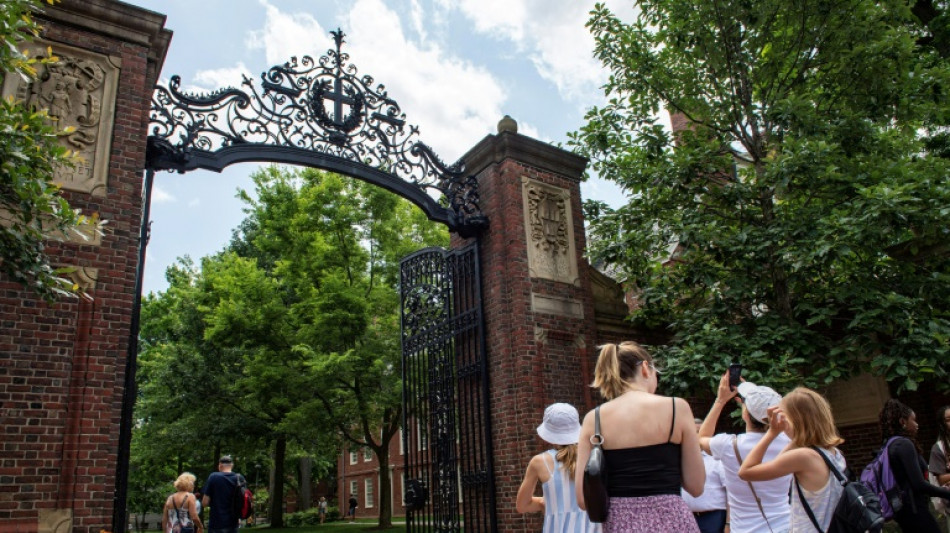
'Legacy admissions' under fire at US universities / Photo: © AFP/File

 Boasting South Korea footballers spark rethink of military service exemptions

 Five dead as Hurricane Simon, Rachel pummel Mexico's Pacific coast
 Seoul, Tokyo stocks plunge as Asia suffers fresh tech rout

 Damaged and drained, Indonesia's peatlands go up in smoke

 Dominant Australia wary of Pacific threat at Rugby League World Cup

 Pope to be admitted to hospital for lung operation

 Samoa's McFarland welcomes 'massive' arrival of ex-All Blacks for World Cup run-in

 Brewers beat Dodgers 7-4 to extend MLB playoff lead

 Teenager shoots headmaster, teacher at French school

 'Breaking Bad' actor RJ Mitte dead: representatives

 Former DR Congo president Kabila forms new force with M23 armed group

 Tom Cruise's 'Digger' tanks, leaving studio with $250 mn hole
 US actress Selma Blair arrested after flight altercation

 One dead as Hurricane Simon creeps along Mexico's Pacific coast

 Carrick's Man United 'hungry and eager' to fix worst start in decades

 Fury as US federal agents search anti-Trump lawmaker's home

 One goal enough for Flick as Barca enter Galatasaray cauldron

 A7 to unveil a service that will re-invent the international payments market

 'Status quo' with EU 'not good enough', UK PM says as summit date set

 Stolen Renoir paintings found behind wall in France

 French supermarkets suffer refrigerator shutdown after 'unprecedented' cyberattack

 Arsenal lose Hincapie and Zubimendi in freak double blow

 Saudi says resilience tested, vows response after deadly airport attacks

 Alcaraz exits Shanghai Masters in straight-sets loss
 Pope to enter hospital on Tuesday for lung operation

Should you get a leg up on your university application just because Mom or Dad had studied at that school?
So-called "legacy admissions" -- long a standard practice at many prestigious American universities, including Harvard and Stanford -- are coming under increased scrutiny, though it's unlikely they'll go without a fight, even in a country that extols success through individual merit.
But cracks are beginning to form, galvanized by a recent Supreme Court case and an Education Department investigation sparked by a legal complaint aiming to take down what one university president called an "aristocratic" system unfit for a democracy.
Legacy admissions don't guarantee entry into a particular university, but they do give hopefuls an edge: If a prospective student can boast that, in addition to having a solid academic record, they are the child or relative of an alumnus, that can tip the scales in their favor during the very competitive admissions process.
Harvard University's acceptance rate for "legacy" students from 2014 to 2019 was 33 percent, according to the student newspaper -- compared to its overall acceptance rate of six percent.
In addition to current complaints about the practice, experts say it has dark origins, dating back to the beginning of the 20th century when universities sought to limit the number of Jewish students on their campuses.
The persistence of legacy admissions is "deeply unethical," James Murphy of the Education Reform Now think tank told AFP.
The practice "is very much against the idea that higher education in this country is supposed to drive social mobility," Murphy said.
But two reasons explain its ongoing existence, he added: "Money and privilege."
Many institutions fear alumni will stop donating to them if preferential admissions for their sons and daughters stop. And some boards of trustees are attached to the elitist tradition, Murphy said.
- 'Indefensible' -
In recent years, several institutions have taken the lead in addressing the issue.
In 2020, Johns Hopkins University formalized its break with preferential admissions. The practice "puts a thumb on the scale for young people who already enjoy so many advantages by virtue of being born to parents who benefited from a university education," said Ron Daniels, the president of the university.
Legacy admissions are an "aristocratic" policy which is "indefensible in our democratic society," he said in recent comments.
And since the prestigious Baltimore institution stopped legacy admissions, the college has had "more space and opportunity to recruit a broader array of talented students," he said.
The debate is far from new, but a recent ruling by the Supreme Court has, perhaps unexpectedly, breathed new life into it.
At the end of June, in a decision decried by those seeking more equitable college admissions, the court overturned one of the key achievements of the Civil Rights Movement of the 1960s by putting an end to affirmative action in college applications.
As a result, universities can no longer consider applicants' race or ethnicity as they seek to correct long-standing inequalities resulting from America's segregationist past, with the aim of boosting Black, Hispanic and Native American enrollment.
But some saw an opening in the court's ruling, and moved to cast legacy admissions as a de-facto affirmative action program for the white and wealthy, given the backgrounds of those who typically benefit.
Within a few days, lawyers filed a complaint against Harvard with the Department of Education to force the famous university to put an end to the "discriminatory" policy of legacy admissions if it wishes to continue to benefit from federal funds.
"We decided that it was critical for us to move very quickly to ensure that barriers to higher education that harm applicants of color... also be eliminated," said Michael Kippins of Lawyers for Civil Rights, who filed the complaint on behalf of several organizations.
The complaint also targeted the boost given to candidates linked to wealthy donors. The Education Department has opened an investigation.
- Beginning of the end? -
President Joe Biden has also spoken of legacy admissions expanding "privilege rather than opportunity."
And even among students who have taken advantage of it, unease is growing.
"I absolutely think it's affirmative action for the rich," Yoni Rechtman, 28, who has benefited from the policy, told AFP.
"If you said 'Hey, the people whose parents worked at this company will get preferential treatment'... it would not stand."
Murphy, of Education Reform Now, said he expects more universities to announce an end to legacy admissions by October, as pressure continues to mount.
"If I'm one of these Ivy League colleges, if I'm Stanford University, do I really want to be the last one" to abandon such a criticized practice, he asked.
F.Pavlenko--BTB