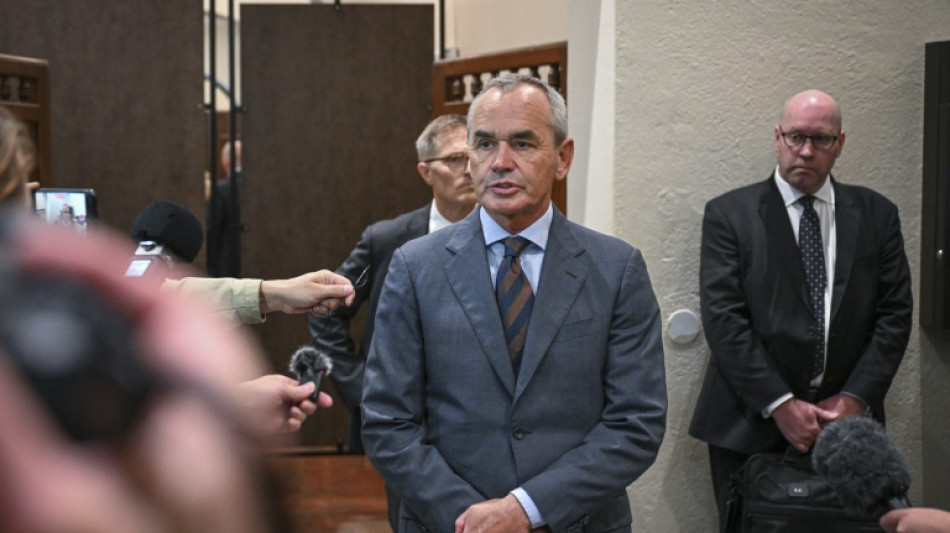
Oil execs on trial in Sweden over Sudan war crimes role / Photo: © AFP

 Boasting South Korea footballers spark rethink of military service exemptions
 Five dead as Hurricane Simon, Rachel pummel Mexico's Pacific coast

 Seoul, Tokyo stocks plunge as Asia suffers fresh tech rout
 Damaged and drained, Indonesia's peatlands go up in smoke

 Dominant Australia wary of Pacific threat at Rugby League World Cup
 Pope to be admitted to hospital for lung operation
 Samoa's McFarland welcomes 'massive' arrival of ex-All Blacks for World Cup run-in
 Brewers beat Dodgers 7-4 to extend MLB playoff lead

 Teenager shoots headmaster, teacher at French school
 'Breaking Bad' actor RJ Mitte dead: representatives

 Former DR Congo president Kabila forms new force with M23 armed group

 Tom Cruise's 'Digger' tanks, leaving studio with $250 mn hole
 US actress Selma Blair arrested after flight altercation
 One dead as Hurricane Simon creeps along Mexico's Pacific coast
 Carrick's Man United 'hungry and eager' to fix worst start in decades

 Fury as US federal agents search anti-Trump lawmaker's home

 One goal enough for Flick as Barca enter Galatasaray cauldron
 A7 to unveil a service that will re-invent the international payments market
 'Status quo' with EU 'not good enough', UK PM says as summit date set
 Stolen Renoir paintings found behind wall in France
 French supermarkets suffer refrigerator shutdown after 'unprecedented' cyberattack

 Arsenal lose Hincapie and Zubimendi in freak double blow
 Saudi says resilience tested, vows response after deadly airport attacks
 Alcaraz exits Shanghai Masters in straight-sets loss
 Pope to enter hospital on Tuesday for lung operation
A Swedish oil firm operated in Sudan with support from the military allegedly knew violence would affect civilians to bring the areas under control, prosecutors said Tuesday as two former executives faced war crimes charges.
Swede Ian Lundin and Swiss national Alex Schneiter are accused of asking Sudan's government to make its military responsible for security at the site of one of Lundin Oil's exploration fields, which later led to aerial bombings, killing of civilians and burning of entire villages, according to the prosecution.
Mikael Ekman, Senior Legal Adviser at rights group Civil Rights Defenders, told AFP that the case was "extremely significant".
"This is about grave international crimes and what responsibility company leaders themselves have when doing business in countries in conflict," Ekman, who had come to watch the trial in person, told AFP.
"It's a tragedy that it hasn't happened before and that it doesn't happen more," Ekman continued, adding the outcome of the trial was of course still uncertain.
Lundin, 62, was chief executive of family firm Lundin Oil, now known as Orron Energy, from 1998-2002, and Schneiter, 61, was vice president at the time.
Heading into the courtroom, Lundin, dressed in a grey suit, told reporters he and Schneiter looked "forward to defending ourselves in a court of law".
"The accusations against us are false, they are completely false. They are also very vague," he continued.
The trial is set to be the biggest in Swedish history, following an over a decade-long probe, a more than 80,000-page investigation report and with closing arguments scheduled for February 2026.
The two, who were formally named as suspects in 2016, face the charge of "complicity in grave war crimes" committed during the rule of Omar al-Bashir.
In their opening arguments, the prosecution claimed that after Lundin Oil struck oil in 1999 in the "Block 5A" field in what is now South Sudan, the Sudanese military, together with an allied militia, led offensive military operations to take control of the area and create "the necessary preconditions for Lundin Oil's oil exploration".
Public prosecutor Henrik Attorps said: "The perpetrators used tactics and weapons that neither distinguished between civilians and fighters nor civilian property and military targets."
- 'Military force' -
According to the charge sheet, this included aerial bombardments from transport planes, shooting civilians from helicopter gunships, abducting and plundering civilians and burning villages and crops.
Prosecutors claim the accused were complicit because Lundin Oil had entered into agreements with Sudan's government to make the military responsible for security, knowing it meant the military and allied militias would need to take control of areas by "military force".
Prosecutor Karolina Wieslander told the court that Lundin and Schneiter had demanded that Sudan create "conditions" for oil operations in areas not controlled by the military or regime allied militias, knowing the military would need to perform "offensive" operations to do this.
If convicted, Lundin and Schneiter risk life sentences.
The prosecution has already requested that the two be banned from any business undertakings for 10 years.
It has also asked for the confiscation of 2.4 billion kronor ($218 million) from Orron Energy, equivalent to the profit the company made on the sale of its Sudan operations in 2003.
The defence meanwhile argued that the prosecution's case does not hold up.
"Our opinion is that these two years that will now be spent in the district court will be a huge waste of time and resources," Torgny Wetterberg, a lawyer for Ian Lundin, told AFP on the eve of the trial.
- 'Their own hands' -
Wetterberg told the court that the defence disagreed with the prosecution's descriptions of events, and that it had built its case on circumstantial claims with no concrete evidence.
Laying out his case to the court, Wetterberg also noted that the prosecutor did not even argue that the defendants had been part of any specific crime or even having knowledge of the time and place of instances of abuse.
He also said there many of the facts put forward by the prosecution, such as links between certain militias and the government were not backed up by substantial evidence.
Lundin himself noted that Sudan had long suffered from internal conflict.
"We never had anything to do with this conflict, to the contrary we were a force for good," Lundin told reporters Monday.
Mark Klamberg, a professor of international law at Stockholm University, told AFP that cases involving business leaders facing charges relating to war crimes are rare, and the case is a first for Sweden.
Charges are instead more commonly brought for crimes that the defendants were complicitly or indirectly involved, since those in leadership positions "rarely commit crimes with their own hands".
"But it places demands on the prosecutor and evidence, making cases complicated and drawn out," Klamberg told AFP.
Sweden can prosecute crimes committed abroad in its court system, though the government had to give its approval to indict a foreign national for crimes committed abroad.
O.Krause--BTB